





British Gas Vs Eon Next

Written by Shay Ramani
Reviewed by Andrea Troy
5 min read
Updated: 29 Sep 2026
British Gas Vs Eon Next

British Gas vs E.ON Next comes down to a small price difference and a clearer gap on customer service, so the right choice depends on whether you value the cheapest headline tariff or fewer problems when things go wrong. In one comparison, the two suppliers were effectively tied on their cheapest overall tariffs, with only a negligible difference between them.

Both are among the most-switched-to suppliers in the UK, and both sit under the same Ofgem rules that protect you whichever you pick. What separates them for a bill-conscious household is exit fees on fixed deals, service ratings, and which tariff type suits your usage. Free Price Compare sources tariff and market context from Ofgem publications and live supplier deals, and we always compare against your own postcode and usage rather than a national average.

Quick Answer: British Gas Vs Eon Next

  • British Gas and E.ON Next were near-tied on their cheapest overall tariffs, with only a negligible difference between them.
  • British Gas fixed tariffs in the research showed higher exit fees (examples of £100 and £150), while some E.ON Next tracker deals carried £0 exit fees – check the exit fee before you fix.
  • E.ON Next was rated more highly than British Gas in one recent customer review snapshot.
  • The Ofgem energy price cap changed for 1 April to 30 June 2026 and is reviewed quarterly – it caps unit rates and the standing charge for a typical user, not your total bill.
  • Your actual price depends on postcode, annual kWh usage, meter type and payment method, so always compare a personalised quote before switching.

Last updated: August 2026

Written by the Free Price Compare editorial team | Reviewed August 2026

Which is cheaper, British Gas or E.ON Next?

British Gas and E.ON Next are close enough on price that neither wins outright for every household. In one August 2026 comparison, British Gas’s cheapest overall tariff came in at around £1,745/year and E.ON Next’s at around £1,746/year, a gap of roughly £1. On a direct unit-rate comparison, E.ON Next edged ahead slightly on electricity and gas prices, plus marginally lower standing charges. These are small margins, and the position changes with tariff refreshes, so the cheaper supplier for you depends on your region, usage and the exact deals live on the day you compare.

The bigger lever is not which of the two brands you pick, but whether you move off a standard variable tariff at all. Households on standard variable tariffs pay unit rates set by the Ofgem price cap, and a competitive fixed or tracker deal from either supplier can undercut that. Because the price gap between the two is narrow, exit fees and service quality often matter more than a few pounds of headline difference.

Example rate (2025 comparison) British Gas E.ON Next
Electricity unit rate 24.85p/kWh 24.79p/kWh
Gas unit rate 6.40p/kWh 6.38p/kWh
Electricity standing charge 63.50p/day 62.90p/day
Gas standing charge 33.10p/day 32.90p/day

Figures are indicative and may change.

Compare live British Gas and E.ON Next tariffs

Is E.ON cheaper than British Gas on fixed deals?

E.ON Next tended to edge British Gas on fixed tariffs in the 2026 research, but the lead was small and shifted by month and assumptions. One roundup put E.ON Next as slightly cheaper than British Gas on a 14-month fixed tariff, with British Gas a little higher on monthly cost. A separate comparison listed E.ON Next’s cheapest fixed option as lower than British Gas’s cheapest fixed option for a 24-month deal.

A fixed tariff locks your unit rates and standing charge for the contract term, protecting you if wholesale prices rise, though you pay an exit fee if you leave early. The catch worth checking is the exit fee, not just the headline rate. British Gas fixed deals in the research carried exit fees such as £100 and £150, while some E.ON Next products, including certain trackers, showed £0 exit fees. If you might move home or switch again within the year, a £0 or low-fee deal can be better value than a marginally cheaper fixed rate. You can read more in our British Gas exit fees and switching guide.

What are the exit fees if I switch mid-contract?

Exit fees on fixed energy tariffs are the charge your supplier applies if you leave before the contract ends, and in the research British Gas fixed deals carried higher fees than several E.ON Next options. British Gas fixed products showed exit fees of £100 and £150 in the comparison data, sometimes charged per fuel, while E.ON Next offered both fixed deals with fees and some tracker products with £0 exit fees.

You will not pay an exit fee on a standard variable tariff, because it has no fixed end date, so you can leave at any time. Under Ofgem rules, you also cannot be charged an exit fee in the final weeks of a fixed deal, which gives you a window to switch penalty-free before renewal. Before you fix, confirm whether the fee is per fuel or per account, because a £150 per-fuel charge on a dual-fuel deal effectively doubles the cost of leaving early.

Thinking of switching away from a standard variable tariff?

Compare fixed and tracker deals from British Gas, E.ON Next and other suppliers side by side.

Which supplier has better customer service and reviews?

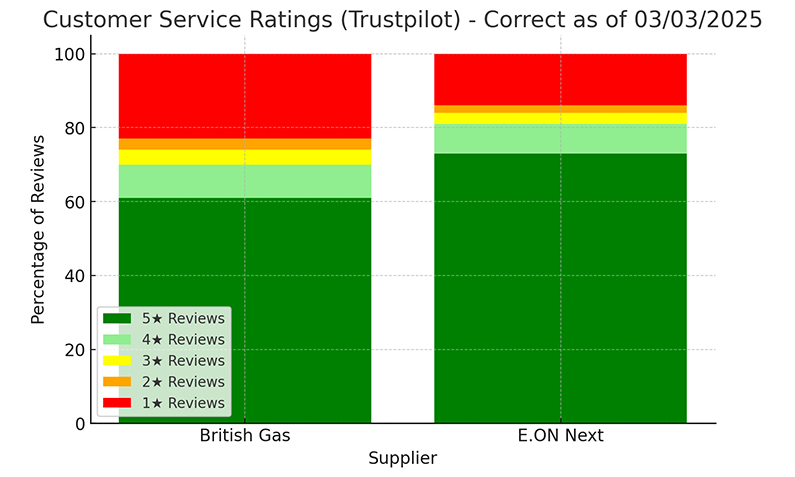
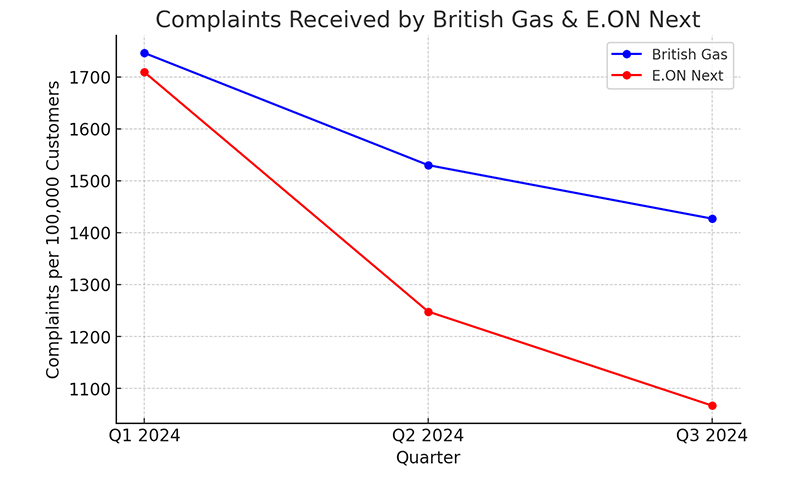
E.ON Next held a stronger customer-review position than British Gas in one comparison, with a higher share of five-star reviews. E.ON Next is also frequently described as quicker to answer calls and to handle complaints, with weekend support available. British Gas remains the largest supplier by customer numbers and has a wide branch and engineer network, but its service scores in independent reviews have generally trailed E.ON Next.

Service quality matters most when something goes wrong: a billing dispute, a smart meter fault, or a payment problem. If you have missed problems with a previous supplier, the review gap is a real reason to weigh E.ON Next ahead, even where British Gas is a pound or two cheaper. Both suppliers are covered by the Energy Ombudsman, so if a complaint is not resolved within eight weeks you can escalate it free of charge. For another head-to-head on service and price, see our British Gas vs OVO Energy comparison.

Which supplier has better customer service and reviews

Which is greener, and is E.ON Next 100% renewable?

E.ON Next supplies 100% renewable electricity as standard on its fixed tariffs, according to E.ON Next. E.ON Next matches customers’ electricity use with renewable generation and certificates, according to E.ON Next. For a household prioritising lower-carbon electricity without paying a premium tariff, E.ON Next’s standard renewable backing is a practical advantage.

It is worth understanding what “100% renewable electricity” means in practice: it refers to matching your electricity consumption with renewable generation, backed by Renewable Energy Guarantees of Origin certificates, not that every unit reaching your home is physically from a wind turbine. Gas remains a fossil fuel from both suppliers unless a specific green-gas or offset option is offered. If greener supply is your priority, confirm the exact tariff’s environmental claims when you compare, because green credentials can vary between a supplier’s individual deals.

Check which suppliers offer 100% renewable electricity

How does the energy price cap affect both suppliers?

The Ofgem energy price cap sets the maximum unit rates and standing charge a supplier can charge on a standard variable tariff, and it applies equally to British Gas and E.ON Next. Ofgem confirmed a change to the price cap for the period 1 April to 30 June 2026, and it reviews the cap quarterly, according to Ofgem. The cap limits the rate per kWh and the daily standing charge for a typical user, so it does not cap your total bill: use more energy and you pay more.

Because the cap applies to both suppliers’ standard variable tariffs, neither can undercut the other by much while you stay on a capped default deal. The saving comes from choosing a competitive fixed or tracker tariff that prices below the cap. If you are on a standard variable tariff above the price cap floor and paying more than you need to, comparing personalised fixed and tracker quotes is usually where the money is. Our guide on smart meter tariffs explains how usage-based deals compare.

Are E.ON and E.ON Next the same company?

E.ON Next is the UK residential supply arm of E.ON, so they are part of the same group, and E.ON Next is now where E.ON’s home energy customers are served. E.ON migrated most household accounts onto the E.ON Next platform, so if you were an older E.ON customer you have likely already been moved. For a bill-conscious household comparing suppliers today, E.ON Next is the brand to quote against British Gas.

British Gas is owned by Centrica and remains the largest domestic supplier by customer numbers. Both suppliers operate under the same Ofgem licence conditions, both must protect you if a supplier fails through Ofgem’s supplier-of-last-resort process, and both offer schemes such as the Warm Home Discount and the Priority Services Register for eligible or vulnerable customers. Choosing between them is a decision about price, exit fees and service, not about safety or protection, which are the same either way.

How do I switch and set up my account correctly?

Switching between British Gas and E.ON Next takes a personalised quote, a meter reading and about five working days, with your supply never interrupted. Start by finding your annual usage in kWh from a recent bill or online account, because a quote based on real usage is far more accurate than a national average estimate. Then compare live deals for your postcode, choose a tariff, and provide an opening meter reading so your new supplier bills from the right point.

  • Check your current tariff and end date first, so you avoid an exit fee if you are still in a fixed deal.
  • Have your annual kWh usage and payment method ready, as both affect the quoted price.
  • Submit an accurate opening meter reading to prevent a disputed bill later.
  • Set up direct debit if offered, as monthly direct debit is usually the cheapest payment method.
  • Keep your final bill from the old supplier until any credit balance is refunded.

Ofgem’s switching protections mean the process completes reliably and you are covered if anything goes wrong, and both suppliers offer a “take us with you” style option if you move home mid-contract. If you want to weigh a wider set of suppliers before deciding, our So Energy vs E.ON Next guide and British Gas vs EDF Energy comparison add useful context.

Get a personalised energy quote for your postcode

Should you choose British Gas or E.ON Next?

Choose E.ON Next if you value stronger customer reviews, 100% renewable electricity as standard, and lower exit fees, since E.ON Next held a higher five-star review share (74% versus 65%) in one August 2026 comparison and offered some £0-exit-fee deals. Choose British Gas if a specific British Gas deal is cheaper for your postcode and usage, or if you value its large engineer and service network. The price gap between the two is often only a few pounds a year, so let exit fees, service and green credentials decide.

For a bill-conscious household on a standard variable tariff above the price cap floor, the real saving comes from moving to a competitive fixed or tracker tariff, not from the brand alone. Compare a personalised quote for both suppliers on the same day, check the exit fee before you fix, and pick monthly direct debit for the lowest rate. If you want to broaden the shortlist, our British Gas vs Scottish Power guide covers another common matchup.

Should you choose British Gas or E.ON Next

FAQs about british gas vs eon next

Is Octopus Energy cheaper than British Gas?

Octopus Energy is often close to British Gas on price, and some comparisons put its unit rates and standing charges slightly lower on certain tariffs. The cheapest of the major suppliers changes with each tariff refresh, so the only reliable answer is a personalised quote for your postcode and usage. Differences between the leading suppliers are frequently only a few pounds a year on the cheapest deals.

Is E.ON cheaper than British Gas overall?

E.ON Next tended to edge British Gas on price in 2026 comparisons, but the gap was small and sometimes negligible. On cheapest overall tariffs the two were effectively tied at around £1,745 to £1,746 a year in one August 2026 comparison. Your own result depends on region, annual kWh usage, meter type and payment method, so compare a live quote before deciding.

What is the difference between E.ON and E.ON Next?

E.ON Next is the UK home energy supply brand within the E.ON group, and E.ON moved most household customers onto the E.ON Next platform. If you were an older E.ON residential customer you have most likely already been transferred to E.ON Next. When comparing against British Gas today, E.ON Next is the brand to quote.

Can I switch from British Gas to E.ON Next mid-contract?

You can switch at any time, but if you are on a fixed British Gas tariff you may pay an exit fee to leave early. Standard variable tariffs have no exit fee, so you can leave those freely. Under Ofgem rules you also cannot be charged an exit fee in the final weeks before a fixed deal ends, giving you a penalty-free window to switch.

Does E.ON Next supply 100% renewable electricity?

E.ON Next supplies 100% renewable electricity as standard on its fixed tariffs, according to E.ON Next. This means your electricity use is matched with renewable generation, not that every physical unit comes directly from a renewable source. Gas remains a fossil fuel unless a specific green-gas or offset option is chosen.

Which supplier has better customer service?

E.ON Next held a stronger customer-review position than British Gas in one recent comparison. E.ON Next is often described as faster to answer calls and resolve complaints, with weekend support. Both suppliers are covered by the Energy Ombudsman if a complaint is not resolved within eight weeks.

Do British Gas or E.ON Next offer the Warm Home Discount?

Both British Gas and E.ON Next take part in the Warm Home Discount scheme, which gives eligible low-income households a one-off credit towards their winter electricity bill. Eligibility is set by government rules and depends on benefits and circumstances rather than the supplier. Both also offer a Priority Services Register for customers who need extra support.

What happens if my energy supplier goes bust?

If your supplier stops trading, Ofgem appoints a new supplier through its supplier-of-last-resort process, and your gas and electricity keep flowing without interruption. Any credit balance you hold is protected and transferred or refunded. You do not need to do anything immediately; wait to be contacted by the new supplier before switching if you want a different deal.

Is a fixed or variable tariff better with these suppliers?

A fixed tariff locks your unit rates and standing charge for the term and protects you from price rises, but usually carries an exit fee if you leave early. A standard variable tariff follows the Ofgem price cap and lets you leave penalty-free, but the rate can rise each quarter. If you want budget certainty, a competitive fixed deal from either supplier is often the stronger choice.

How long does it take to switch between British Gas and E.ON Next?

A switch between British Gas and E.ON Next usually completes in about five working days once you have chosen a tariff and provided a meter reading. Your supply is never cut off during the switch, and there is a short cooling-off period after you sign up. Submitting an accurate opening meter reading helps avoid a disputed first bill.

Does the price cap mean both suppliers charge the same?

The Ofgem price cap sets the same maximum unit rates and standing charge on standard variable tariffs for both suppliers, so their default rates are broadly similar. The cap does not apply to fixed or tracker tariffs, which is where suppliers compete on price. Savings usually come from moving off a capped standard variable tariff to a competitive fixed or tracker deal.

Are exit fees charged per fuel or per account?

Exit fees can be charged per fuel or per account depending on the tariff, so a fee shown as £75 per fuel effectively becomes £150 on a dual-fuel deal. British Gas fixed tariffs in recent comparisons showed exit fees of £100 and £150, sometimes per fuel. Always check the tariff's terms so you know the true cost of leaving early before you fix.

Also Read Related Articles


Information correct as of 11 August 2026. Prices, tariffs, policy details and providers change frequently, so please check the latest details before making a decision. This article is for general information only and does not constitute financial advice. Free Price Compare is authorised and regulated by the Financial Conduct Authority (FCA).

4000+ reviews