





British Gas vs EDF Energy: Cost, Service and Fixes

Written by Shay Ramani
Reviewed by Ankit Sureja
8 min read
Updated: 1 Oct 2026
British Gas vs EDF Energy: Cost, Service and Fixes

British Gas vs EDF Energy comes down to your exact postcode, usage and how you pay, because neither supplier is cheaper for every household. On the example tariffs tracked in August 2026, British Gas was slightly cheaper on the cheapest variable deal, while EDF Energy was slightly cheaper on the cheapest fixed deal. Small margins like these flip whenever standing charges, unit rates and exit fees shift.

Both are large, established suppliers regulated by Ofgem, so switching between them is protected and takes about five working days. The real decision for a bill-conscious household is whether to fix, track or stay on a price-capped variable tariff. Free Price Compare pulls live tariffs from across the market so you can see which supplier wins for your address rather than a national average.

Quick Answer: British Gas vs EDF Energy

  • On example tariffs (August 2026), British Gas Cap Tracker Plus Sep27 v1 was around £1,745/year with a £50 exit fee; EDF Simply Tracker Sep27 was around £1,755/year.
  • On fixed deals, EDF Simply Fixed 2Yr Aug28 was around £1,824/year with a £150 exit fee; British Gas’s cheapest fixed was around £1,834/year.
  • The Ofgem price cap sets the benchmark for standard variable tariffs and changes every three months; it caps unit rates and standing charges, not your total bill.
  • Both suppliers charge exit fees on fixed deals (around £150) but far lower fees on tracker tariffs (around £50), which matters if you might switch again.
  • The ‘cheaper’ supplier changes by postcode, meter type and payment method, so run a live comparison for your address rather than relying on a headline figure.

Last updated: August 2026

Written by the Free Price Compare editorial team | Reviewed August 2026

Which is cheaper, British Gas or EDF?

British Gas was around £10 a year cheaper than EDF Energy on the cheapest variable tariff in the August 2026 examples, while EDF Energy was around £10 a year cheaper on the cheapest fixed tariff. On those comparisons, British Gas’s Cap Tracker Plus Sep27 v1 came in slightly below EDF’s Simply Tracker Sep27, and EDF’s Simply Fixed 2Yr Aug28 came in slightly below British Gas’s cheapest fixed tariff. These are example tariffs for a typical dual-fuel household, not universal prices. The winner changes with your postcode, annual usage, meter type and payment method, so a £10 gap on a national example can reverse entirely for your address.

Neither supplier is reliably cheaper across every tariff type. If you want the lowest possible price today, the practical answer is to compare both on your own consumption rather than trust a headline. For low-usage homes, a lower standing charge can matter more than the unit rate, which is exactly where the two suppliers can swap positions.

Example tariff Type Annual cost Exit fee
British Gas Cap Tracker Plus Sep27 v1 Variable around £1,745 £50
EDF Simply Tracker Sep27 Variable around £1,755 £50
EDF Simply Fixed 2Yr Aug28 Fixed (24 months) around £1,824 £150
British Gas cheapest fixed Fixed (24 months) around £1,834 £150

Figures are indicative and may change.

See which supplier is cheaper for your postcode

How British Gas and EDF tariffs differ

British Gas and EDF tariffs differ mainly in where each supplier is most competitive: British Gas has priced its tracker and variable range keenly in recent examples, while EDF Energy has fielded a strong fixed-tariff range. Both offer the three core structures a UK household chooses between, and the right one depends on how much certainty you want over the next year or two.

  • Standard variable tariff (SVT) – the default, capped by the Ofgem price cap, with prices moving each quarter as the cap changes.
  • Tracker or capped variable – follows the price cap or a wholesale index, usually with a low exit fee of around £50, giving flexibility to switch again.
  • Fixed tariff – locks your unit rate and standing charge for 12 to 24 months, with a higher exit fee of around £150 if you leave early.

The Ofgem price cap is the benchmark for both suppliers’ variable tariffs. The cap limits the unit rate and standing charge for a typical direct-debit customer, not your total bill, so if you use more energy you pay more. A fixed deal above the current cap can still be worthwhile if you expect the cap to rise, which is the core fix-or-track decision covered below.

Is EDF cheaper than British Gas for your home?

EDF is cheaper than British Gas for some homes and dearer for others, so there is no single answer that holds for every household. In the August 2026 examples, EDF undercut British Gas on the cheapest fixed deal by around £10 a year, but British Gas undercut EDF on the cheapest variable deal by a similar margin. What tips the balance for your address is the split between standing charge and unit rate, your annual kWh usage and whether you have a smart or Economy 7 meter.

Low-usage households should weigh the standing charge heavily, because it is paid every day regardless of how much energy you use. Higher-usage or electric-vehicle homes benefit more from a low unit rate and, in some cases, a time-of-use tariff. Free Price Compare compares live tariffs from British Gas, EDF and other suppliers against your own consumption, which is the only reliable way to see who is cheaper for you rather than for an average home. If you are weighing British Gas against other majors, our British Gas vs Scottish Power comparison and British Gas vs E.ON Next guide apply the same approach.

Is EDF cheaper than British Gas for your home

Compare British Gas, EDF and the whole market

See live tariffs for your postcode in minutes and switch with confidence.

Which has better customer service?

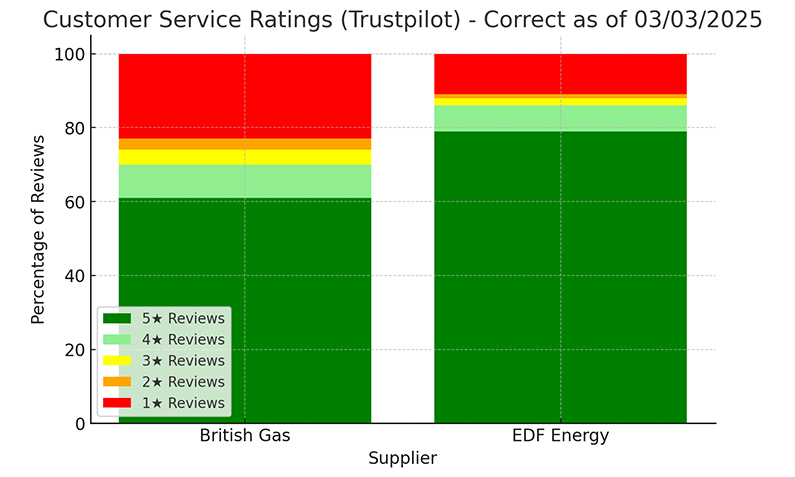
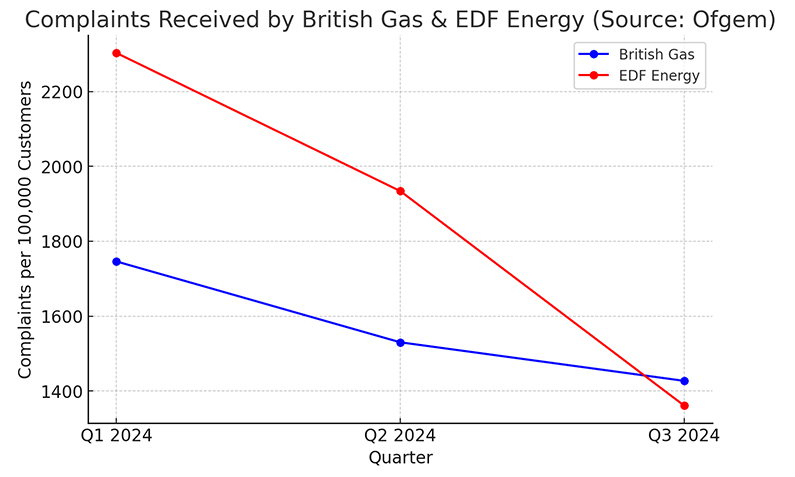
Customer service between British Gas and EDF Energy is mixed, and neither ranks among the strongest large suppliers in independent assessments. Both have faced criticism from customers over billing accuracy and delayed switch completions, which is why checking recent complaint handling matters as much as price. Ofgem publishes complaint and service data by supplier, and the Ofgem Confidence Code accredits comparison services, so you can research a supplier’s record before you commit.

Billing disputes are the most common complaint across both suppliers, usually where estimated readings build up a large balance. To reduce that risk, submit regular meter readings or fit a smart meter, and keep monthly direct debits aligned to your actual usage rather than a low estimate. If a complaint is not resolved within eight weeks, you can escalate free of charge to the Energy Ombudsman, whose decision is binding on the supplier. For British Gas specifically, our British Gas complaints and customer service guide explains how to get issues resolved faster.

Read how to resolve a British Gas complaint

What are the exit and cancellation fees?

Exit fees on fixed tariffs are higher than on tracker tariffs for both British Gas and EDF Energy, while tracker and capped variable tariffs usually carry a lower fee. Standard variable tariffs carry no exit fee, so you can leave a price-capped SVT at any time without charge. Exit fees apply per fuel on dual-fuel accounts in some cases, so check whether a quoted fee is for one fuel or both before you commit.

Exit fees matter most if you think you might switch again soon. Ofgem rules mean you cannot be charged an exit fee if you switch in the final 49 days of a fixed deal, so you can move to a better tariff near the end without penalty. If avoiding fees is a priority, a tracker tariff with a £50 exit fee gives more flexibility than a fixed deal for a small trade-off in price certainty. Our British Gas exit fees and switching guide sets out exactly when a fee applies.

Which is greener or more renewable?

EDF Energy generates a large share of low-carbon electricity from nuclear and renewables, while British Gas offers renewable-backed electricity tariffs supported by certificates rather than its own generation. Both supply electricity that is matched to renewable sources for eligible tariffs, but the underlying generation mix differs. If low-carbon supply is your priority, check each supplier’s Fuel Mix Disclosure, which every UK supplier must publish annually.

For households generating their own power, both suppliers participate in the Smart Export Guarantee, which pays you for surplus electricity exported to the grid, provided your installation meets the Microgeneration Certification Scheme standard. Rates vary, so compare export tariffs separately from your import deal. Our British Gas renewable energy guide explains how green their tariffs really are.

Should I fix or stay on the price cap?

Fix if a fixed deal is at or below your current price-capped rate and you value certainty; stay on the cap if fixed prices are notably higher and you expect the cap to fall. The Ofgem price cap changes every three months, so a capped standard variable tariff moves with it, up or down. A fixed tariff locks your unit rate and standing charge for the term, protecting you from a rising cap but leaving you above the market if the cap falls.

To decide, compare the fixed deal’s annual cost against your current cap-based cost and against the exit fee if you might leave early. As a practical rule, if a fixed deal is within a few per cent of your capped price and you want budget certainty, fixing is worth considering; if the fixed premium is large, a tracker tariff keeps you close to the cap with the freedom to switch. Free Price Compare shows both fixed and variable options side by side so you can judge the trade-off for your usage. For wider savings, see our guide to cutting energy costs.

Compare fixed and variable energy tariffs

How do I switch between British Gas and EDF?

Switching between British Gas and EDF Energy takes around five working days and is protected by Ofgem’s switching rules, so your supply is never interrupted and you keep the same meters and cables. Start by taking a meter reading, then run a comparison using your postcode and annual usage in kWh, which you can find on a recent bill. Choose your tariff, and the new supplier arranges the switch and closes your old account.

Before switching, check whether you are within an exit-fee window on a current fixed deal, and confirm any outstanding balance is cleared or transferred. If you are in credit, your old supplier must refund it. There is a 14-day cooling-off period on most switches during which you can cancel without penalty. Households on the Priority Services Register or receiving the Warm Home Discount keep those protections when they switch, though you may need to re-register with the new supplier. Compare British Gas and EDF against the whole market through our energy comparison service to make sure you are not overpaying on either.

How do I switch between British Gas and EDF

FAQs about british gas vs edf energy

Is EDF Energy online saver8 cheaper than British Gas?

Whether an EDF online saver tariff beats British Gas depends on your postcode, annual usage and meter type, not the tariff name alone. On the August 2026 examples, EDF was slightly cheaper on fixed deals and British Gas slightly cheaper on variable deals, but the margins were around £10 a year. Compare both on your own consumption to see which wins for your address.

Is Octopus Energy cheaper than British Gas?

Octopus Energy can be cheaper than British Gas for some households, but not all, and the difference depends on your usage, tariff type and whether you have a smart meter. Time-of-use and electric-vehicle tariffs often favour one supplier over another. Run a live comparison against your own kWh usage rather than relying on a general claim.

Do British Gas and EDF charge exit fees?

Yes, both charge exit fees on fixed tariffs, typically around £150 on 24-month deals in the August 2026 examples, and a lower fee of around £50 on tracker tariffs. Standard variable tariffs carry no exit fee. Under Ofgem rules, no exit fee applies if you switch in the final 49 days of a fixed deal.

Is EDF better than British Gas overall?

Neither EDF nor British Gas is clearly better overall; both are large suppliers with mixed customer service records and closely matched pricing that swaps depending on tariff type. EDF has a strong fixed range while British Gas has priced its trackers keenly. The better choice is the one cheaper for your postcode and usage with a service record you are comfortable with.

How long does it take to switch from British Gas to EDF?

Switching between British Gas and EDF takes around five working days once you confirm the switch, and your supply is never cut off during the process. You keep the same meters, and the new supplier handles closing your old account. Most switches also carry a 14-day cooling-off period during which you can cancel.

Which has better customer service, British Gas or EDF?

Customer service is mixed for both British Gas and EDF, with billing accuracy the most common complaint against each. Neither ranks among the strongest large suppliers in independent service assessments. Submitting regular meter readings and keeping your direct debit aligned to actual usage reduces the most common billing disputes.

Should I fix my energy or stay on the price cap in 2026?

Fix if a fixed deal is at or below your current capped price and you want budget certainty; stay on the cap if fixed prices are notably higher and you expect the cap to fall. The Ofgem price cap changes every three months. Compare the fixed annual cost against your cap-based cost, and factor in any exit fee before deciding.

Does the Ofgem price cap mean my bill is fixed?

No, the Ofgem price cap limits the unit rate and standing charge for a typical direct-debit customer, not your total bill. If you use more energy, you pay more. The cap changes every three months, so a standard variable tariff moves up or down each quarter in line with it.

Can I keep the Warm Home Discount if I switch supplier?

You may keep Warm Home Discount eligibility when you switch, but you often need to check that your new supplier offers the scheme and re-register with them. Not every supplier participates in the same way. Protections such as the Priority Services Register also transfer, though re-registration may be required.

Are British Gas or EDF tariffs greener?

EDF generates a large share of low-carbon electricity from nuclear and renewables, while British Gas offers renewable-backed electricity supported by certificates. Both match eligible tariffs to renewable sources, but the underlying generation differs. Check each supplier's annual Fuel Mix Disclosure if low-carbon supply is your priority.

What happens to my credit balance when I switch?

If your account is in credit when you switch, your old supplier must refund the balance, usually within a few weeks of the final bill. If you owe money, you will need to clear or arrange to transfer the balance. Take a meter reading on your switch date to make sure the final bill is accurate.

Can I get an exit fee waived if I switch near the end of my deal?

Yes, Ofgem rules mean you cannot be charged an exit fee if you switch during the final 49 days of a fixed tariff. This lets you move to a better deal as your fix ends without penalty. Outside that window, a fixed tariff exit fee of around £150 typically applies.

Also Read Related Articles


Information correct as of 11 August 2026. Prices, tariffs, policy details and providers change frequently, so please check the latest details before making a decision. This article is for general information only and does not constitute financial advice. Free Price Compare is authorised and regulated by the Financial Conduct Authority (FCA).

4000+ reviews