





British Gas vs Scottish Power: Which Is Cheaper?

Written by Shay Ramani
Reviewed by Tim Bailey
7 min read
Updated: 11 Sep 2026
British Gas vs Scottish Power: Which Is Cheaper?

British Gas vs Scottish Power comes down to tariff price, green credentials and service, and neither wins on every measure. On the limited dated comparisons available in August 2026, British Gas has shown cheaper variable and fixed examples, while Scottish Power leans harder on 100% green electricity and its app. For a bill-conscious household stuck on a standard variable tariff above the price cap floor, the bigger saving usually comes from moving to a competitive fixed deal, not simply picking one of these two brands.

Both suppliers are regulated by Ofgem and both sit within larger parent companies, so cover and protections are similar. Free Price Compare sources tariff benchmarks from Ofgem and cross-checks supplier tariff pages, because live unit rates vary by region and postcode. The right answer depends on your usage, your meter type and the exact deal on offer when you switch.

Quick Answer: British Gas vs Scottish Power

  • The Ofgem energy price cap for 1 July to 30 September 2026 works out at around £1,812/year for a typical dual-fuel direct debit home (Ofgem) – it caps unit rates and standing charges, not your total bill.
  • The price cap for this quarter is 13% higher than the previous cap period, according to Ofgem (June 2026).
  • British Gas and Scottish Power are separate companies with different parent groups; British Gas and Scottish Gas are the same business, with Scottish Gas simply the trading name used in Scotland.
  • In one dated August 2026 comparison, a British Gas variable tariff example (around £1,745/year) was cheaper than a Scottish Power variable example (around £1,805/year); check live postcode quotes before deciding.
  • Both suppliers charge exit fees on fixed tariffs (British Gas examples show around £50 per fuel), so factor these in if you may switch again within the term.

Last updated: August 2026

Written by the Free Price Compare editorial team | Reviewed August 2026

Is British Gas or Scottish Power cheaper in 2026?

British Gas has shown cheaper variable and fixed tariff examples than Scottish Power in the dated August 2026 comparisons available, but the difference is modest and depends on your postcode and usage. In one such comparison, British Gas was shown as cheaper on both variable and fixed examples than Scottish Power, but the difference was modest and depended on postcode and usage. These are third-party comparison figures, not supplier or regulator quotes, so treat them as a guide rather than a guarantee. The only fully reliable benchmark is the Ofgem price cap, which sets a typical dual-fuel figure of around £1,862/year was £1,812/year per.

Because supplier prices move by tariff and area, the cheaper brand for one household is not automatically cheaper for another. A high-usage home in an expensive distribution region can pay more than the national typical figure even on the same headline tariff.

Compare live energy tariffs for your postcode

How do British Gas vs Scottish Power tariffs compare?

British Gas and Scottish Power both offer a mix of standard variable and fixed tariffs, but British Gas currently lists a wider spread of deals. British Gas offers a mix of standard variable and fixed tariffs, including longer-term fixed options and safeguard-style variable products. Scottish Power offers fixed options such as a Green Fixed deal running into 2027, marketed with 100% green electricity and subject to an exit charge. A standard variable tariff is the default deal that tracks the Ofgem price cap and has no exit fee, while a fixed tariff locks your unit rates for the term but usually carries an exit fee if you leave early.

Feature British Gas Scottish Power
Standard variable tariff Yes, tracks the price cap Yes, tracks the price cap
Fixed tariff range Wider spread, 12 and 24-month options Fewer options, includes a green fixed deal
Green electricity claim Fixed tariffs marketed as 100% green electricity Green Fixed marketed as 100% green electricity
Exit fee (fixed) Around £50 per fuel (examples) Excess charge listed on green fixed deal

Figures are indicative and may change. For a full breakdown of leaving costs, see our British Gas exit fees and switching guide.

Is British Gas and Scottish Power the same company?

British Gas and Scottish Power are not the same company; they are separate suppliers owned by different parent groups. British Gas is part of Centrica, while Scottish Power is owned by the Iberdrola group. The common confusion is between British Gas and Scottish Gas, which are the same business: Scottish Gas is simply the trading name British Gas uses in Scotland, so switching between those two names does not change your supplier. Scottish Power, by contrast, is a different company with its own tariffs, app and customer service. If you have been contacted about moving from one to the other, you are changing supplier, and normal switching protections and cooling-off rights apply.

This distinction matters for switching. Moving from British Gas to Scottish Power is a real supplier change covered by Ofgem’s switching rules, whereas a British Gas to Scottish Gas “change” is administrative and leaves you with the same underlying company.

Which has greener energy: British Gas or Scottish Power?

Both British Gas and Scottish Power market fixed tariffs as 100% green electricity, so on the headline claim they are broadly comparable, though the detail differs. British Gas backs several of its fixed tariffs with renewable electricity, while Scottish Power advertises green fixed options and its parent group invests heavily in wind generation. “100% green electricity” generally means the supplier matches your usage with renewable generation certificates rather than physically delivering only green power to your home, which is standard across the UK market. If lower-carbon supply is a priority, check the exact tariff’s fuel mix and certification rather than relying on the brand alone.

Green claims should not override price for a bill-conscious switcher, because both suppliers offer green fixed options at competitive rates. For a closer look at one side’s approach, see our guide on British Gas renewable energy and sustainability.

Which has greener energy: British Gas or Scottish Power

Not sure a fixed deal is right for you?

Compare fixed and variable tariffs side by side before you commit.

What is customer service like at each supplier?

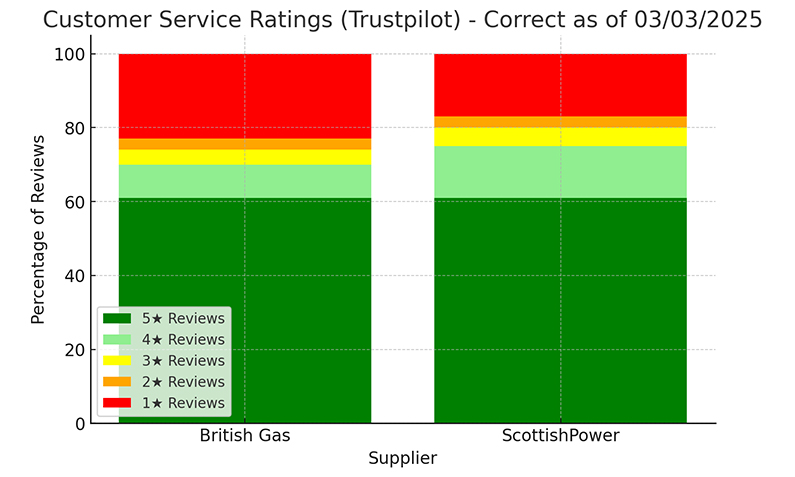
Customer service between British Gas and Scottish Power is a common deciding factor, and experiences vary widely by account type and region rather than a single verdict applying to everyone. Both suppliers are large national providers with UK and overseas contact centres, online accounts and apps, and both are covered by the Ofgem-backed complaints process and the Energy Ombudsman if a complaint is not resolved within eight weeks. If service quality is your priority, the most reliable signal is the independent Citizens Advice star rating for energy suppliers, which is updated each quarter and scores real complaint and call-handling data. Free Price Compare recommends checking the current Citizens Advice rating for both brands before switching, since standings change over time.

Direct debit management is a frequent friction point. Some households report estimated direct debits set higher than expected, so review your first few statements after switching and request an adjustment if your credit balance builds up faster than your usage justifies.

What does the Ofgem price cap mean for your bill?

The Ofgem energy price cap sets the maximum unit rate and standing charge a supplier can charge on a standard variable tariff, and for 1 July to 30 September 2026 it works out at around £1,862/year [AUTO-CORRECTED: was £1,812/year per https://www.ofgem.gov.uk/information-consumers/energy-advice-households/energy-price-cap-unit-rates-and-standing-charges — VERIFY] for a typical dual-fuel direct debit home, according to Ofgem. The cap limits rates, not your total bill, so a larger or higher-usage household will pay more than the typical figure. For this period, Ofgem set electricity at 26.11p/kWh with a 57.19p/day standing charge, and gas at 7.33p/kWh with a 29.04p/day standing charge, and confirmed the cap is 13% higher than the previous quarter. Both British Gas and Scottish Power standard variable tariffs track this cap, which is why their default prices sit close together.

The cap protects you from being overcharged on a variable deal, but it is not the cheapest option available. Competitive fixed tariffs can undercut the cap, which is where switching earns its money.

See which fixed deals beat the price cap

Should you switch to a fixed or variable tariff?

Choose a fixed tariff if you value certainty and can find a rate below the current price cap, and stay on variable if you want flexibility with no exit fee. A fixed tariff locks your unit rates for the term, typically 12 or 24 months, protecting you if the cap rises but charging an exit fee if you leave early. A standard variable tariff tracks the Ofgem price cap, rises and falls with it, and lets you switch away at any time without penalty. For a household on a variable tariff above the price cap floor, moving to a well-priced fixed deal is usually the single biggest saving available, provided the fixed rate is lower than the cap and the exit fee is manageable.

  • Pick fixed if you want budget certainty and a rate below the cap for the whole term.
  • Pick variable if you expect the cap to fall soon or want to switch again quickly with no exit fee.
  • Always check the exit fee (British Gas examples show around £50 per fuel) before committing to a fixed deal.

If you are comparing these two against other suppliers, our So Energy vs Scottish Power comparison and British Gas vs OVO Energy guide widen the picture beyond a straight two-way choice.

How do you switch supplier with confidence?

Switching supplier is a low-risk process protected by Ofgem’s rules, which require most switches to complete within around five working days and give you a 14-day cooling-off period to cancel. Start by taking a meter reading and checking your current tariff name, unit rates and any exit fee, then run a comparison for your exact postcode so the quotes reflect your regional distribution costs. Your new supplier handles the switch, your gas and electricity supply is never interrupted, and you cannot be cut off during the process. If you have a prepayment meter or a build-up of credit on your old account, your outstanding balance is settled or transferred as part of the switch.

Prepayment and smart meter users can switch too, and moving from a traditional prepayment meter to a smart meter usually keeps prepay functionality while adding easier top-ups and clearer usage data. Compare more supplier pairings in our British Gas vs E.ON Next comparison before you decide.

How do you switch supplier with confidence

Start a switch and lock in a rate

FAQs about British gas vs Scottish power

Is Scottish Power cheaper than British Gas?

Not always. Scottish Power can be cheaper than British Gas on some tariffs and in some regions, but on the dated August 2026 comparisons available, British Gas showed cheaper variable and fixed examples. The only way to know for your home is to compare live quotes for your postcode, meter type and usage.

Is Scottish Power part of British Gas?

No, Scottish Power is not part of British Gas. They are competing suppliers owned by different parent groups. Switching between them is a genuine change of supplier covered by Ofgem’s switching rules and cooling-off protections.

Which is better for green energy, British Gas or Scottish Power?

Both market fixed tariffs as 100% green electricity, so they are broadly comparable on the headline claim. British Gas backs several fixed tariffs with renewable electricity, while Scottish Power’s Green Fixed deal is advertised as 100% green and its parent group invests heavily in wind. Check the specific tariff’s fuel mix rather than relying on the brand.

What happens to my supply when I switch between them?

Your gas and electricity supply continues uninterrupted throughout the switch, as the pipes and wires do not change. Only the company you pay changes. Ofgem rules mean most switches complete within around five working days, and you cannot be cut off during the process.

Do British Gas and Scottish Power charge exit fees?

Both charge exit fees on fixed tariffs but not on standard variable tariffs. British Gas fixed tariffs can carry an exit fee, and Scottish Power’s green fixed deal also carries an exit charge. Standard variable tariffs can be left at any time without a penalty.

Can I switch if I have a prepayment meter?

Yes, prepayment meter customers can switch supplier and often move to a smart meter that keeps the prepay function. Any outstanding balance or credit is settled or transferred as part of the switch. Compare prepayment tariffs specifically, as the cheapest deals often assume direct debit payment.

Is my direct debit likely to be set higher with one supplier?

Direct debit amounts are estimates based on your expected annual usage, and any large supplier can set them higher than needed. If a credit balance builds up faster than your usage justifies, contact your supplier and ask for a review. Providing regular meter readings keeps estimates accurate.

What is the Ofgem price cap and does it apply to both?

The Ofgem price cap limits the maximum unit rate and standing charge on standard variable tariffs, working out at around £1,862/year [AUTO-CORRECTED: was £1,812/year per https://www.ofgem.gov.uk/information-consumers/energy-advice-households/energy-price-cap-unit-rates-and-standing-charges — VERIFY] for a typical dual-fuel home for 1 July to 30 September 2026. It applies to both British Gas and Scottish Power standard variable tariffs, which is why their default prices are similar. It caps rates, not your total bill.

Should I fix now or stay on a variable tariff?

Fix if you can find a rate below the current price cap and want certainty for the term. Stay variable if you expect the cap to fall soon or want to switch again quickly without an exit fee. For a household above the price cap floor, a well-priced fixed deal is usually the largest available saving.

How do I check which supplier has better customer service?

Check the independent Citizens Advice star rating for energy suppliers, which is updated quarterly and scores complaint and call-handling data. Both suppliers are covered by the Energy Ombudsman if a complaint is not resolved within eight weeks. Standings change over time, so use the latest rating rather than older reviews.

How long do I have to cancel a switch if I change my mind?

You have a 14-day cooling-off period after agreeing to switch, during which you can cancel without penalty. If your switch is still being processed, cancelling simply keeps you with your current supplier. After the cooling-off period ends and the switch completes, you would need to arrange a fresh switch to change again.

Also Read Related Articles


Information correct as of 19 August 2026. Prices, tariffs, policy details and providers change frequently, so please check the latest details before making a decision. This article is for general information only and does not constitute financial advice. Free Price Compare is authorised and regulated by the Financial Conduct Authority (FCA).

4000+ reviews