





Eon Next Vs Ovo Energy

Written by Shay Ramani
Reviewed by Prajesh Manvar
10 min read
Updated: 14 Sep 2026
Eon Next Vs Ovo Energy

E.ON Next vs OVO Energy comes down to how you use energy: in recent comparison snapshots, E.ON Next’s cheapest fixed deal was lower-priced than OVO’s cheapest variable tariff, but the best option depends on your usage, region and whether you want a fixed price or an exit-fee-free variable deal. Neither supplier is automatically the right choice for every home, and the picture changes with your region, usage and whether you want a fixed price or an exit-fee-free variable deal.

Both suppliers now sit within the same corporate group after E.ON agreed to acquire OVO, which matters if you are an OVO customer weighing up a switch. Free Price Compare sources tariff and price-cap context from Ofgem publications and runs whole-of-market energy comparisons, so this article steers you towards the right decision for a bill-conscious household rather than a blanket verdict.

Quick Answer: Eon Next Vs Ovo Energy

  • E.ON Next’s lowest fixed tariff carried a £200 total exit fee in August 2026, while OVO’s cheapest deal was a variable tariff with no fixed term and no exit fees (third-party comparison, August 2026).
  • The Ofgem energy price cap caps unit rates and standing charges for a typical dual-fuel direct debit household, not your total bill, so your actual cost rises or falls with how much you use.
  • E.ON agreed to acquire OVO in 2026; if the deal completes, existing OVO tariffs continue on their current terms until they end, and you keep the legal right to switch away.
  • E.ON Next and OVO both offer EV-focused tariffs with cheaper overnight electricity, but the off-peak rates and hours differ, so the better EV deal depends on your charging pattern.
  • Switching energy supplier takes around 5 working days under Ofgem rules, with a 14-day cooling-off period and no interruption to your gas or electricity supply.

Last updated: August 2026

Written by the Free Price Compare editorial team | Reviewed August 2026

Which is cheaper, E.ON Next or OVO?

E.ON Next was the cheaper supplier in recent fixed-tariff comparison snapshots, but the better choice depends on whether you want a fixed price or a flexible variable tariff. That headline hides an important detail: E.ON Next’s lower price came from a fixed tariff that carried a £200 total exit fee, whereas OVO’s figure came from its Simpler Energy variable tariff with no fixed term and no exit charges. So E.ON Next tends to win on the sticker price for fixed deals, while OVO’s variable option gives you the freedom to leave whenever you want. The right pick depends on whether you value price certainty or flexibility more.

Prices also move with your region and how much gas and electricity you use. Earlier 2026 comparison data showed E.ON Next and OVO moving within a similar price range, with the cheapest option depending on the tariff type, region and usage. Because tariffs change frequently and vary by postcode, the only reliable way to see which wins for your home is a live quote for your address and usage. You can compare energy prices across the whole market before committing.

Compare E.ON Next and OVO prices for your postcode

How does the energy price cap affect these tariffs?

The energy price cap sets the maximum a supplier can charge per unit of gas and electricity and per day in standing charges for customers on a standard variable tariff, according to Ofgem. The cap is not a fixed limit on your total bill: it caps rates for a typical dual-fuel direct debit household, so your actual cost rises if you use more and falls if you use less. Both E.ON Next and OVO price their standard variable tariffs at or near the cap, which is why their variable deals tend to move together whenever Ofgem updates the cap each quarter.

Fixed tariffs work differently. When you fix with E.ON Next or OVO, you lock the unit rates and standing charges for the term regardless of what the cap does, which protects you if wholesale prices rise but costs you if they fall. Free Price Compare’s own energy comparison data showed a benchmark price cap of £1,755 for a typical dual-fuel customer around April 2025, with the cheapest available tariff at £1,617, an indicative saving of £231 against the cap. Because the cap changes on a set schedule, always check the current Ofgem figure before deciding whether a fixed deal beats staying on a capped variable tariff.

What are the exit fees with each supplier?

Exit fees are charges you pay for leaving a fixed tariff before it ends, usually a set amount per fuel: E.ON Next fixed tariffs commonly carry exit fees, with one August 2026 fixed deal showing a £200 total exit charge, while OVO’s variable Simpler Energy tariff had no fixed term and no exit fees (third-party comparison, August 2026). This matters for a bill-conscious household because a fixed deal that looks cheaper on paper can cost more if you leave early and trigger the exit charge.

OVO’s exit-fee-free variable tariff is the more flexible option if you expect to move home, want to switch again soon, or think prices might fall. E.ON Next’s fixed deals suit you better if you want a locked price for 12 or 24 months and plan to stay for the full term. Under Ofgem rules, you can also switch away from any fixed tariff without an exit fee in the final 49 days before it ends, so timing your move near the end of a fix avoids the charge entirely. Weighing the exit fee against the annual saving is the key sum before you sign up.

Not sure a fix is right for you?

See how E.ON Next compares against another big supplier before you decide.

Which has better customer service and fewer complaints?

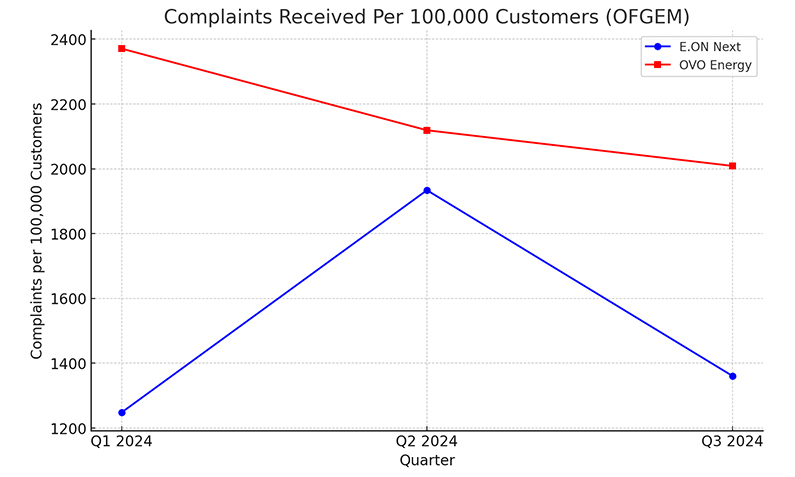
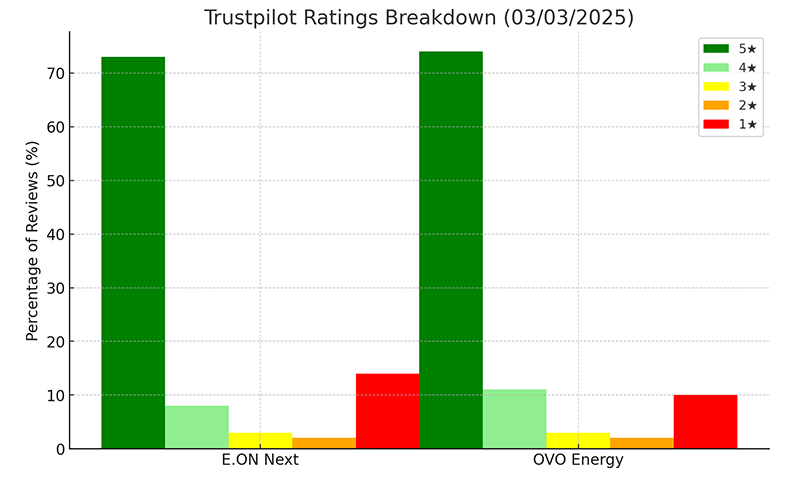
Customer service between E.ON Next and OVO is close, and no single supplier is definitively better for every household, so it is worth checking the latest independent ratings for both before you commit. E.ON Next moved its systems onto the Kraken platform, which several long-standing customers say improved account handling and app performance, while OVO has a good reputation for its app and 12-month fixed deals. Both suppliers appear in the mid-to-upper range of recent independent supplier rankings rather than at the very top. Ofgem publishes supplier-level customer satisfaction indicators for seven energy supply groups (including OVO) drawn from its Energy Consumer Satisfaction Survey, and Citizens Advice publishes a quarterly Star Rating league table of energy suppliers’ customer service.

For a factual view, check Citizens Advice, which publishes a star rating comparing energy suppliers on complaints, ease of contact and billing accuracy. If service reliability matters more to you than saving the last few pounds, that rating is a better guide than any single review. Vulnerable customers should also ask either supplier about the Priority Services Register, a free scheme giving extra support such as priority reconnection and accessible bills. Both E.ON Next and OVO are signed up to it.

Which has better customer service and fewer complaints

How does the E.ON and OVO merger affect me as a customer?

The E.ON and OVO merger means the two suppliers would sit in the same corporate group if the acquisition completes, but as an existing customer your tariff, unit rates and terms stay exactly as they are until your current deal ends. A merger does not automatically move you onto a new tariff or change your prices. If the deal completes, OVO’s existing tariffs continue on their agreed terms, and you keep the legal right under Ofgem rules to switch supplier at any time.

If you are currently with OVO and considering a switch, the merger is a reason to compare rather than a reason to rush. You are free to move to E.ON Next, back to OVO, or to any other supplier whenever your deal allows without an exit fee. It also means comparing E.ON Next and OVO on price alone is a smaller decision than it once was, since account handling may eventually converge. Before switching, it is worth also weighing up how these two compare with alternatives, for example our Octopus Energy vs OVO Energy comparison.

Check whether switching from OVO saves you money

Which is better for EV drivers and solar owners?

E.ON Next and OVO both offer EV-focused tariffs with cheaper overnight electricity, so the better choice for EV drivers depends on your charging hours and how much you charge each night. E.ON Next’s Next Drive style tariffs include a longer window of cheaper night-rate electricity, which suits drivers who charge over several hours, while OVO’s Drive Anytime style offering advertises a low flat off-peak rate. Because the off-peak rates and eligible hours differ between the two, the cheaper option is the one that matches when your car actually charges.

For solar owners, both suppliers participate in the Smart Export Guarantee, the scheme that pays households for surplus electricity exported to the grid. Export rates and eligibility vary by supplier and tariff, so if you have solar panels or a home battery, compare the export payment as carefully as the import price. A tariff with a slightly higher import rate but a much better export rate can work out cheaper overall for a well-sized solar and battery setup. Always run the numbers on both import and export for your specific system before choosing. Ofgem says you should compare both your import and export tariffs for your specific solar-and-battery setup, because a higher export rate can make the overall deal better even if the import price is not the lowest.

Is switching between them worth it, and how long does it take?

Switching between E.ON Next and OVO takes around 5 working days under Ofgem’s switching rules, with a 14-day cooling-off period and no interruption to your gas or electricity supply. Your pipes and wires do not change, only who bills you, so there is no engineer visit and no risk of losing power during the move. You will need a recent meter reading and your bank details, and if you have a smart meter it usually keeps working, though occasionally it may temporarily lose its smart features until the new supplier updates it.

Whether the switch is worth it depends on the size of the saving against any exit fee on your current deal. If moving saves you more per year than any exit charge costs, switching is worth doing, and Ofgem’s rules protect you throughout with a guaranteed switch window and compensation if anything goes wrong. For a bill-conscious household on a standard variable tariff sitting above the cheapest available fixes, running a comparison is the fastest way to see the potential saving. It is also worth looking beyond these two, for example our British Gas vs E.ON Next guide or Octopus Energy vs E.ON Next comparison.

See live energy quotes for your home in minutes

Is E.ON Next a good energy supplier for a bill-conscious household?

E.ON Next can be a good choice for a bill-conscious household that wants predictable costs. Its fixed deals lock your rates for the term, which suits households that value price certainty over flexibility. The trade-off is that several E.ON Next fixed tariffs carry exit fees, so leaving early can cost you.

For a household currently on a standard variable tariff sitting above the price cap floor, moving to a competitive E.ON Next fixed deal can reduce your annual cost, provided the saving outweighs any exit fee on your existing tariff. The main things to check are the unit rates and standing charges for your region, the length of the fix, and the exit fee. If flexibility matters more than a locked price, OVO’s exit-fee-free variable tariff is worth weighing against E.ON Next’s fixes. Comparing both against the wider market, including suppliers like those in our So Energy vs E.ON Next comparison, gives you the full picture.

E.ON Next vs OVO Energy at a glance

E.ON Next and OVO Energy differ most on tariff structure and exit fees rather than on being fundamentally cheaper or more expensive, so the table below summarises the practical differences a bill-conscious household should weigh. Figures reflect third-party comparison snapshots from August 2026 and change frequently, so treat them as indicative rather than a live quote.

Feature E.ON Next OVO Energy
Lowest deal type (Aug 2026) Fixed tariff, around £1,746/year Variable tariff, around £1,805/year
Exit fees Yes on fixed deals (example £200 total) None on variable Simpler Energy tariff
Price certainty Fixed rates for the term Variable, tracks the price cap
EV tariff Next Drive style, longer night window Drive Anytime style, flat off-peak rate
Solar export Smart Export Guarantee Smart Export Guarantee
Best suited to Households wanting a locked price Households wanting flexibility

Figures are indicative and may change.

E.ON Next vs OVO Energy at a glance

FAQs about eon next vs ovo energy

Is OVO part of E.ON now?

E.ON agreed to acquire OVO Energy in 2026, which would place both suppliers in the same corporate group once the deal completes. Until then they operate as separate brands with their own tariffs. Even after completion, existing OVO customers keep their current terms until their deal ends and retain the right to switch supplier at any time.

Do E.ON Next fixed tariffs have exit fees?

Most E.ON Next fixed tariffs carry exit fees, with one August 2026 deal showing a £200 total exit charge for leaving early. Under Ofgem rules you can switch away without an exit fee in the final 49 days of any fixed tariff. OVO's variable Simpler Energy tariff had no fixed term and no exit fees in the same period.

How does the price cap affect my E.ON Next or OVO bill?

The Ofgem price cap sets the maximum unit rates and standing charges a supplier can charge on a standard variable tariff, but it does not cap your total bill. Your actual cost rises with usage and falls if you use less. Fixed tariffs from E.ON Next or OVO lock your rates for the term and are unaffected by cap changes during that period.

How long does it take to switch between E.ON Next and OVO?

Switching between E.ON Next and OVO takes around 5 working days under Ofgem's switching rules. There is a 14-day cooling-off period, and your gas and electricity supply is never interrupted during the move. You will need a recent meter reading and your bank details to complete the switch.

Will my smart meter keep working if I switch supplier?

Your smart meter keeps supplying gas and electricity when you switch between E.ON Next and OVO, and in most cases it continues to work normally. Occasionally a meter temporarily loses its smart features, such as automatic readings, until the new supplier updates its systems. If that happens, you may need to submit manual readings for a short period.

Which is better for EV drivers, E.ON Next or OVO?

Both E.ON Next and OVO offer EV tariffs with cheaper overnight electricity, so the better choice depends on your charging pattern. E.ON Next's Next Drive style tariffs include a longer window of cheap night-rate power, suiting drivers who charge over several hours. OVO's Drive Anytime style offering advertises a low flat off-peak rate. Compare the off-peak rates and hours against when your car actually charges.

Which has better customer service, E.ON Next or OVO?

E.ON Next and OVO are closely matched on customer service, and neither is definitively better for every household. E.ON Next improved its account handling after moving to the Kraken platform, while OVO has a strong reputation for its app. Check the latest Citizens Advice supplier star ratings, which compare complaints, contact and billing, for an independent view before you decide.

Can I get paid for solar exports with E.ON Next or OVO?

Both E.ON Next and OVO participate in the Smart Export Guarantee, which pays households for surplus electricity exported to the grid. Export rates and eligibility differ between suppliers and tariffs, so if you have solar panels or a home battery, compare the export payment as carefully as the import price. A better export rate can offset a slightly higher import rate for a well-sized system.

Is it worth switching from OVO to E.ON Next before the merger?

Switching from OVO to E.ON Next is worth it only if the annual saving outweighs any exit fee on your current OVO deal. The planned merger does not force any change to your tariff, so there is no need to rush. Compare live quotes for your address and check both suppliers against the wider market before moving, as the cheaper option varies by region and usage.

What happens if my energy supplier goes bust?

If your energy supplier stops trading, Ofgem appoints a new supplier to take over your account under its supplier of last resort process, and your supply continues without interruption. Any credit balance on your account is protected. You do not need to do anything except wait to be contacted by the new supplier, after which you are free to switch again if you wish.

Do I get the Warm Home Discount with E.ON Next or OVO?

Both E.ON Next and OVO participate in the Warm Home Discount, a government scheme giving eligible low-income households a one-off reduction on their electricity bill each winter. Eligibility depends on receiving certain benefits and meeting the scheme's criteria, not on which of the two suppliers you choose. Check each supplier's current scheme details and application process to confirm you qualify.

Also Read Related Articles


Information correct as of 11 August 2026. Prices, tariffs, policy details and providers change frequently, so please check the latest details before making a decision. This article is for general information only and does not constitute financial advice. Free Price Compare is authorised and regulated by the Financial Conduct Authority (FCA).

4000+ reviews