





What Does a Home Insurance Cover in the UK?

Written by Prajesh Manvar
Reviewed by Tim Bailey
6 min read
Updated: 4 Nov 2026
What Does a Home Insurance Cover in the UK?

Home insurance cover protects the structure of your property and the belongings inside it against sudden, insurable events such as fire, theft, flooding, storm damage and burst pipes. A standard combined policy has two parts: buildings insurance for the physical structure, and contents insurance for your possessions, usually with public liability cover included as standard.

Home insurance is not a maintenance or repair contract. It pays out when something sudden and unexpected goes wrong, not for wear and tear, gradual damage or general upkeep. Knowing exactly where that line sits, and what sits outside it, is the difference between a claim that pays and one that is declined.

At Free Price Compare we compare home insurance from a panel of 42 UK providers across buildings, contents and combined cover. The explanations below use UK regulator and industry data from the Association of British Insurers, the Financial Conduct Authority and Citizens Advice, so you can set the right sum insured, excess and add-ons without overpaying.

Quick Answer: What Does a Home Insurance Cover in the UK?

  • Buildings cover pays to repair or rebuild the structure; contents covers your belongings.
  • Most policies cover sudden events only, not wear and tear or poor maintenance.
  • Accidental damage, home emergency and legal expenses are usually optional add-ons.
  • Average combined buildings and contents cover was £375 in Q1 2026 (ABI).
  • Flood cover must be stated in the policy; check gardens, walls and fences are included.

Last updated: November 2026

Written by the Free Price Compare editorial team | Reviewed November 2026

Buildings and contents: the two parts of home insurance cover

Home insurance cover has two distinct parts, and most homeowners need both. Buildings insurance covers the physical structure of your property, including the rebuilding cost after damage; contents insurance covers the possessions inside it, such as furniture, clothes, electricals and carpets. A combined policy bundles the two with one insurer and usually one excess per claim.

According to the ABI, buildings insurance covers the structure and the rebuild cost, with pricing shaped by property size, construction type, flood risk, subsidence risk and previous claims. Contents cover is priced on the total value of your possessions, higher-risk items such as jewellery, your location, claims history and home security. Public liability cover, which protects you if a visitor is injured or a slate falls and causes damage to someone else, is typically built into both.

Here is how the Q1 2026 average premiums compared across the three main cover types.

Cover type Average premium (Q1 2026) Year-on-year change
Combined buildings and contents £375 Down £22 (5%)
Buildings-only £306 Down £19 (6%)
Contents-only £117 Down £15 (12%)
Source: ABI, Q1 2026

Price valid as of 03/11/2026

Figures are indicative and may change. The ABI reported these as the fourth consecutive quarterly fall in home premiums. For a fuller breakdown of what a typical policy bundles together, see our home insurance coverage guide.

Compare combined buildings and contents cover

Do I need both buildings and contents insurance?

You need buildings insurance if you own your home, and contents insurance if you want your possessions protected, but the two are separate decisions. Mortgage lenders require buildings cover as a condition of the loan, because the lender needs the structure protected. Contents cover is not legally required by anyone, but without it you would pay out of pocket to replace everything inside after a fire, flood or burglary.

Flat owners and leaseholders are a common exception. If your service charge already includes buildings insurance arranged by the freeholder or managing agent, you usually only need contents cover for your own possessions. Check your lease and service-charge statement before buying a buildings policy you do not need.

Renters never need buildings cover, as that is the landlord’s responsibility, but contents insurance is worth it to protect your own belongings. Our guide on whether renters need home insurance explains how tenant cover differs from a homeowner’s policy.

What events does home insurance cover?

Home insurance covers sudden, one-off insurable events, not gradual deterioration. A standard combined policy pays out for fire, theft, vandalism, escape of water from a burst pipe, storm damage, falling trees, impact damage, and flooding where flood cover is included. It is designed around unexpected perils, so the test is usually whether the damage happened suddenly and accidentally rather than over time.

Common covered events on a standard UK policy include:

  • Fire, smoke and explosion damage to the building or contents
  • Theft, attempted theft and malicious damage from a break-in
  • Escape of water, such as a burst pipe or leaking washing machine
  • Storm and flood damage, where flood cover is stated in the policy
  • Subsidence, heave and landslip, usually with a higher separate excess
  • Impact damage from vehicles, falling trees or aerials

Subsidence is treated differently from most perils. The ground moving beneath a property is slow and progressive rather than a single sudden event, so most policies have an excess of around £1,000 for a subsidence claim, according to the Association of British Insurers, and insurers may ask for a survey before covering it.

What events does home insurance cover

Not sure what your policy actually includes?

Compare 42 UK providers and see cover levels side by side in minutes.

Does home insurance cover accidental damage?

Accidental damage is usually an optional add-on, not standard cover, so not every policy includes it. Accidental damage cover pays for sudden, one-off mishaps you cause yourself, such as drilling through a pipe, putting a foot through the loft ceiling, or knocking a television off its stand. Without the add-on, a standard policy would decline these because they are not caused by an insured peril like fire or theft.

Some policies include limited accidental damage as standard for specific items, such as mirrors, glass in furniture or audio-visual equipment, then offer full accidental damage as a paid extra. Full cover typically applies separately to buildings and to contents, so check which you are adding. If you have children or pets, full accidental damage cover often earns its place in the policy.

Deliberate damage, poor workmanship and damage that builds up over time are never covered as accidents. For the complete list of what sits outside a standard policy, our guide to home insurance exclusions walks through each one.

Does home insurance cover a boiler or boiler repairs?

A standard home insurance policy does not cover boiler breakdown, servicing or replacement caused by age, wear and tear or mechanical failure. Buildings insurance covers the boiler only if it is damaged by an insured event, such as a fire or a flood. A boiler that simply stops working because it has reached the end of its life falls outside standard cover.

To cover sudden boiler breakdown you generally need home emergency cover, which is an optional add-on or a separate boiler cover plan. Home emergency pays for an urgent call-out and temporary repair to make a property safe, for example after a total boiler failure or a burst pipe in winter, usually up to a set limit. It does not pay to replace an old boiler on condition grounds.

If escape of water from a boiler damages your floors, ceilings or belongings, the resulting water damage is normally covered, even though the boiler itself is not. Our detailed explainer on whether home insurance covers boilers sets out exactly where cover begins and ends.

See what boiler and home emergency cover costs

When does home insurance cover a roof leak or water damage?

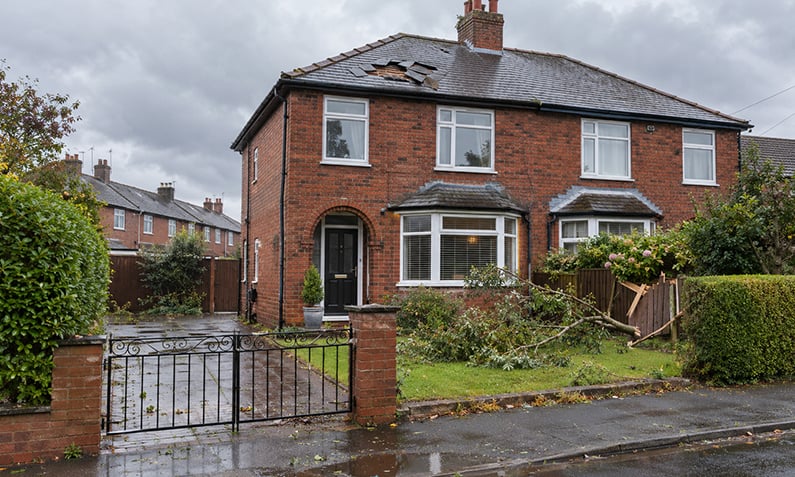
Home insurance covers a roof leak when it results from a sudden, insured event such as a storm that strips tiles or a falling tree, but not when it results from wear, age or lack of maintenance. Insurers draw a firm line here: a storm tears the roof open and the resulting water damage is covered; a roof that has slowly deteriorated and begun to let water in over months is treated as a maintenance issue and declined.

Water damage follows the same principle. Escape of water from a burst pipe, a failed seal or an overflowing appliance is a standard covered peril, including the damage it causes to floors, walls and contents. Damp, condensation, and slow leaks that develop gradually are excluded as wear and tear. Keeping gutters clear and acting on small leaks quickly protects both your home and your ability to claim.

Mould is rarely covered on its own. If mould appears because of a sudden covered escape of water, the cleanup can form part of that claim; if it results from long-term condensation or poor ventilation, it is excluded as a maintenance and upkeep matter. The key question an insurer asks is always whether the underlying cause was sudden and insured, or gradual and avoidable.

Does home insurance cover floods, subsidence and extreme weather?

Flood, subsidence and storm cover are included in most standard policies, but flood cover in particular must be specifically stated, and the detail matters. Citizens Advice warns that flood cover is not always prominent on comparison listings, so you should confirm it is included and check whether gardens, driveways, boundary walls and fences are covered, according to government-backed guidance and consumer advice bodies.

Flood Re is a UK Government and insurer scheme that helps homeowners in high flood-risk areas obtain affordable cover. To be eligible, the property generally must have been built before 1 January 2009, subject to the scheme’s other conditions. Where flood cover is essential, Citizens Advice recommends applying directly to insurers that participate in Flood Re rather than relying on a listing alone. Our dedicated guide on whether home insurance covers flood damage covers eligibility and what to check.

Extreme weather such as storms, high winds and heavy snow is a standard covered peril, but insurers expect the property to be reasonably maintained. Storm damage to a roof that was already in poor condition can be reduced or declined on maintenance grounds, so the age and condition of your roof, fences and chimney directly affect a weather claim.

Will home insurance cover a home business?

A standard home insurance policy usually does not fully cover a home business, because business equipment, stock and business liability sit outside domestic cover. Clerical home working, such as using a laptop for an office job, is often accepted with no change needed, but running a business with customer visits, stock, or specialist equipment typically requires either an extension or separate business cover.

The risk is that an undeclared business invalidates a related claim. If a customer is injured at your home, or business stock is stolen, a standard domestic policy may decline because the activity was not disclosed. Always tell your insurer about any business use, as non-disclosure breaches the duty to give accurate information under the Consumer Insurance (Disclosure and Representations) Act 2012.

If you work from home regularly, our guide on home insurance when working from home explains when a simple extension is enough and when standalone business cover is the safer route.

What is a sum insured and how do excess and exclusions work?

The sum insured is the maximum amount your insurer will pay out, set separately for buildings (the rebuild cost) and contents (the total value of your possessions). Underinsuring either figure is one of the most common reasons a claim is reduced, so set the buildings sum insured to the rebuild cost, not the market value, and add up your contents realistically room by room.

An excess is the amount you agree to pay towards each claim before the insurer pays the rest. There are two types: the compulsory excess set by the insurer, and the voluntary excess you choose to lower your premium. A higher voluntary excess reduces your price but increases what you pay at claim time, and specific perils such as subsidence carry their own separate, higher excess.

Exclusions are the situations a policy will not pay for, and they are where claims most often fail. Standard exclusions include wear and tear, gradual damage, poor maintenance, deliberate damage and, frequently, items worth more than a single-article limit unless specified. High-value items such as jewellery, watches and bicycles usually need listing individually once they exceed the policy’s single-item limit.

  • Set buildings cover to the rebuild cost, which a surveyor or the RICS rebuild calculator can estimate
  • List valuables above the single-article limit as specified items
  • Choose a voluntary excess you could afford to pay on the day
  • Read the exclusions and limits, not just the headline price

Compare cover levels, excess and add-ons

Am I paying too much for home insurance?

You may be paying too much if you auto-renew without comparing, because premium differences between insurers for the same cover can run to several hundred pounds. Average combined buildings and contents cover was £375 in Q1 2026, down 5% year on year according to the ABI, and prices fell for a fourth consecutive quarter, so loyalty does not guarantee the best price.

Since January 2022, FCA rules under ICOBS 6B mean a firm cannot set your renewal price higher than it would charge an equivalent new customer, according to the FCA. That removed the old loyalty penalty on renewal, but it does not mean your current insurer is the cheapest in the whole market, so comparing across providers still pays.

If you pay monthly, premium finance adds interest to the cost. The FCA reported the average home-insurance finance cost fell from £18 in 2022 to £15 in 2026, based on an estimated £220 representative premium, as interest rates on premium finance dropped by an average of 4.1 percentage points since 2022. Paying annually avoids that interest entirely where you can afford the lump sum. For myths that push people into overpaying, see our home insurance myths explained guide.

Am I paying too much for home insurance

FAQs about home insurance cover

Does home insurance cover a boiler breakdown?

A standard home insurance policy does not cover boiler breakdown, servicing or replacement caused by age, wear or mechanical failure. The boiler is only covered if it is damaged by an insured event such as a fire or flood. For sudden breakdowns you generally need home emergency cover as an add-on or a separate boiler plan.

Does home insurance cover accidental damage as standard?

Accidental damage is usually an optional add-on rather than standard cover. Some policies include limited accidental damage for specific items like glass or electronics, with full cover available as a paid extra for buildings and contents separately. If you have children or pets, full accidental damage cover often pays for itself.

Does home insurance cover a leak in the roof?

Home insurance covers a roof leak when it is caused by a sudden insured event, such as a storm stripping tiles or a falling tree. A roof that has gradually deteriorated and begun to let water in is treated as wear and tear and is not covered. Keeping the roof maintained protects both your home and your ability to claim.

Does home insurance cover water damage?

Escape of water from a burst pipe, failed seal or overflowing appliance is a standard covered peril, including the damage it causes to floors, walls and contents. Slow, gradual leaks, damp and condensation are excluded as wear and tear. The insurer's test is whether the water damage was sudden and accidental rather than developing over time.

Does home insurance cover mould?

Mould is only covered when it results directly from a sudden insured event, such as an escape of water, in which case the cleanup can form part of that claim. Mould caused by long-term condensation, poor ventilation or a slow leak is excluded as a maintenance issue. Insurers assess the underlying cause rather than the mould itself.

Does buildings insurance cover retaining walls, fences and gardens?

Cover for walls, fences, gates and gardens varies between policies and is not guaranteed, so you should check the specific wording. Boundary walls and fences are often excluded from storm and flood cover or carry lower limits. If a retaining wall or garden feature is important to you, confirm it is listed as covered before you buy.

Does home insurance cover subsidence?

Most policies cover subsidence, heave and landslip, but it is treated differently from sudden perils because the ground moves gradually. Insurers apply a separate, higher subsidence excess, commonly £1,000, and may require a survey. If your property has a history of subsidence, you must disclose it when applying for cover.

Does CCTV or a home alarm lower home insurance?

Approved home security such as a monitored alarm or CCTV can reduce a contents premium, because insurers price contents partly on theft risk and security measures. The discount varies by insurer and is not guaranteed. Always declare your actual security setup accurately, as overstating it could affect a future theft claim.

What does home insurance not cover?

Home insurance does not cover wear and tear, gradual deterioration, poor maintenance, deliberate damage or general upkeep. It also commonly excludes items above a single-article limit unless specified, undeclared business use, and flood where flood cover is not stated. Reading the exclusions and limits matters as much as the headline price.

How do I know if I am paying too much for home insurance?

Compare your renewal against the wider market rather than auto-renewing, as prices for the same cover can vary by hundreds of pounds. FCA rules since 2022 mean your insurer cannot charge you more at renewal than an equivalent new customer, but that does not make them the cheapest overall. Paying annually rather than monthly also avoids premium finance interest.

Also Read Related Articles


Information correct as of 3 November 2026. Prices, tariffs, policy details and providers change frequently, so please check the latest details before making a decision. This article is for general information only and does not constitute financial advice. Free Price Compare is authorised and regulated by the Financial Conduct Authority (FCA).

4000+ reviews