





So Energy vs Octopus Energy: Which Wins in 2026?

Written by Shay Ramani
Reviewed by Andrea Troy
5 min read
Updated: 23 Sep 2026
So Energy vs Octopus Energy: Which Wins in 2026?

So Energy vs Octopus Energy comes down to a trade-off: Octopus scores higher for customer service and has the widest range of smart and EV tariffs, while So Energy offers a simpler tariff range with a tracker guaranteed to sit £50 a year below the price cap. Both supply 100% renewable electricity and both are worth a look if you are stuck on a standard variable tariff above the current price cap.

If you pay a fixed monthly Direct Debit and have not switched in a while, you are almost certainly on a variable rate near the Ofgem cap, which rose 13% on 1 July 2026. This comparison weighs the two suppliers on price, service, EV and smart tariffs, exit fees and switching, so you can pick the better fit for your home. Free Price Compare sources tariff and service data from Ofgem and Citizens Advice publications, and live prices always vary by postcode and meter type.

Quick Answer: So Energy vs Octopus Energy

  • Octopus Energy scored higher than So Energy in the Citizens Advice star rating for Q1 2026, when the industry median service score was 3.26 out of 5 (Citizens Advice).
  • So Energy’s tracker tariff, So Green Tracker, is guaranteed to stay £50 a year below the Ofgem price cap at typical dual-fuel usage (£25 per fuel).
  • Both suppliers offer variable tariffs with no exit fee, but some fixed deals from either supplier can carry an exit fee, so always check the tariff terms before you sign.
  • Octopus has a wider range of EV and smart tariffs, including Intelligent Octopus Go with automated off-peak charging; So Energy’s So EV tariff drops to 6.5p/kWh between midnight and 5am.
  • The Ofgem price cap for a typical Direct Debit dual-fuel household is £1,663 a year from 1 July to 30 September 2026, up 13% on the previous quarter (Ofgem).

Last updated: August 2026

Written by the Free Price Compare editorial team | Reviewed August 2026

So Energy vs Octopus Energy at a glance

So Energy and Octopus Energy are both 100% renewable-electricity suppliers, but they differ most on tariff range and customer service. Octopus Energy is the UK’s largest energy supplier, serving around 1 in 4 households., and offers the widest choice of smart, EV and export tariffs. So Energy is a smaller supplier with a tidier tariff line-up built around fixed deals, a standard variable tariff (So Flex) and a price-cap tracker. For a bill-conscious household on a variable rate, the decision usually turns on whether you want the flexibility and smart-tariff range of Octopus or the simpler, tracker-led approach of So Energy.

Feature So Energy Octopus Energy
Renewable electricity 100% 100%
Tariff range Fixed, variable (So Flex), tracker Fixed, variable, wide smart/EV range
EV tariff So EV (6.5p/kWh 12am-5am) Intelligent Octopus Go (smart charging)
Tracker So Green Tracker (£50/yr below cap) Agile Octopus (half-hourly)
Citizens Advice service (Q1 2026) Around mid-table Best of the largest suppliers

Figures are indicative and may change.

The two suppliers publish tariffs that reset with the price cap every three months, so live prices differ by postcode, meter type and payment method. For a like-for-like decision, it helps to see both alongside the wider market rather than in isolation. You can also weigh Octopus against other large names in our Octopus Energy vs British Gas comparison.

Compare live energy tariffs by postcode

Which is cheaper, So Energy or Octopus Energy?

Neither So Energy nor Octopus Energy is reliably cheaper for every household, because both price against the same Ofgem price cap and reset rates each quarter. The Ofgem price cap for a typical Direct Debit dual-fuel home is £1,663 a year from 1 July to 30 September 2026, a 13% rise on the prior quarter, according to Ofgem. So Energy’s tracker (So Green Tracker) is guaranteed to sit £50 a year below the cap at typical usage, which gives it a built-in edge over a plain variable rate. Octopus counters with fixed deals and smart tariffs that can beat the cap depending on your usage pattern and how much of your energy you can shift to off-peak.

The cheapest option depends on how you use energy. A low-usage household with steady, all-day consumption may do best on So Energy’s tracker, which stays just below the cap without you doing anything. A household with an EV, storage heaters or a home battery can save more with Octopus smart tariffs by moving load into cheap off-peak windows. The only way to know which is cheaper for you is to compare a live quote for your postcode and meter, because both suppliers’ rates change every three months.

Which supplier has better customer service and reviews?

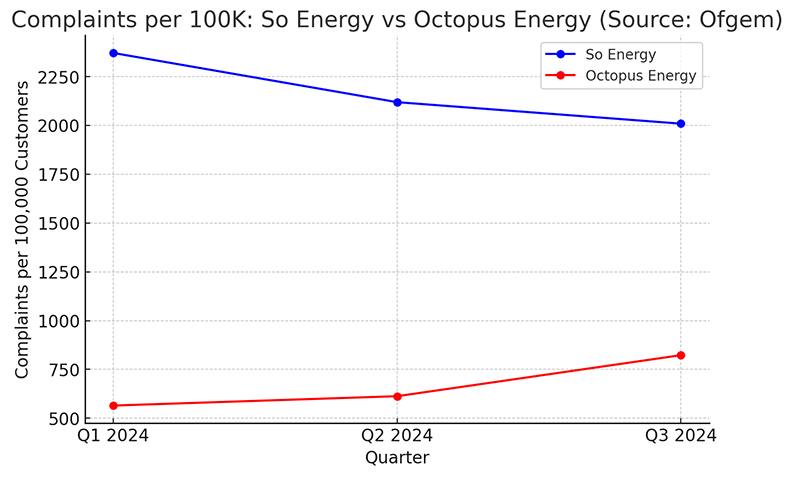
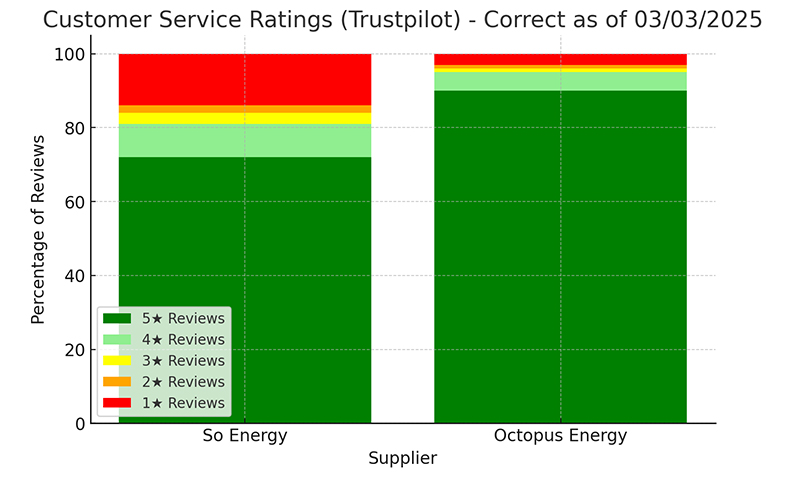
Octopus Energy generally rates higher than So Energy for customer service. In the Citizens Advice star rating for January to March 2026, when the industry median service score was 3.26 out of 5, Octopus was among the best performers of the largest suppliers, according to Citizens Advice. The rating scores suppliers with over 25,000 customers on complaints, call waiting times and customer commitments. So Energy has historically sat closer to mid-table on the same measure, having improved from a weaker position in earlier years.

Service quality matters as much as price for a supplier you may stay with for years. Octopus is known for short call-answering times and fast email responses, and it consistently ranks near the top of independent service tables. So Energy is a smaller operation, and some customers value its more personal feel, though its complaint-handling has been more variable over time. If prompt, reliable support is your priority, Octopus has the stronger recent record. For a wider service picture, our Octopus Energy vs OVO Energy guide compares two large suppliers on the same measures.

See how the largest UK suppliers compare

Do So Energy and Octopus charge exit fees?

Both So Energy and Octopus Energy offer variable tariffs with no exit fee, but some fixed deals from either supplier can carry an exit fee, so you should always check the tariff terms before signing. So Energy’s standard variable tariff (So Flex) and its tracker have no exit fees and let you switch any time. Octopus’s Flexible Octopus variable tariff also has no exit fee. On fixed deals, exit charges vary by product and launch window, and published figures on third-party sites do not always match the supplier’s current terms.

An exit fee is a charge you pay to leave a fixed contract early, usually stated per fuel. If you value the freedom to switch whenever a better deal appears, a no-exit-fee variable or tracker tariff avoids that cost entirely. If you fix, weigh the exit fee against how likely you are to leave before the term ends. Because these terms change every few months, confirm the exit fee on the live tariff information document at the point you sign, not from a comparison summary written months earlier.

Are both suppliers 100% renewable?

So Energy and Octopus Energy both supply 100% renewable electricity, backed by generation from renewable sources and Renewable Energy Guarantees of Origin. So Energy sells 100% renewable electricity across its tariffs, and Octopus does the same. Gas is a separate matter: neither supplier can make mains gas fully renewable, though both offer carbon-offset or green-gas elements on some tariffs. If a green supply is central to your choice, both meet the 100% renewable-electricity standard.

Renewable claims in the energy market can rest on different methods, from direct generation and power purchase agreements to certificate-backed supply. Both suppliers publish their fuel mix and the basis of their renewable claims. For most households comparing the two, the renewable question is effectively a tie, and the decision comes down to price, service and tariff features instead. If you generate your own power, both also participate in the Smart Export Guarantee, which we cover below.

Are both suppliers 100% renewable

Stuck on a variable tariff above the cap?

Compare fixed, tracker and smart tariffs side by side for your postcode.

Which is better for EV owners and smart meters?

Octopus Energy is generally the stronger choice for EV owners, because it offers a wider range of EV and smart tariffs than So Energy. Octopus tariffs such as Intelligent Octopus Go add automated smart charging that shifts your car to the cheapest overnight times without you managing it manually. So Energy’s So EV tariff is simpler: it drops unit rates to 6.5p/kWh between midnight and 5am, which suits drivers who charge in a fixed overnight window. If you want dynamic, automated charging and half-hourly pricing, Octopus has more to offer; if you want a straightforward cheap overnight rate, So EV works well.

Smart meters get access to the best of both suppliers’ tariffs, because time-of-use pricing depends on half-hourly meter readings. Octopus also runs Agile Octopus, a variable tariff where prices change every half hour to track wholesale costs, which can reward households that shift heavy use to cheaper periods. Households with storage heaters, home batteries or heat pumps tend to benefit most from Octopus’s smart range. For a car-first household, the automated charging and broader tariff choice usually make Octopus the better fit.

How do I switch and submit meter readings?

Switching to either So Energy or Octopus Energy takes a few minutes online and completes within about five working days, with a 14-day cooling-off period once you sign up. You provide your address, current supplier details and a recent meter reading, and the new supplier handles the transfer. Under Ofgem rules, your supply is never interrupted during a switch, and you are protected if anything goes wrong. Submitting meter readings is done through each supplier’s app or website, or automatically if you have a smart meter sending half-hourly data.

To switch with confidence, note your current tariff, unit rates and any exit fee first, then compare a live quote for your postcode. A regular meter reading keeps your bills accurate and avoids estimated charges, which is especially important on time-of-use tariffs where readings drive the price you pay. If you are eligible for support such as the Warm Home Discount or the Priority Services Register, both suppliers can register you. Compare the pair against other providers before you commit, and see our So Energy vs OVO Energy comparison for another option.

Switch energy supplier in minutes

Which should you choose for your home?

Choose Octopus Energy if customer service, EV tariffs and smart, time-of-use pricing matter most to you, and choose So Energy if you prefer a simpler tariff range and a tracker guaranteed to sit £50 a year below the price cap. A household with an electric car, a home battery or storage heaters usually gets more value from Octopus’s automated smart tariffs. A low-usage household that wants a set-and-forget rate below the cap, without managing off-peak windows, is often better served by So Energy’s tracker.

Both suppliers price against the same Ofgem price cap and both supply 100% renewable electricity, so the differences are real but not large for a typical bill. The most reliable way to decide is to compare a live quote for your postcode and meter, then weigh the tariff, the service record and any exit fee together. If you also want to weigh So Energy against other large names, our So Energy vs British Gas guide and So Energy vs E.ON Next comparison cover the same measures.

Which should you choose for your home

FAQs about so energy vs octopus energy

Is Octopus Energy cheaper than So Energy?

Neither is reliably cheaper for every home, because both price against the same Ofgem price cap and reset rates every three months. So Energy's tracker is guaranteed to sit £50 a year below the cap at typical usage, while Octopus smart tariffs can beat the cap for households that shift heavy use to off-peak windows. Compare a live quote for your postcode to see which is cheaper for your usage.

Which has better reviews, So Energy or Octopus?

Octopus Energy rates higher than So Energy for customer service. In the Citizens Advice star rating for January to March 2026, Octopus was among the best of the largest suppliers, while So Energy sat closer to mid-table. The rating scores complaints, call waiting times and customer commitments for suppliers with over 25,000 customers.

Which is better for EV owners?

Octopus Energy is generally better for EV owners, with a wider range of EV and smart tariffs. Intelligent Octopus Go automatically shifts charging to the cheapest overnight times, and Agile Octopus offers half-hourly pricing. So Energy's So EV tariff is simpler, dropping rates to 6.5p/kWh between midnight and 5am, which suits drivers who charge in a fixed overnight window.

How long does it take to switch supplier?

Switching to So Energy or Octopus Energy typically completes within about five working days, with a 14-day cooling-off period after you sign up. Your supply is never interrupted during a switch under Ofgem rules, and you are protected if anything goes wrong. You provide your address, current supplier details and a recent meter reading, and the new supplier handles the transfer.

What is a tracker tariff?

A tracker tariff is a variable tariff that moves in line with a benchmark, in this case the Ofgem price cap. So Energy's So Green Tracker is guaranteed to stay £50 a year below the cap at typical dual-fuel usage, with rates and standing charges resetting every three months. It has no fixed term and no exit fee, so you can switch any time.

Should I switch from a standard variable tariff?

If you are on a standard variable tariff at or above the Ofgem price cap and have not switched in a while, comparing fixed and tracker deals is worth doing. A tracker below the cap or a competitively priced fixed deal can lower your bill. Always compare a live quote for your postcode first, and check any exit fee before committing to a fixed contract.

Can I get the Warm Home Discount with either supplier?

Both So Energy and Octopus Energy participate in the Warm Home Discount, which gives eligible low-income households a one-off credit towards their winter electricity bill. Eligibility is set by government rules and usually depends on receiving certain benefits. Contact your supplier directly to confirm whether you qualify and how the discount is applied to your account.

How do I submit meter readings?

Meter readings are submitted through each supplier's app or website, or automatically if you have a smart meter sending half-hourly data. Regular readings keep your bills accurate and avoid estimated charges. On time-of-use or EV tariffs, accurate half-hourly readings from a smart meter are essential, because they drive the exact price you pay across the day.

Do both suppliers offer a Smart Export Guarantee tariff?

Yes, both So Energy and Octopus Energy participate in the Smart Export Guarantee, which pays you for surplus electricity you export from solar panels. Octopus offers Outgoing Octopus, including a dynamic Agile version where the export rate changes every half hour. Export rates and terms differ, so compare both if you generate your own power and want the best return.

Which supplier is better for a low-usage household?

A low-usage household with steady, all-day consumption is often better served by So Energy's tracker, which stays £50 a year below the price cap without any effort to shift usage. Octopus smart tariffs reward households that can move load to off-peak windows, so they suit EV and battery owners more. Compare a live quote for your usage before deciding.

Also Read Related Articles


Information correct as of 11 August 2026. Prices, tariffs, policy details and providers change frequently, so please check the latest details before making a decision. This article is for general information only and does not constitute financial advice. Free Price Compare is authorised and regulated by the Financial Conduct Authority (FCA).

4000+ reviews