


Fibre Broadband vs Standard Broadband: The 2026 Guide

Written by Tim Bailey
Reviewed by Shay Ramani
6 min read
Updated: 21 Aug 2026
Fibre Broadband vs Standard Broadband: The 2026 Guide

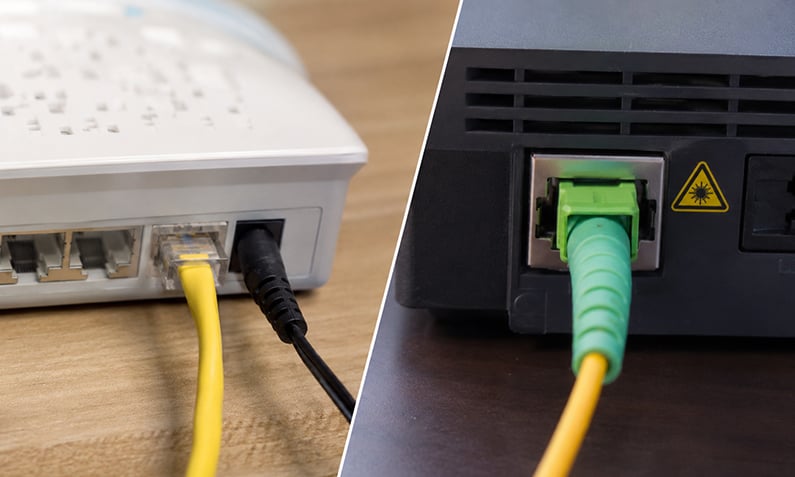
Fibre broadband vs standard broadband is the choice most UK households now face when picking a deal, and the gap between the two is wider than it has ever been. Standard broadband runs partly or fully over old copper phone lines, while fibre carries your connection on fibre-optic cable for faster, steadier speeds. With full fibre now reaching 82% of UK homes, the decision usually comes down to what is available at your address and how much you actually use the internet.

This guide explains the difference in plain terms, compares speed, reliability and price, and helps you decide which is right for your home.

  • Fibre broadband (FTTP) uses fibre-optic cable all the way to your home, giving faster downloads, much faster uploads and fewer dropouts than standard broadband.
  • Standard broadband relies on copper lines for some or all of the connection, so speeds are slower and can drop the further you live from the exchange or cabinet.
  • Full fibre now reaches 82% of UK homes (Ofcom, January 2026) and is often the same price as, or cheaper than, older copper-based deals.
  • If full fibre is available at your postcode, it is usually the better choice on speed, reliability and future-proofing.

The three connection types behind every UK deal

Every home broadband deal in the UK runs on one of three connection types, and the labels providers use can be confusing. Knowing which one you have tells you what speeds are realistic and whether an upgrade is worth it.

ADSL: the oldest copper broadband

ADSL is the oldest broadband technology, running entirely over copper telephone lines. Speeds typically sit between 10 and 24 Mbps and slow noticeably the further your home is from the local exchange. It is almost universally available but is being phased out as the copper network is retired.

Standard broadband (FTTC or part fibre)

Standard broadband, often sold as “fibre” or “part fibre”, is technically fibre to the cabinet (FTTC). Fibre-optic cable runs from the exchange to the green street cabinet, then copper carries the signal the rest of the way to your home. Typical speeds range from around 35 to 67 Mbps, with the copper section limiting both speed and stability.

Full fibre (FTTP)

Full fibre, or fibre to the premises (FTTP), uses fibre-optic cable from the exchange directly into your home with no copper in the connection. This delivers the fastest, most reliable speeds, holding up well even at peak times. Cable networks such as Virgin Media use coaxial cable rather than copper, which also supports very fast speeds. Our guide to the types of broadband from fibre to ultrafast breaks these tiers down further.

James Ford Broadband Deals Reviewed by James Ford, TV and Broadband Expert

Extra

  • New customers only
500Mb average* speed
Unlimited Downloads
£0.00 Setup costs
24 Month contract
Pay as you goCalls
£27.99per month

Superior

  • New customers only
900Mb average* speed
Unlimited Downloads
£0.00 Setup costs
24 Month contract
Pay as you goCalls
£29.99per month

Full Fibre 150

  • New customers only
  • Switch to Fibrus and they'll cover up to £400 of your switching fees
  • No mid-contract price rises
159Mb average* speed
Unlimited Downloads
£0.00 Setup costs
18 Month contract
Pay as you goCalls
£34.99per month

Fibre vs standard broadband at a glance

Full fibre beats standard broadband on speed, upload performance and reliability, while standard broadband holds an edge only on availability in the small number of areas full fibre has not yet reached. The table below summarises the main differences.

Feature Standard broadband (ADSL/FTTC) Full fibre (FTTP)
Connection Copper only, or fibre to cabinet then copper Fibre-optic cable all the way to the home
Typical download speed 10 to 67 Mbps 100 Mbps to 1 Gbps and beyond
Upload speed Usually under 20 Mbps Often 50 Mbps to symmetrical gigabit
Reliability at peak times Can slow or drop Holds up well
Affected by distance Yes, speed falls with distance No
Availability Near universal 82% of UK homes (Ofcom, Jan 2026)

Figures are indicative and may change.

How much faster is full fibre in practice?

Full fibre is several times faster than standard broadband on both download and upload, and the upload difference is the one many households underestimate. Ofcom’s Connected Nations 2025 report put the UK average maximum download speed at 285 Mbps in 2025, up from 223 Mbps a year earlier, driven largely by people moving onto full fibre.

On standard FTTC broadband, download speeds usually top out around 67 Mbps and uploads sit below 20 Mbps. Full fibre regularly delivers 100 Mbps to 1 Gbps downloads, with uploads of 50 Mbps or more. That upload speed matters for video calls, cloud backups, gaming and sending large files, where copper-based connections struggle.

Usage patterns back this up. Ofcom found average monthly data use was 583 GB per connection in 2025, rising to 738 GB on full fibre lines. Homes with faster connections simply do more online.

How much faster is full fibre in practice

Compare broadband deals in your area

Is fibre more expensive than standard broadband?

Fibre broadband is often the same price as, or cheaper than, standard broadband, which surprises many households expecting a premium. Faster fibre packages frequently start at a similar monthly cost to older copper deals, so paying more for less speed makes little sense where full fibre is available.

Entry-level full fibre deals from national providers commonly sit in the low-to-mid £20s a month, while ultrafast connections of 900 Mbps and above averaged around £30.73 a month as of June 2026. Standard FTTC packages of 50 to 67 Mbps often cost £20 to £30 a month, overlapping heavily with full fibre pricing. If you only need a moderate connection, a deal like Plusnet Full Fibre 74 shows how affordable mid-tier full fibre has become.

Prices are promotional, postcode-dependent and change often, so always check live results for your address before committing.

What happened to inflation-linked price rises

Mid-contract price rises are now clearer than they used to be. Under Ofcom rules in force from 17 January 2025, broadband, phone and pay-TV providers can no longer use inflation-linked or percentage-based price rise terms in new contracts. Instead, any rise must be set out upfront in pounds and pence, so you know exactly what you will pay each year before you sign.

Find full fibre at your postcode

Compare current fibre and standard broadband deals side by side in minutes.

Why the copper switch-off makes this decision easier

The UK’s old copper phone network is being switched off, which is steadily pushing households towards full fibre by default. Openreach is retiring the Public Switched Telephone Network (PSTN), with the switch-off scheduled for 2027. ADSL and FTTC services that rely on copper will eventually be withdrawn as part of this programme.

For most homes this means an upgrade to a digital, fibre-based service is coming regardless. Choosing full fibre now, where it is available, avoids a forced change later and gives you a connection built for the next decade rather than the last one. Our guide on the difference between ADSL, cable and fibre explains how these technologies relate.

Do you actually need fibre, or is standard enough?

Whether you need full fibre depends on how many people use your connection and what for. Standard broadband can be enough for a one or two-person home doing light browsing, email and standard-definition streaming. Beyond that, fibre’s extra speed and reliability quickly earn their place.

  • Standard broadband may suit you if: you live alone or as a couple, stream in standard or HD on one device at a time, and rarely upload large files.
  • Full fibre is the better fit if: several people are online at once, you work from home, you game, you stream in 4K, or you back up to the cloud regularly.
  • Larger households with multiple smart devices, TVs and games consoles will feel the benefit of full fibre most, especially during busy evening hours.

If your home has heavier demands, a higher-speed tier such as Plusnet Full Fibre 145 gives more headroom for simultaneous use.

See full fibre speed tiers

How to check what you can get at your address

The fastest way to find out whether you can get full fibre is to run a postcode check, because availability varies street by street. Ofcom data shows full fibre reaches 82% of UK homes as of January 2026, with 89% within reach of a gigabit-capable network, but coverage is uneven across regions and even within streets.

You can also check your current connection type by looking at the speed quoted on your existing contract: anything around 10 to 24 Mbps is likely ADSL, 35 to 67 Mbps points to FTTC standard broadband, and 100 Mbps or more usually means full fibre or cable. A postcode comparison will then show which networks and providers serve your home and what they charge.

If you want flexibility while you wait for full fibre to arrive, a shorter contract can help. See our overview of 12-month broadband deals for short-term options.

How to check what you can get at your address

Check broadband availability now

FAQs about fibre broadband vs standard broadband

What's the difference between fibre and standard broadband?

Fibre broadband uses fibre-optic cable to carry your connection, either all the way to your home (full fibre, FTTP) or to a street cabinet before copper takes over (part fibre, FTTC). Standard broadband is the older type, running partly or entirely over copper phone lines, which limits speed and stability. The key practical difference is that fibre is faster, more reliable and far quicker for uploads.

Is fibre broadband worth upgrading to?

For most households, yes, especially where full fibre is available and priced similarly to your current deal. Upgrading gives faster downloads, much faster uploads and a steadier connection during busy evening hours. It is most worthwhile if several people use the internet at once, you work from home, or you stream in 4K and game online.

Which is better, fibre optic or standard broadband?

Full fibre is better than standard broadband on almost every measure that affects everyday use: download speed, upload speed and reliability. Standard broadband only wins on availability, in the minority of areas full fibre has not yet reached. If both are offered at your address for a similar price, full fibre is the stronger choice.

How do I check whether I have fibre or copper broadband?

Check the headline speed on your current contract or bill. Speeds of around 10 to 24 Mbps usually mean ADSL copper broadband, 35 to 67 Mbps indicates part fibre (FTTC), and 100 Mbps or more typically means full fibre or cable. A postcode availability check will confirm exactly which connection types reach your home.

Is fibre more expensive than standard broadband?

Not usually. Entry-level full fibre from national providers often starts in the low-to-mid £20s a month, which overlaps with standard FTTC packages priced around £20 to £30 a month. In many areas full fibre costs the same as or less than older copper deals, so paying more for slower broadband rarely makes sense.

Do I need full fibre, or is standard broadband enough for my household?

Standard broadband can be enough for one or two people doing light browsing, email and HD streaming on a single device. Full fibre is the better fit for larger households, anyone working from home, gamers, 4K streamers and homes with many connected devices. The more people and devices online at once, the more you will notice fibre's extra speed.

What is the copper switch-off and how does it affect me?

The copper switch-off is the planned retirement of the UK's old phone network (PSTN), scheduled for 2027 by Openreach. Services that rely on copper, including ADSL and FTTC standard broadband, will be withdrawn over time. Most homes will eventually move to a digital, fibre-based connection, so choosing full fibre now where available avoids a forced change later.

Why is the upload speed difference between fibre and standard broadband so important?

Upload speed governs how quickly you send data, which matters for video calls, cloud backups, online gaming and sharing large files. Standard broadband uploads usually stay below 20 Mbps, while full fibre often offers 50 Mbps up to symmetrical gigabit. Homes with several people on video calls or uploading content feel this difference most.

Does full fibre slow down at peak times like standard broadband?

Full fibre holds its speed far better than standard broadband during busy periods. Copper-based connections can slow noticeably in the evenings when many homes are online at once, partly because copper is more affected by distance and line quality. Fibre-optic cable to the home avoids these limits, keeping speeds steadier through peak hours.

If full fibre isn't available at my address yet, what are my options?

If full fibre has not reached your street, standard FTTC broadband is usually the fastest option available, offering up to around 67 Mbps. Networks continue to expand, with Ofcom data suggesting full fibre could reach 92% of UK homes by the end of 2028. Choosing a shorter contract now means you can switch to full fibre as soon as it arrives.

Also Read Related Articles


Information correct as of 18 June 2026. Prices, tariffs, policy details and providers change frequently, so please check the latest details before making a decision. This article is for general information only and does not constitute financial advice.

4000+ reviews



