




Home Insurance Moving House: What Cover You Need

Written by Andrea Troy
Reviewed by Pratik Aghera
6 min read
Updated: 18 Nov 2026
Home Insurance Moving House: What Cover You Need

Home insurance moving house usually means arranging buildings cover for your new property from the point of exchange, not completion, because the contract commonly passes responsibility for the building to you at exchange. For a first-time buyer, this is the single most important timing rule: get buildings insurance in place for exchange day, confirm the exact position with your conveyancer, and have contents cover ready for the day you move in.

Your existing policy does not automatically transfer to a new address or cover a house move on its own. You need to tell your insurer, and they will either adjust your policy for the new property or ask you to take out a new one. Below, we explain what buildings and contents cover actually does, how to set the right sums insured so you are not over- or under-insuring, and what happens to possessions in transit on moving day.

Free Price Compare compares home insurance, including buildings, contents and combined cover, from a panel of 42 UK providers, so you can line up quotes for the new property before you exchange.

Quick Answer: Home Insurance Moving House

  • Buildings insurance usually needs to start at exchange of contracts, not completion.
  • Confirm with your conveyancer exactly when responsibility for the building passes to you.
  • Tell your current insurer before you move; cover does not transfer automatically.
  • Set buildings cover to the rebuild cost, not the market or purchase price.
  • A mortgage lender will require buildings insurance for the full rebuild value.

Last updated: November 2026

Written by the Free Price Compare editorial team | Reviewed November 2026

When should buildings insurance start when moving house?

Buildings insurance should normally start from exchange of contracts, because that is when the buyer commonly becomes responsible for the property under the sale contract. If the building is damaged by fire or flood between exchange and completion, the buyer, not the seller, is usually liable, which is why having cover from exchange protects your deposit and your purchase.

The exact point at which risk passes can vary, so always confirm the position with your conveyancer or solicitor before exchange. On a standard freehold purchase using the Standard Conditions of Sale, risk typically passes to the buyer at exchange. Set the policy start date to match exchange day, and set the policy to continue after you complete and move in.

A mortgage lender will require buildings insurance for the full rebuild value of the property to be in place by completion at the latest, and often names this as a condition of the mortgage offer. If you are buying with a mortgage, treat buildings cover as non-negotiable rather than optional.

Compare home insurance for your new property

What is buildings and contents cover, and which do you need?

Buildings insurance covers the physical structure of your home, including the walls, roof, floors, permanent fixtures, and often fitted kitchens and bathrooms. Contents insurance covers your movable possessions, such as furniture, electronics, clothing and valuables. A combined policy bundles both into one contract, which is what most homeowners buy.

As a homeowner, you need buildings insurance to protect the structure and to satisfy your mortgage lender, and contents insurance to protect your belongings. If you are buying a leasehold flat, the freeholder commonly insures the building and recovers the cost through your service charge, so you may only need contents cover. Check your lease and your service-charge documents before paying for buildings insurance you do not need.

According to the Association of British Insurers (ABI), the average annual premium for combined buildings and contents cover was around £383 in the second quarter of 2026, with buildings-only cover averaging around £309 and contents-only around £118 (ABI data, April to June 2026, reported via market analysis). Prices depend heavily on your postcode, rebuild value and contents sum insured, so these are reference points rather than a quote.

Cover type What it protects Average annual premium (Q2 2026)
Buildings only Structure, roof, permanent fixtures around £309
Contents only Furniture, electronics, belongings around £118
Combined Both structure and contents around £383

Price valid as of 15/11/2026

Figures are indicative and may change. Source: ABI data, April to June 2026.

If you are moving out of a rented home into your first purchase, our guide to whether renters need home insurance explains how contents cover carries over between homes.

How do you avoid over- or under-insuring your new home?

To avoid under-insuring, set your buildings cover to the rebuild cost of the property, not its market value or the price you paid. The rebuild cost is what it would cost to completely reconstruct your home from scratch, and it is usually lower than the purchase price because it excludes the land. Your mortgage valuation or survey often states a rebuild figure, and the Building Cost Information Service calculator can estimate one.

Under-insuring the buildings is risky because many insurers apply “average”: if you insure for less than the full rebuild value, they can reduce a claim payout by the same proportion you are underinsured. The average home-insurance claim exceeded £7,000 in the second quarter of 2026, and average weather-damage claims reached around £8,548 (ABI data, April to June 2026), so a shortfall on the sum insured can leave you badly out of pocket.

For contents, do a room-by-room inventory and total the replacement cost of everything you would need to buy again. People routinely underestimate this, especially clothing, kitchen equipment and electronics. Note any high-value items such as jewellery, bicycles or laptops, because most policies cap single-item claims unless you specify valuables separately.

  • Insure buildings at rebuild cost, confirmed by survey or a rebuild calculator.
  • Total your contents by replacement value, room by room.
  • List valuables above the single-item limit and add them specifically.
  • Review the sums insured each year, as building and contents costs rise.

How do you avoid over- or under-insuring your new home

Moving into your first home?

Compare buildings and contents cover from 42 UK providers in about five minutes.

Do I need to tell my insurer I am moving house?

Yes, you must tell your insurer before you move, because a home insurance policy does not transfer automatically to a new address. Your current property details sit at the heart of your policy, so your insurer needs the new address to decide whether your cover can continue, and at what price. Failing to notify them can leave you without valid cover at the new home.

When you contact your insurer, they will either transfer your policy to the new property or set up a new one. The premium may change, up or down, because the new postcode, property type, age and rebuild value all affect underwriting. Some insurers charge a small admin fee for the change; others do not. If your new property falls into a flood or subsidence risk category, your current insurer may decline it, so having alternative quotes ready is sensible.

It is worth asking whether your insurer will cover both your old and new properties for a short overlap period around the move, which many will do. Our guide on how to transfer home insurance when moving walks through the steps in detail.

Can I transfer my home insurance to my new home?

You can often transfer your home insurance to a new property, but it is not guaranteed and is never automatic. Your insurer reviews the new address against their underwriting criteria and either moves your policy across, adjusts the premium, or declines the risk and asks you to find new cover elsewhere. Moving is also a natural point to compare the whole market rather than accepting an adjusted renewal.

If your contents cover is mid-term, your insurer may let you switch it to the new property for the day you move in, while your buildings cover starts separately from exchange. If the adjusted premium looks high, or your insurer will not take on the new postcode, comparing fresh quotes is usually the better route. Moving house is one of the most common reasons premiums change, alongside the reasons we cover in our explainer on why cover costs rise.

See combined buildings and contents quotes

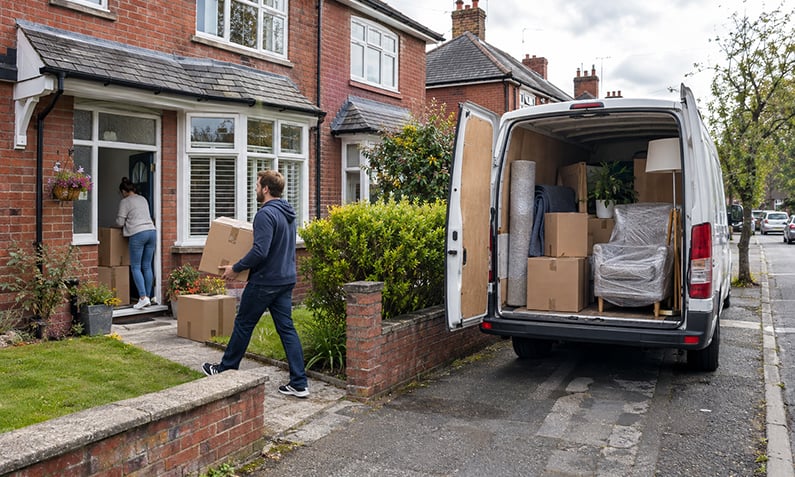
Does home insurance cover removals and your belongings in transit?

Home insurance does not automatically cover your belongings during a house move, and whether removals are covered depends on your specific policy. Some contents policies include cover for possessions in transit on the condition that you use a professional removals company, while self-drive or DIY moves may be excluded or restricted. Always read the policy wording before moving day rather than assuming you are protected.

Where cover does apply, there are often conditions and limits: fragile items may need professional packing, storage periods may be capped, and valuables may be subject to lower single-item limits. If your policy excludes moving-day cover or you are doing a DIY move, a professional removals firm’s own goods-in-transit insurance, or standalone removals cover, fills the gap. Check what your removals company’s liability actually covers, as it is sometimes limited to a low amount per item.

  • Check whether your policy covers goods in transit, and under what conditions.
  • Using a professional removals firm often get access tos transit cover; DIY moves may not.
  • Ask about storage cover if there is a gap between moving out and moving in.
  • Confirm the removals company’s own liability limits in writing.

Do I need insurance for an empty house between exchange and completion?

Buildings insurance between exchange and completion protects the property during the period when you are legally responsible for it but have not yet moved in. Because risk commonly passes to the buyer at exchange, you need buildings cover running from exchange even though the house is empty and you do not have the keys. Standard home insurance usually covers short empty periods during a move, but extended vacancy is treated differently.

If a property will be unoccupied for longer than the period your policy allows, often around 30 to 60 days, you may need specialist home insurance for an empty house. Unoccupied-property cover is generally more expensive than standard occupied-home cover because an empty property carries a higher risk of undetected leaks, break-ins and vandalism. Our unoccupied house insurance guide explains when standard cover stops applying.

This matters for buyers facing a gap between exchange and moving in, or anyone keeping an old property empty while it sells. If you expect a long vacancy, tell your insurer up front, because a claim on an empty property can be refused if you have not declared the occupancy status.

Buying a property that will sit empty?

Check specialist unoccupied-home cover before your standard policy stops applying.

Is it okay not to cancel home insurance when moving?

It is usually not sensible to leave an old home insurance policy running after you move, unless you still own and are responsible for that property. Once you have sold and completed, the buyer becomes responsible for their buildings insurance, so continuing to pay for cover on a home you no longer own is wasted money. The practical step is to transfer the policy to your new address or cancel it and take out appropriate cover.

Before cancelling, check the numbers: after the 14-day cooling-off period, cancelling an annual policy may not give a full pro-rata refund, and cancellation fees can sometimes exceed the refund due. In that situation, transferring the policy to your new home is often better value than cancelling. Compare the cost of adjusting your existing policy against fresh quotes before deciding. If you are also sorting out utilities, our checklist on unexpected moving costs helps you budget for the move as a whole.

Is it okay not to cancel home insurance when moving

Compare moving-house home insurance quotes

FAQs about home insurance moving house

Do I need temporary home insurance between exchange and completion?

You generally need buildings insurance, not a separate temporary policy, from exchange of contracts, because responsibility for the property usually passes to you at exchange. Most standard home insurance policies cover the short period when the property is empty between exchange and moving in. Confirm with your conveyancer exactly when risk passes, and set your buildings cover to start on exchange day.

When should I update my home insurance address?

Tell your insurer as soon as you know your completion date, and before you move. Your policy does not cover the new property until the insurer has your new address and has agreed to continue cover there. Updating late, or after you have moved, risks a gap where your belongings or building are uninsured.

Does my home insurance automatically cover a house move?

No, home insurance does not automatically cover a house move or transfer to a new address on its own. You must notify your insurer, who will either move your policy to the new property or set up a new one. Cover for belongings in transit depends on your policy wording and often requires you to use a professional removals company.

Will my premium change after I move house?

Your premium may change after you move because the new property’s postcode, type, age, rebuild value and crime and flood risk all affect the price. It can go up or down. Moving is a good moment to compare the whole market rather than accepting your insurer’s adjusted figure.

Does buildings insurance cover the deposit if the house burns down before completion?

If the building is damaged after exchange but before completion, you as the buyer are usually liable, which is why buildings insurance from exchange matters. With valid cover in place from exchange, your insurer should respond to the damage. Without it, you could lose your deposit and still be contractually bound to complete, so never leave buildings cover until completion day.

Do I need buildings insurance if I am buying a leasehold flat?

Usually not, because the freeholder commonly insures the building and recovers the cost through your service charge. You will still typically need contents insurance to protect your own belongings inside the flat. Check your lease and service-charge documents to confirm what the building insurance covers before paying for separate buildings cover.

How do I work out the rebuild cost for buildings insurance?

The rebuild cost is what it would cost to completely reconstruct your home, excluding the land, and it is usually lower than the purchase price. Your mortgage valuation or survey often states a rebuild figure, or you can use a rebuild cost calculator. Insuring for less than the full rebuild value can lead the insurer to reduce any claim payout proportionally.

Can my insurer refuse to cover my new property?

Yes, an insurer can decline to cover a new property if it falls outside their underwriting criteria, such as a high flood or subsidence risk area, or a property type they do not insure. If this happens, you will need to find alternative cover, so it is wise to line up quotes before you exchange. Comparing several providers improves your chances of finding cover for a higher-risk property.

What happens to my contents insurance when I move?

Your contents insurance can often be switched to the new property for the day you move in, but this is arranged with your insurer, not automatic. Your belongings are not necessarily covered while in transit unless your policy specifically includes moving cover. Review your contents sum insured when you move, as people often acquire more possessions than their old policy reflects.

Do I lose my no-claims record if I switch home insurer when moving?

Moving house and switching home insurer does not reset your claims history, which insurers assess based on your record rather than policy continuity. Be honest about any previous claims when you get new quotes, as non-disclosure can invalidate a policy. Shopping around at a move often finds a better price than staying with an insurer out of habit.

Is short-term home insurance cheaper than an annual policy when moving?

There is no guarantee that short-term cover is cheaper than an annual policy, and the best value depends on how long you need cover for. Short-term policies can suit a specific gap, such as a property sitting empty before sale, but annual cover is usually more cost-effective if you will own the property for a year or more. Compare both against your actual circumstances before choosing.

Also Read Related Articles


Information correct as of 15 November 2026. Prices, tariffs, policy details and providers change frequently, so please check the latest details before making a decision. This article is for general information only and does not constitute financial advice. Free Price Compare is authorised and regulated by the Financial Conduct Authority (FCA).

4000+ reviews