





Fuse Energy vs EDF Energy: Which Should You Pick?

Written by Shay Ramani
Reviewed by Ankit Sureja
6 min read
Updated: 11 Aug 2026
Fuse Energy vs EDF Energy: Which Should You Pick?

Fuse Energy vs EDF Energy comes down to a trade-off between price and reassurance: Fuse markets some of the lowest import electricity rates on the open market, clustering in the low-20p/kWh range, while EDF is a long-established supplier with a full call-centre operation and a competitive fixed deal at around £1,649 a year on a recent example. For a bill-conscious household on a standard variable tariff sitting above the price cap floor, the choice is rarely clear-cut.

Free Price Compare sources this comparison from Ofgem’s price cap methodology, published supplier tariff data and Fuse and EDF’s own tariff pages. The right answer depends on whether you value the lowest headline unit rate, a smart-meter-first app experience, or the security of a big supplier with phone support and a long track record.

Quick Answer: Fuse Energy vs EDF Energy

  • Fuse Energy’s electricity-only single-rate 12-month fixed tariff is shown at 22.80p/kWh and a 57.36p/day standing charge, with a typical annual cost of £824.96 (Fuse Energy, 2026).
  • EDF’s cheapest openly marketed fix in a July 2026 example was EDF Essentials Plus 12M at around £1,649/year, with no exit fees on dual-fuel direct debit.
  • For solar export, Fuse pays around 13p/kWh flat while EDF’s export tariffs have ranged from 15p/kWh to 24p/kWh, with a 3.0p/kWh fallback rate.
  • Fuse is an app-first, smart-meter-focused supplier with limited phone support; EDF runs a full UK call-centre operation for households wanting to speak to someone.
  • Both suppliers are covered by Ofgem’s Supplier of Last Resort safety net, so your gas and electricity supply continues even if a supplier fails.

Last updated: July 2026

Written by the Free Price Compare editorial team | Reviewed July 2026

Is Fuse Energy cheaper than EDF?

Fuse Energy is cheaper than EDF on many electricity import tariffs, but this is not guaranteed for every household. Fuse’s electricity-only single-rate 12-month fixed tariff is shown at 22.80p/kWh with a 57.36p/day standing charge, giving a typical annual cost of £824.96, while its single-rate variable equivalent sits at 23.20p/kWh (Fuse Energy, 2026). The clearest recent EDF example is its Essentials Plus 12M fix at around £1,649 a year on a July 2026 quote. Because these figures use different tariff structures and consumption assumptions, the sensible step is to run both suppliers through a comparison using your own postcode, meter type and annual usage rather than relying on a headline number.

Regional pricing matters too. Fuse’s January 2026 Fixed (12m) v3 electricity rates ranged from 23.030p/kWh to 25.050p/kWh depending on region, so a household in South West England (around 24.640p/kWh) pays more than one in the East Midlands (around 23.290p/kWh). Always check the rate for your specific area before switching.

Compare current energy deals for your postcode

James Ford Broadband Deals Reviewed by James Ford, TV and Broadband Expert

Extra

  • New customers only
500Mb average* speed
Unlimited Downloads
£0.00 Setup costs
24 Month contract
Pay as you goCalls
£27.99per month

Superior

  • New customers only
900Mb average* speed
Unlimited Downloads
£0.00 Setup costs
24 Month contract
Pay as you goCalls
£29.99per month

Full Fibre 150

  • New customers only
  • Switch to Fibrus and they'll cover up to £400 of your switching fees
  • No mid-contract price rises
159Mb average* speed
Unlimited Downloads
£0.00 Setup costs
18 Month contract
Pay as you goCalls
£34.99per month

How do Fuse and EDF import electricity rates compare?

Fuse’s import electricity rates cluster in the low-20p/kWh range, while EDF’s clearest recent domestic example is quoted as a total annual cost rather than a single unit rate. Fuse’s published electricity-only fixed rate of 22.80p/kWh and variable rate of 23.20p/kWh (Fuse Energy, 2026) place it towards the cheaper end of the open market. EDF’s Essentials Plus 12M fix, at around £1,649 a year on a July 2026 example, shows EDF remaining competitive in the large-supplier fixed market. Unit rates and standing charges are the two numbers that actually drive your bill, so compare both, not just the annual estimate.

Tariff example Rate / cost Standing charge
Fuse electricity-only single-rate fixed (12m) 22.80p/kWh 57.36p/day
Fuse electricity-only single-rate variable 23.20p/kWh 57.36p/day
Fuse January 2026 Fixed (12m) v3 (regional range) 23.030p-25.050p/kWh Varies by region
EDF Essentials Plus 12M around £1,649/year Included in annual figure

Figures are indicative and may change.

Standing charges are the daily fixed cost you pay before using any energy. Fuse’s electricity standing charge of 57.36p/day is worth weighing against your usage: a low-consumption household pays proportionally more in standing charges, which is why some people look at no standing charge versus fixed price energy plans before deciding.

Does Fuse Energy supply gas as well as electricity?

Fuse Energy is best known as an electricity-first, app-based supplier, and much of its published tariff data covers electricity-only single-rate and multi-rate options. EDF supplies both gas and electricity as a dual-fuel supplier and is one of the longest-established household energy brands in the UK. If you have a combi boiler and mains gas, a dual-fuel account under one supplier keeps billing simpler, whereas an electricity-only Fuse tariff would leave your gas with a separate supplier. Before switching, confirm whether the tariff you are viewing is electricity-only or dual-fuel, because that changes both the price you pay and the admin of running your account.

For households with a smart meter, Fuse also markets multi-rate tariffs such as an Economy 7-style setup at 29.45p/kWh peak and 12.28p/kWh off-peak on its variable option (Fuse Energy, 2026). These suit homes that can shift usage overnight, for example charging an EV or running storage heaters.

Does Fuse Energy supply gas as well as electricity

Not sure which tariff type suits you?

Compare gas and electricity deals side by side and check what fits your usage.

Which is better for smart export guarantee rates?

Fuse Energy pays around 13p/kWh flat on its Single Rate Variable export tariff, while EDF’s export rates have moved between 15p/kWh and 24p/kWh depending on the tariff and date. The Smart Export Guarantee (SEG) is the scheme, overseen by Ofgem, that requires larger suppliers to pay households for surplus solar or renewable electricity they send back to the grid. EDF’s export rate launched at 20p/kWh in June 2024, rose to 24p/kWh in April 2025, then was cut to 18p/kWh in March 2026, and EDF also lists a standard fallback of 3.0p/kWh on its Export Variable Value option. If you have solar panels, the export rate can make a meaningful difference to how quickly the system pays for itself, so it is worth comparing alongside the import rate rather than in isolation.

A flat 13p/kWh from Fuse can suit households that export steadily through the day, while EDF’s higher-rate exclusive export tariffs can pay more per unit but may carry eligibility conditions. If you are also weighing up panel choices, our guide on SunPower vs Jinko solar panels covers the hardware side.

Does Fuse have phone support like EDF?

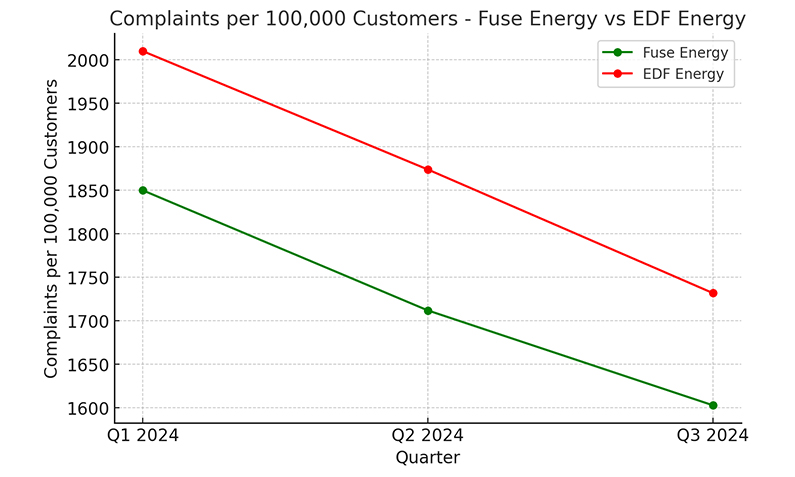
EDF runs a full UK call-centre operation for households, while Fuse Energy is an app-first supplier that handles most contact through its app and online channels rather than a large phone team. For a bill-conscious household, this is a genuine trade-off: Fuse’s lower running costs help fund cheaper tariffs, but if you prefer to phone someone when a problem arises, a big supplier with established phone support carries obvious appeal. Both suppliers must meet the same regulatory standards on complaints handling and, if a complaint goes unresolved after eight weeks, you can escalate to the Energy Ombudsman free of charge.

If service quality matters as much as price, it is worth reading how a supplier handles billing, direct debits and complaints before you commit. Our guide on what matters beyond just price on energy tariffs sets out the checks to run.

See how Fuse compares against other suppliers

What are Fuse Energy reviews and reliability like?

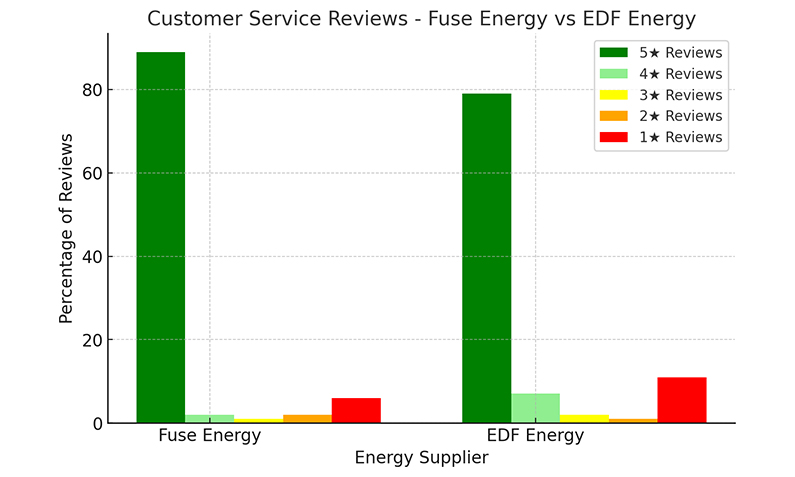
Fuse Energy reviews from UK households tend to praise the app and the low unit rates, while raising the app-first support model and variable direct debit timing as points to check. Fuse operates on a smart-meter-first basis, and its variable direct debit adjusts month to month based on actual usage rather than a fixed estimate, which can feel less predictable than a level monthly payment. On reliability, both Fuse and EDF are licensed suppliers regulated by Ofgem, and every domestic customer is protected by the Supplier of Last Resort process, which moves your account to another licensed supplier and protects any credit balance if your supplier fails. That safety net is the same whether you are with a large legacy brand or a newer entrant.

For a wider view of how newer app-based suppliers stack up against established names, compare our Fuse Energy vs British Gas comparison and our British Gas vs EDF Energy guide.

How do I switch from EDF to Fuse?

Switching from EDF to Fuse takes a comparison of your current rates against Fuse’s tariff, followed by an online sign-up, with the new supplier managing the transfer. Ofgem’s switching rules mean most domestic switches complete within about five working days, and you keep a 14-day cooling-off period after signing up. Before you switch, take a meter reading, check whether your EDF tariff carries exit fees, and confirm your Fuse tariff is fixed or variable so you know how your rate can change. If your EDF deal is a fixed tariff still within its term, exit fees can apply, so weigh any saving against the cost of leaving early.

  • Compare your EDF unit rate and standing charge against the Fuse tariff for your postcode.
  • Check your current tariff for exit fees before committing to leave.
  • Take a meter reading on your switch date to keep the final EDF bill accurate.
  • Keep any direct debit active until your final EDF bill is settled.

For the mechanics of leaving a fixed deal and avoiding surprise charges, our exit fees and switching guide explains how exit fees work across suppliers.

Start comparing energy tariffs now

How does the energy price cap affect this comparison?

The energy price cap, set by Ofgem, limits the maximum unit rates and standing charges a supplier can charge on a standard variable tariff, not the total bill, so your actual cost still depends on how much gas and electricity you use. For a household currently on a standard variable tariff above the price cap floor, a competitively priced fixed deal from either Fuse or EDF can lock in a rate below the variable position for the length of the term. Fixed tariffs are not directly capped, so a supplier can price a fix below the cap when wholesale costs allow, which is how Fuse markets rates undercutting typical variable pricing. Because the cap changes on a set schedule, always check the current cap figure from Ofgem before assuming a fix beats the variable option.

To understand how fixed pricing relates to the cap, see our guide on how fixed tariff pricing is affected by the energy price cap, and for broader savings tactics read our tips on smart ways to cut energy costs in the UK.

How does the energy price cap affect this comparison

FAQs about fuse energy vs edf energy

Is Fuse Energy safe or will it go bust?

Fuse Energy is a licensed domestic supplier regulated by Ofgem, and all its household customers are protected by the Supplier of Last Resort process. If any licensed supplier fails, Ofgem appoints a replacement, your gas and electricity supply continues uninterrupted, and any credit balance is protected. This safety net applies whether you are with a newer supplier or a large legacy brand.

What are Fuse Energy's customer reviews like?

Fuse Energy reviews tend to praise the app and low unit rates, while flagging the app-first support model and variable direct debit timing as points to check. Its direct debit adjusts month to month with actual usage rather than staying level, which some households find less predictable. Service standards are regulated by Ofgem in the same way as larger suppliers.

Which is better for solar export, Fuse or EDF?

Fuse pays around 13p/kWh flat on its Single Rate Variable export tariff, while EDF's export rates have ranged from 15p/kWh to 24p/kWh, with a 3.0p/kWh fallback. A flat rate can suit households exporting steadily through the day, while EDF's higher-rate exclusive options may pay more per unit but carry eligibility conditions. Compare the export rate alongside the import rate before choosing.

Can EDF disconnect my electricity if I don't pay a bill?

Suppliers can only disconnect a domestic customer for unpaid bills as a last resort and must follow strict Ofgem rules first, including offering payment plans and support. Vulnerable households have extra protection, and disconnection over debt is now very rare, with suppliers steered towards prepayment or repayment arrangements instead. Contact your supplier early if you are struggling to pay.

Does Fuse Energy offer fixed tariffs?

Yes, Fuse Energy offers fixed tariffs, including an electricity-only single-rate 12-month fixed option shown at 22.80p/kWh with a 57.36p/day standing charge. A fixed tariff locks your unit rate and standing charge for the term, protecting you from mid-term rate rises, though you may pay an exit fee if you leave early. Check whether the tariff you view is fixed or variable before signing up.

Will flipping the main fuse off make my electricity bill zero?

No, switching off your main fuse will not make your bill zero, because you still pay a daily standing charge whether or not you use any electricity. On a Fuse electricity-only tariff the standing charge is 57.36p/day, which continues to accrue regardless of usage. Standing charges cover the fixed cost of keeping you connected to the network.

How does the energy price cap affect a fixed tariff?

The energy price cap, set by Ofgem, limits maximum unit rates and standing charges on standard variable tariffs, not on fixed tariffs. A supplier can price a fixed deal below the cap when wholesale costs allow, which is how competitive fixes can undercut the variable position. Always check the current cap figure from Ofgem before assuming a fix beats staying on a variable tariff.

Is it worth switching from a standard variable tariff to a fix?

Switching from a standard variable tariff to a competitively priced fix can lock in a lower rate and protect you from future increases, which suits households that value predictable bills. The trade-off is that a fix may carry exit fees and you could miss out if wholesale prices fall sharply. Compare the fixed rate against the current price cap and your typical usage before deciding.

Also Read Related Articles


Information correct as of 31 July 2026. Prices, tariffs, policy details and providers change frequently, so please check the latest details before making a decision. This article is for general information only and does not constitute financial advice. Free Price Compare is authorised and regulated by the Financial Conduct Authority (FCA).

4000+ reviews