





Vodafone vs BT Broadband Compared for 2026

Written by Shay Ramani
Reviewed by Pratik Aghera
5 min read
Updated: 5 Aug 2026
Vodafone vs BT Broadband Compared for 2026

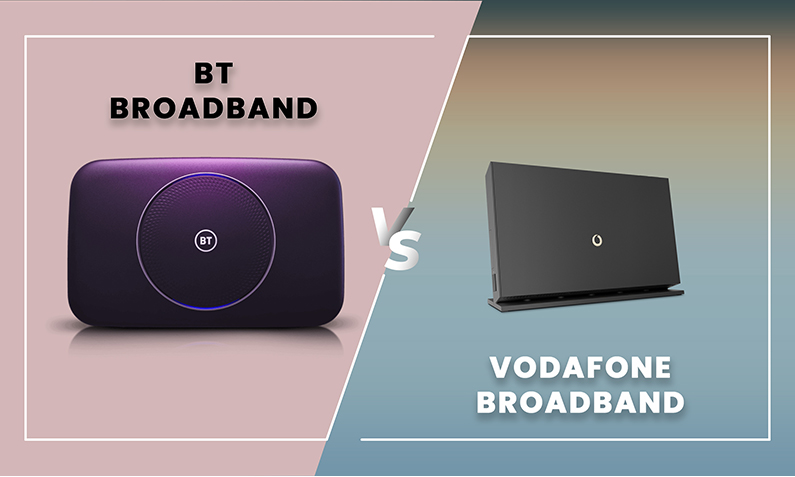
Vodafone vs BT broadband comes down to a simple trade-off for most UK households: Vodafone usually costs less month-to-month at comparable speeds, while BT charges a premium that buys a bigger brand and a fuller support setup. On many plans both providers run over exactly the same Openreach network, so the underlying connection into your home is often identical, and the real difference is price, contract terms and extras.

The one place this changes is the very top and bottom of the range. Vodafone can reach faster peak speeds than BT in some areas through CityFibre, while BT occasionally undercuts Vodafone at entry-level fibre. Free Price Compare checks live deals across whole-of-market broadband providers by postcode, and this guide sets out where each provider wins so you can pick the right one for your address, usage and budget.

Quick Answer: Vodafone vs BT Broadband Compared for 2026

  • On the same Openreach network, Vodafone is typically around £5 to £10 a month cheaper than BT at most speed tiers (Free Price Compare research, July 2026).
  • BT can be cheaper at entry-level 150 Mbps full fibre in some comparisons, so check the specific tier before assuming Vodafone always wins.
  • Vodafone reaches faster peak speeds in select CityFibre areas, while BT tops out at around 900 Mbps.
  • Full fibre is available to 82% of UK homes (24.9 million premises), per Ofcom’s Connected Nations update (Spring 2026, data as of January 2026), so check both providers by postcode.
  • Mid-contract price rises apply to both: annual increases are stated up front in the contract, so factor them into the total cost, not just the headline monthly price.

Last updated: July 2026

Written by the Free Price Compare editorial team | Reviewed July 2026

Which is cheaper, Vodafone or BT broadband?

Vodafone is generally cheaper than BT at comparable full-fibre and legacy fibre tiers, with the clearest saving around 500 Mbps and 900 Mbps packages. On many Openreach plans Vodafone sits roughly £5 to £10 a month below BT for the equivalent speed (Free Price Compare research, July 2026). The exception is entry-level fibre: at 150 Mbps BT can come out cheaper in some comparisons, so the ranking is not absolute across every tier. Because both providers resell the same Openreach lines on most plans, a lower Vodafone price does not usually mean a slower or worse connection at the same advertised speed. The sensible move is to compare the exact speed tier you want at your own postcode rather than assuming one provider always wins.

Independent full-fibre providers offered 900Mbit to 1Gbit deals from around £26 a month, versus about £39 a month for the cheapest comparable deal from a larger provider, according to Ofcom’s Pricing Trends for Communications Services in the UK report (pricing data October 2024). That gap illustrates why Vodafone’s CityFibre-based near-gigabit plans can undercut a BT Openreach equivalent so heavily.

Speed tier Vodafone (indicative) BT (indicative)
67 Mbps (Superfast/Fibre 2) around £27/month around £32/month
150 Mbps full fibre around £23-£25/month around £28-£30/month
500 Mbps full fibre around £26-£28/month around £40/month
900/910 Mbps full fibre around £29-£48/month around £45-£55/month

Figures are indicative and may change.

Check Vodafone and BT deals at your postcode

Bt Broadband Deals

Fibre 2 & phone

  • New customers only
  • Smart Hub 3 Wi-Fi 6 router and Cyber Threat Protect, powered by Norton, included as standard
67Mb average* speed
Unlimited Downloads
£30.00 Setup costs
24 Month contract
Pay as you goCalls
£29.99per month

Sport TV + Fibre 2 Only

  • New customers only
  • Smart Hub 3 Wi-Fi 6 router and Cyber Threat Protect, powered by Norton, included as standard
67Mb average* speed
TV channels
£30.00 Setup costs
24 Month contract
Pay as you goCalls
£44.99per month

Fibre 2 Only

  • New customers only
  • Smart Hub 3 Wi-Fi 6 router and Cyber Threat Protect, powered by Norton, included as standard
67Mb average* speed
Unlimited Downloads
£30.00 Setup costs
24 Month contract
Pay as you goCalls
£24.99per month

Vodafone Broadband Deals

Fibre 2 + Super WiFi

  • New customers only
  • Switch to Vodafone, and get up to £200 switcher credit
  • 4G Broadband Backup
  • Super WiFi Boosters
67Mb average* speed
Unlimited Downloads
£0.00 Setup costs
24 Month contract
Pay as you goCalls
£31.00per month

Pro 2 Fibre 2

  • New customers only
  • Switch to Vodafone, and get up to £200 switcher credit
  • Includes Ultra Hub router
67Mb average* speed
Unlimited Downloads
£0.00 Setup costs
24 Month contract
Pay as you goCalls
£37.00per month

Fibre 2

  • New customers only
  • Switch to Vodafone, and get up to £200 switcher credit
67Mb average* speed
Unlimited Downloads
£0.00 Setup costs
24 Month contract
Pay as you goCalls
£24.00per month

Do Vodafone and BT use the same broadband network?

Vodafone and BT both use the Openreach network for most of their home broadband plans, which means the physical line into your property is often identical on comparable full-fibre products. Openreach owns and maintains the copper and fibre infrastructure that both providers rent access to, so at the same advertised speed the raw connection performs similarly regardless of which name is on the bill. The key difference is that Vodafone also sells plans over the CityFibre network in areas where it has built full fibre, which can bring lower prices and higher peak speeds, while BT sells over Openreach only. Openreach reaching your street does not guarantee CityFibre does, so availability differs address by address. This is why the same household can see a much cheaper Vodafone quote on CityFibre than on Openreach, while a neighbour a few streets away sees no CityFibre option at all.

Full fibre is available to 82% of UK homes, 24.9 million premises, and gigabit-capable broadband reaches 89% of residential premises, per Ofcom’s Connected Nations update (Spring 2026, data as of January 2026). Coverage that high means most households can now get full fibre from at least one of these providers, but the exact networks available still vary by postcode.

Vodafone vs BT full fibre: which is faster?

Vodafone can reach faster peak speeds than BT in selected areas, with near-2 Gbps plans available on CityFibre, while BT’s full-fibre range tops out at around 900 Mbps. For everyday use the difference between a fast BT plan and a fast Vodafone plan at the same advertised speed is minimal, because both deliver the Openreach line speed you pay for. Where Vodafone pulls ahead is at the very top of the range in CityFibre-enabled areas, where multi-gigabit tiers are simply not on BT’s menu. For most households, though, 500 Mbps or 900 Mbps is more than enough, and the choice between the two at those speeds is about price and contract rather than raw performance. If you stream in 4K on several devices, work from home with large uploads, or have a busy household of gamers, a symmetric or near-gigabit full-fibre plan from either provider will handle it comfortably.

Advertised speeds are governed by the Broadband Speed Code of Practice, which requires providers to give you a realistic speed estimate before you sign up and lets you exit penalty-free if speeds fall well below the minimum guaranteed level. Ask for that estimate from both Vodafone and BT for your address before committing. For a wider view of how the two stack up against cable alternatives, our BT vs Virgin broadband comparison and Vodafone vs Virgin Media comparison are useful next reads.

See if full fibre reaches your home

Compare Vodafone, BT and other full-fibre deals side by side by postcode.

Is Vodafone broadband as good as BT for reliability and service?

Vodafone broadband is broadly comparable to BT for reliability on the same Openreach line, because the underlying connection performs the same way regardless of which provider bills you. Reliability differences tend to show up in the router, the customer support experience and how each provider handles faults rather than in the raw connection. BT bundles a fuller support setup and a large engineer network, which some households value for the reassurance of a well-known brand, while Vodafone competes hard on price and increasingly on its own router hardware and 4G or 5G backup options on higher tiers. Ofcom publishes quarterly customer service and complaints data covering the major broadband providers, so if support quality is your deciding factor, check the latest Ofcom complaints tables for both before you choose. Both providers occasionally have network incidents, and a single outage should not be read as a permanent verdict on either.

Whichever you pick, your rights are the same under the Consumer Rights Act 2015 and Ofcom’s rules: if a fault persists or the service is not as described, you can escalate and, if unresolved, take the complaint to an independent ombudsman.

Is Vodafone broadband as good as BT for reliability and service

Does Vodafone or BT offer TV and extras with broadband?

BT offers a more developed TV and entertainment package alongside its broadband, including set-top box options and sport add-ons, whereas Vodafone focuses primarily on broadband and mobile rather than a full TV service. If you want live sport, a large channel line-up or a single bill covering broadband and TV, BT has the broader offering. Vodafone’s extras lean towards its higher-tier broadband features, such as an upgraded router and mobile signal boost or connectivity backup on its Pro plans, plus discounts if you also hold a Vodafone mobile contract. For households that already stream through smart TVs and apps, a TV bundle adds cost that a broadband-only plan avoids, which is part of why Vodafone’s headline broadband prices can look cheaper. Decide first whether you actually need a TV package: if you do, weigh BT’s bundle value; if you do not, a cheaper standalone broadband plan is usually better value.

Compare broadband-only and bundle deals

Which broadband provider to choose for your situation?

The right provider depends on your address, the speed you need and whether extras matter to you, and for most price-focused households on the same Openreach network Vodafone is the cheaper of the two. Choose Vodafone if the lowest monthly price is your priority, if CityFibre is available at your postcode and get access tos faster or cheaper plans, or if you already have Vodafone mobile and want a bundle discount. Choose BT if you want a TV and sport package on one bill, if you place a high value on a large well-known support operation, or if BT happens to be cheaper at the specific entry-level tier you want. Contract length matters too: both typically run 24-month deals, and switching is easier than it used to be.

Over 2 million customers used One Touch Switch to change broadband and/or landline provider between its September 2024 launch and the end of 2025, according to Ofcom, so moving between providers when your contract ends now generally involves contacting only your new provider, who arranges the switch for you. If your BT contract is ending soon, run a fresh comparison rather than defaulting to a renewal, because out-of-contract prices are often higher than new-customer deals. You can weigh other routes too in our Plusnet vs BT comparison, TalkTalk vs BT comparison and Vodafone vs Sky comparison.

How do mid-contract price rises work on both providers?

Both Vodafone and BT apply annual mid-contract price rises, and under Ofcom’s rules any increase must now be set out in pounds and pence in the contract before you sign, rather than linked to an unpredictable inflation index. This means you can see the exact yearly rise built into a deal and add it to the headline price when comparing. A plan that looks a few pounds cheaper today can end up costing more over 24 months once each provider’s stated annual increase is applied, so compare the total cost of the contract, not just month one. When you check deals, look for the fixed annual increase figure quoted per plan and factor two rises into a 24-month term. This is one of the clearest ways to avoid a nasty surprise a year into a contract, and it applies whichever provider you choose.

Compare deals by total contract cost

FAQs about vodafone vs bt broadband

Which is cheaper overall, Vodafone or BT broadband?

Vodafone is usually cheaper than BT at comparable speeds, particularly at 500 Mbps and 900 Mbps where the saving can be several pounds a month on the same Openreach network. The exception is some entry-level fibre plans, where BT can occasionally undercut Vodafone. Always compare the exact tier you want at your own postcode.

Is Vodafone broadband any good?

Vodafone broadband performs comparably to other Openreach providers because it delivers the same line speed you pay for. It competes strongly on price and offers upgraded routers and connectivity backup on higher tiers. As with any provider, check the latest Ofcom complaints data if customer service quality is important to you.

Which provider offers faster broadband speeds?

Vodafone can reach faster peak speeds than BT in selected areas, with near-2 Gbps plans available over CityFibre, while BT tops out at around 900 Mbps. For most households, though, both providers deliver identical real-world speed at the same advertised Openreach tier, so speed rarely separates them below gigabit.

My BT contract is ending soon, should I switch to Vodafone?

It is worth comparing rather than auto-renewing, because out-of-contract prices are often higher than new-customer deals and Vodafone is frequently cheaper at the same speed. Switching between broadband providers now usually means contacting only your new provider, who arranges the move. Check both providers, and other options, by postcode before deciding.

Does Vodafone or BT offer a TV bundle with broadband?

BT offers a more developed TV and sport package alongside its broadband on a single bill, while Vodafone focuses mainly on broadband and mobile. If you want live sport or a large channel line-up, BT has the broader offering. If you already stream through apps, a broadband-only Vodafone plan usually costs less.

Which has better customer service, Vodafone or BT?

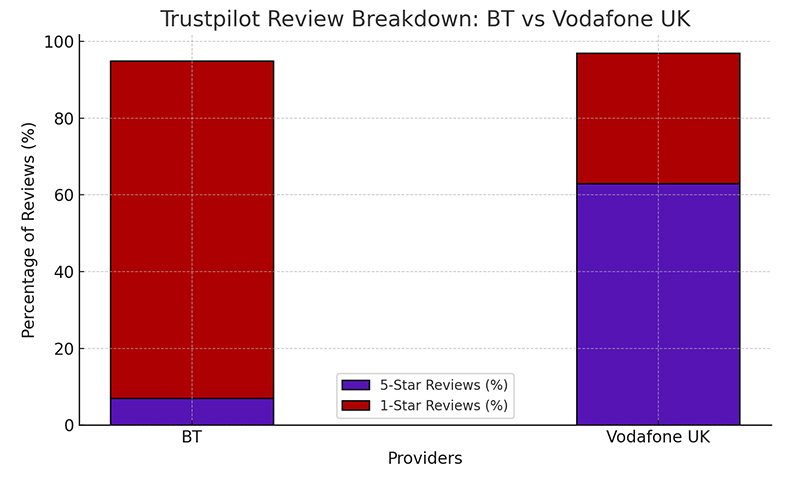
Both are large providers with mixed reputations, so the best guide is Ofcom's quarterly complaints and customer service data, which tracks the major broadband providers. BT bundles a large support operation, while Vodafone competes on price and hardware. Check the most recent Ofcom tables for both before choosing if support is your deciding factor.

Is Vodafone broadband available at my address if BT is?

Not always, because availability depends on which networks reach your specific postcode. Both providers commonly cover the same Openreach areas, but Vodafone's cheaper or faster CityFibre plans are only available where CityFibre has built full fibre. Run a postcode check for both providers, as coverage can differ street by street.

How much do mid-contract price rises add to the cost?

Both Vodafone and BT apply an annual increase that, under Ofcom's rules, must be shown in pounds and pence in the contract before you sign. Over a 24-month deal you typically face two rises, so add them to the headline price when comparing. A plan that looks cheaper today can cost more overall once increases are applied.

Can I keep my phone number if I switch between Vodafone and BT?

Yes, if you have a landline number you want to keep, you can usually port it when switching broadband providers. Tell your new provider during sign-up that you want to keep your existing number so they can arrange the transfer. The One Touch Switch process handles most of this for you automatically.

Do I need to pay an exit fee to leave BT for Vodafone?

If you are still within your BT minimum contract term, an early exit fee usually applies, based on the remaining months. If your contract has ended, you can switch without an early termination charge. Check your remaining term before switching, and time the move for when your contract ends to avoid fees.

Is full fibre worth it over standard fibre from either provider?

Full fibre (FTTP) runs fibre directly to your home and delivers more stable, higher speeds than older part-fibre connections that use copper for the final stretch. If you work from home, stream in 4K or have several heavy users, full fibre from either Vodafone or BT is worth it. For light single-user use, a lower-speed plan may be enough.

Also Read Related Articles


Information correct as of 29 July 2026. Prices, tariffs, policy details and providers change frequently, so please check the latest details before making a decision. This article is for general information only and does not constitute financial advice. Free Price Compare is authorised and regulated by the Financial Conduct Authority (FCA).

4000+ reviews