

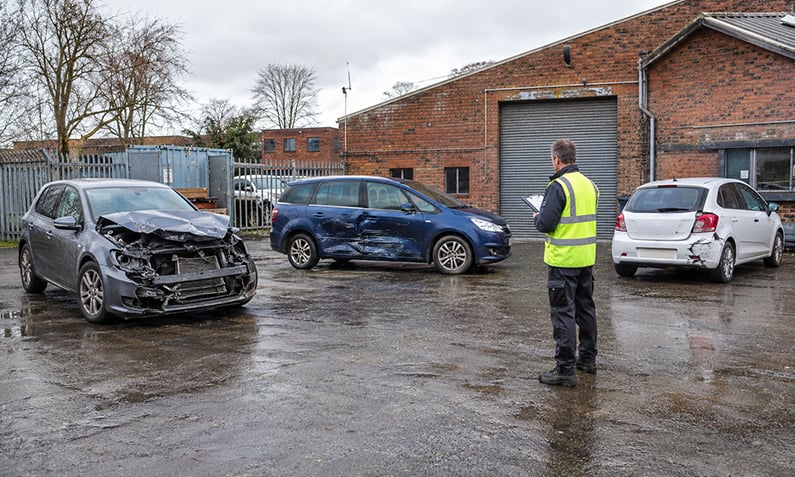



Car Insurance Write-Off Categories Explained

Written by Shay Ramani
Reviewed by Andrea Troy
5 min read
Updated: 19 Nov 2026
Car Insurance Write-Off Categories Explained

Car insurance write-off categories are the four UK salvage grades, A, B, S and N, that an insurer assigns when it declares a car a total loss. Categories A and B cannot legally return to the road as complete vehicles, while Categories S and N can be used again once repaired to a roadworthy condition, according to GOV.UK guidance updated on 2 October 2026.

A write-off is a financial decision, not always a verdict that a car is beyond repair. An insurer records a total loss when the cost of repairs plus associated costs is uneconomic compared with the vehicle’s value, which is why a car with a repairable dent can still end up written off. The category reflects the type of damage, not simply how large it looks.

If you are weighing up a repaired Cat S or Cat N car, or your own vehicle has just been assessed, the category changes resale value, what checks you need and how straightforward cover will be. Free Price Compare sources this guidance from GOV.UK, the ABI and FCA-regulated insurers, and compares cover across a panel of 130+ insurers so you can see who will quote on a categorised car.

Quick Answer: Car Insurance Write-Off Categories Explained

  • Cat A: scrap only, the whole vehicle must be crushed.
  • Cat B: body shell crushed, but salvageable parts may be reused.
  • Cat S: structural damage, repairable and can return to the road.
  • Cat N: non-structural damage, repairable and roadworthy after repair.
  • The write-off marker stays on the car’s history permanently.

Last updated: October 2026

Written by the Free Price Compare editorial team | Reviewed October 2026

What do Cat A, B, S and N actually mean?

Cat A, B, S and N are the four current UK insurance write-off categories, each describing how badly a car is damaged and whether it can return to the road. Categories A and B are scrap-only, while S and N are repairable, as confirmed by GOV.UK guidance updated on 2 October 2026. The grades are assigned under the salvage framework overseen by the Association of British Insurers (ABI), the Code of Practice for the Categorisation of Motorised Vehicle Salvage.

Category What it means Back on the road?
Cat A So badly damaged the whole vehicle must be crushed. No parts may be salvaged. No
Cat B Body shell must be crushed, but undamaged parts can be removed and reused. No, not as a complete car
Cat S Structural damage to the frame or chassis. Repairable. Yes, once repaired to a roadworthy standard
Cat N Non-structural damage. The frame and chassis are not affected. Repairable. Yes, once repaired to a roadworthy standard

Figures and definitions are indicative and may change.

Category A is the most severe. Even salvageable-looking parts from a Cat A vehicle must go for scrap, which is why these cars should never be advertised as road cars. Category B allows a specialist to strip reusable components, but the shell itself cannot return to service.

What’s the difference between Cat S and Cat N?

Cat S means structural damage and Cat N means non-structural damage. A Cat S car has damage to the frame, chassis or other load-bearing parts, while a Cat N car has damage that leaves the structure intact. Both are repairable and both can legally go back on the road once a competent repair has been carried out and the vehicle is roadworthy.

Cat N is not the same as “cosmetic only”. A non-structural write-off can still have substantial damage to airbags, electrical systems, suspension, steering or safety-critical panels. The category only tells you the frame was unharmed, not that the repair bill was small. Ageas notes that for electric vehicles, high-voltage system damage must be non-structural for a car to qualify as Cat N, and battery damage can count as structural where the battery forms part of the floor.

Compare car insurance across 130+ insurers

Why is a car written off instead of repaired?

A car is written off when an insurer judges that repairing it is uneconomic or unsafe, not necessarily because the damage is impossible to fix. The decision compares the likely repair cost, plus associated costs such as hire and salvage handling, against the pre-accident market value of the vehicle. If the sums do not add up, the insurer declares a total loss and pays out instead.

Repair costs have stayed high, which pushes more borderline cars into the write-off bracket. The ABI reported on 30 April 2026 that the average UK motor premium was £560 in Q1 2026, broadly stable on the previous quarter, while flagging that the cost of repairs remained a significant pressure on insurers. Older or lower-value cars reach the point of being uneconomic to repair more quickly, because a modest repair bill can still exceed their value.

There is no single published percentage of value at which every insurer writes a car off. Each total loss is assessed on its own facts by the insurer’s engineer, taking in the car’s condition, the parts and labour needed and current used values. If you disagree with the valuation your insurer offers, you can challenge it with evidence of comparable cars for sale.

What were the old Cat C and Cat D categories?

Cat C and Cat D were the previous repairable write-off categories, replaced by Cat S and Cat N in October 2017. Cat C covered cars where repair costs exceeded the vehicle’s value, and Cat D covered cars that were economically repairable but still written off. The newer system shifted the focus from cost to the type of damage, so buyers get clearer information about whether a car had structural harm.

You may still see older Cat C and Cat D markers on the history of cars written off before the change. A car categorised under the old system keeps that classification on its record; it is not re-graded into S or N retrospectively.

Why is a car written off instead of repaired

Buying a repaired write-off?

Get a quote before you commit so you know cover is available and affordable.

Does the write-off status stay on the car permanently?

Yes, an insurance write-off marker stays on a car’s history permanently and cannot be removed after repair. Once a vehicle has been categorised as A, B, S or N, that record follows the number plate for the rest of the car’s life and should be disclosed whenever it is sold. A history check from a provider such as HPI will reveal the category even years after a quality repair.

This permanence is why a repaired Cat S or Cat N car sells for less than an equivalent car with a clean history. The exact discount varies by model, age and how well the repair was done, and no single official figure applies across the market. Full disclosure protects you as a seller too, because a buyer who later discovers an undeclared write-off can pursue you.

For repairable categories, the law requires the car to be properly repaired and roadworthy before it returns to use, and the DVLA must be told when a Cat S vehicle is repaired so a new V5C registration certificate can be issued. A valid MOT and correct insurance remain legal requirements under the Road Traffic Act 1988 before you drive.

Can you insure a Cat S or Cat N car?

Yes, you can insure a repaired Cat S or Cat N car, including on comprehensive cover, though the choice of insurers is narrower than for a car with no write-off history. Many mainstream insurers will quote on repairable write-offs, while some decline them, so it pays to compare rather than assume you cannot get cover. You must always declare the category when you apply, as non-disclosure can void a policy.

Around 88 to 89% of car insurance quotes through Free Price Compare are for comprehensive cover (Free Price Compare data, January to June 2026), and that level of cover is often available on categorised cars from the insurers that accept them. Comparing across a panel of 130+ insurers is the fastest way to find which providers will quote, because acceptance of write-offs differs widely between companies.

When you ask for a quote, be ready to confirm the category and any repair details, as this is one of the questions insurers ask. An insurer may want evidence that structural repairs were carried out properly before setting a price.

See which insurers quote on Cat S and Cat N cars

What happens to your payout and your car after a write-off?

After a write-off, your insurer pays you the car’s market value and normally keeps the vehicle for salvage, though you can often ask to keep it for a reduced payout. The sum you receive is based on the car’s pre-accident value, not what you originally paid, which is a common source of dispute. If you have outstanding finance, the payout goes towards clearing the balance first.

If the settlement does not cover your finance balance, you could owe the difference unless you have GAP insurance. This matters because around 78 to 80% of cars quoted through Free Price Compare were bought by the current owner rather than supplied new (Free Price Compare data, January to June 2026), and many are still on finance agreements. Our guide to a car written off on finance explains the steps in more detail.

When you make a total-loss claim, your compulsory excess is deducted from the payout, and if someone else was fully at fault you should eventually recover it. Our explainer on whether you pay excess when you are not at fault covers how that works in practice. It is also worth understanding how your car insurance excess is split between compulsory and voluntary amounts before you set it.

Can you keep your car if it’s written off?

You can usually keep a written-off car if it falls into a repairable category, but not if it is Cat A or Cat B. For a Cat S or Cat N vehicle, you tell your insurer you want to retain the salvage, and they deduct the salvage value from your payout so you receive less cash but keep the car. A Cat A car must be crushed and a Cat B shell destroyed, so retention is not an option for those grades.

If you keep a Cat S or Cat N car, you are responsible for ensuring it is repaired to a roadworthy standard and legally insured and MOT’d before driving. For a Cat S retention you must apply to the DVLA for a new V5C once repairs are complete.

Get a quick car insurance quote

How are write-off categories assigned?

Write-off categories are assigned by the insurer’s engineer or assessor after they inspect the damage and decide the vehicle is a total loss. The engineer judges whether structural, load-bearing parts are affected, which separates Cat S from Cat N, and whether the car is too badly damaged or contaminated to return to the road at all, which gives Cat A or Cat B. The decision follows the ABI salvage code, not a government inspection.

A category is only applied when a claim results in a total-loss decision. If you repair accident damage yourself without involving an insurer, no category is recorded, because there is no insurer assessment and no total-loss claim. The marker is tied to the insurance process, not simply to the fact that a car was damaged.

What happens to your payout and your car after a write-off

FAQs about car insurance write-off categories

Is a Cat N car safe to drive?

A Cat N car can be perfectly safe once it has been properly repaired and is roadworthy, but the category alone does not guarantee that. Cat N means the damage was non-structural, yet the car could still have needed airbag, electrical or suspension repairs. Always have a repaired write-off inspected by an independent mechanic and confirm it holds a valid MOT before you buy or drive it.

How much cheaper is a Cat S or Cat N car to buy?

Repaired Cat S and Cat N cars sell for less than equivalent cars with a clean history, but there is no fixed discount that applies across the market. The reduction depends on the model, its age, the extent of the original damage and how well the repair was done. Use a history check to confirm the category and get the car professionally inspected before agreeing a price.

Does a write-off affect my no-claims bonus?

A total-loss claim is treated like any other at-fault or fault claim and will usually reduce your no-claims bonus unless you have protected it. If the accident was entirely someone else’s fault and your insurer recovers its costs from the other party, your bonus should be reinstated. Check your policy wording, because protection terms and the number of claims allowed before your discount drops vary between insurers.

Can a Cat A or Cat B car ever be put back on the road?

No, a Cat A or Cat B car cannot legally return to the road as a complete vehicle. A Cat A car must be crushed entirely with no parts salvaged, and a Cat B shell must be destroyed, although usable parts can be removed and sold. Anyone advertising a Cat A or Cat B car as a roadworthy vehicle is misrepresenting it.

Do I have to tell my insurer my car is a repaired write-off?

Yes, you must declare a repaired Cat S or Cat N category whenever you apply for or renew insurance. The write-off marker is a material fact, and failing to disclose it can allow an insurer to void your policy or refuse a claim. Being upfront lets the insurer price the risk correctly and ensures your cover is valid if you need it.

What happens to my finance if my car is written off?

If your car is written off while on finance, the insurer’s payout goes towards clearing the outstanding balance first. If the payout is less than the amount you owe, you could be left to pay the shortfall unless you have GAP insurance to cover the gap. Contact your finance provider and insurer promptly so they can coordinate the settlement.

Can I challenge my insurer’s write-off valuation?

Yes, you can challenge a total-loss valuation if you believe it is too low. Gather evidence of comparable cars for sale with similar age, mileage and specification, and present it to your insurer with a clear explanation. If you cannot reach agreement, you can escalate the complaint and ultimately refer it to the Financial Ombudsman Service.

Will my car get a category if I repair accident damage myself?

No, a write-off category is only recorded when an insurer assesses the car and declares it a total loss. If you pay for repairs yourself without making a claim, there is no insurer assessment, so no Cat S or Cat N marker is applied. The classification is tied to the insurance claim process rather than to the damage itself.

Does a Cat S car need re-registering with the DVLA?

Yes, when a Cat S car has been repaired you must apply to the DVLA for a new V5C registration certificate before it returns to the road. This confirms the repaired structural write-off is back in use. A Cat N car does not require the same structural re-registration process, but you should still keep records of the repairs carried out.

How long does a write-off stay on a car’s history?

A write-off marker stays on a car’s history permanently and cannot be removed, even after a high-quality repair. Any buyer running a vehicle history check will see the category years later. This is why repaired write-offs sell for less and why full disclosure is essential when you come to sell.

Can I get comprehensive cover on a repaired write-off?

Yes, comprehensive cover is often available on a repaired Cat S or Cat N car, though not every insurer will offer it. Some providers decline repairable write-offs altogether, so the range of quotes is narrower than for a car with a clean history. Comparing across many insurers is the most reliable way to find comprehensive cover at a competitive price.

How many claims can I make in a year before it affects my cover?

There is no fixed legal limit on the number of car insurance claims you can make in a year, but most insurers set their own thresholds. Multiple claims in a short period can increase your renewal premium or, in some cases, lead an insurer to decline to renew. Each claim is also likely to reduce your no-claims bonus unless it is protected.

Also Read Related Articles


Information correct as of 15 October 2026. Prices, tariffs, policy details and providers change frequently, so please check the latest details before making a decision. This article is for general information only and does not constitute financial advice. Free Price Compare is authorised and regulated by the Financial Conduct Authority (FCA).

4000+ reviews