





Eon Next Vs Scottish Power

Written by Shay Ramani
Reviewed by Prajesh Manvar
8 min read
Updated: 25 Sep 2026
Eon Next Vs Scottish Power

E.ON Next vs Scottish Power often comes down to price for bill-conscious households, with recent examples suggesting E.ON Next can be cheaper on both fixed and variable tariffs. In recent comparison examples, E.ON Next’s cheapest fixed deal has been estimated at a slightly lower annual cost than Scottish Power’s cheapest fix for a typical dual-fuel home on direct debit.

Price is not the whole picture. Exit fees, contract length, service records and features such as solar export payments differ between the two, and the cheapest headline figure only holds if your usage and region match the assumptions behind it. Free Price Compare uses live tariff data so you can check what each supplier actually charges for your postcode before you commit.

If you are stuck on a standard variable tariff above the price cap, moving to a competitive fix from either supplier may cut your annual cost. This comparison sets out where E.ON Next leads, where Scottish Power can still be the right call, and how to switch without paying more than you need to.

Quick Answer: Eon Next Vs Scottish Power

  • E.ON Next’s Next Fixed 24m tariff carries a £200 total exit fee, while Scottish Power’s cheapest fixed example had no exit fee (August 2026 comparison examples).
  • Ofgem’s price cap was £1,758 a year for a typical dual-fuel household for 1 January to 31 March 2026; always check the current cap before switching as it changes quarterly.
  • The price cap limits unit rates and standing charges for a typical user, not your total bill, so actual costs rise or fall with how much gas and electricity you use.
  • Switching supplier is protected by Ofgem’s rules and completes within about five working days once you agree; you keep any credit balance from your old account.
  • Scottish Power generates its own wind power, while E.ON Next backs its electricity with renewable certificates (REGOs), so their green claims are structured differently.

Last updated: August 2026

Written by the Free Price Compare editorial team | Reviewed August 2026

Is E.ON Next cheaper than Scottish Power?

E.ON Next can be cheaper than Scottish Power in recent examples, particularly on fixed tariffs. Recent comparison examples put E.ON Next’s cheapest fix slightly below Scottish Power’s cheapest fix for a typical dual-fuel household on direct debit. On variable tariffs, recent examples also show E.ON Next slightly ahead of Scottish Power. These are estimated annual costs for typical usage, so your own figure depends on how much energy you use and where you live.

Both are members of what the industry calls the Big Six, and both price against Ofgem’s energy price cap. Ofgem set the energy price cap at £1,758 a year for a typical dual-fuel household for 1 January to 31 March 2026. E.ON Next’s fixed deals have recently undercut the cap more aggressively than Scottish Power’s offers in recent examples. That said, cheapest is a moving target: tariff prices change month to month, so the only figure that matters is the one quoted for your postcode today.

Compare live E.ON Next and Scottish Power prices

Is E.ON part of Scottish Power?

E.ON and Scottish Power are separate companies with no shared ownership. E.ON Next is the retail arm of E.ON UK, part of the German-owned E.ON group, while Scottish Power is owned by the Spanish utility Iberdrola. They compete directly for domestic customers and share no billing systems, tariffs or accounts. If you switch between them, your supply transfers through Ofgem’s industry switching process, not through any internal transfer.

This distinction matters when things go wrong. Households who move between two separate suppliers occasionally hit crossed billing, where the old supplier keeps billing after the switch date. Ofgem rules require your old supplier to send a final bill promptly after the switch and to refund any credit balance, so keep your final meter readings and switch confirmation until both accounts close cleanly. Ofgem says suppliers must send a final bill within six weeks of a switch and refund any credit balance within 10 working days of that final bill, under its guaranteed standards.[1]

Scottish Power vs E.ON tariffs compared

Scottish Power and E.ON Next both offer fixed and variable tariffs, but the terms attached to their cheapest deals differ in ways that affect real value. E.ON Next’s headline fixes have tended to be priced lower, but some carry meaningful exit fees, while Scottish Power’s cheapest fixed offers can sometimes have no exit fee. The table below sets out illustrative examples from an August 2026 comparison so you can see the trade-off between price and flexibility.

Tariff example Est. annual cost Term Exit fee
E.ON Next fixed (24-month) around £1,733 24 months £200 total
E.ON Next tracker (12-month) around £1,747 12 months Varies
Scottish Power fixed (12-month) around £1,776 12 months No exit fee
Scottish Power standard variable around £1,805 No fixed term None

Figures are indicative and may change.

A longer 24-month fix locks in your unit rates for two years, which suits households who value certainty and expect prices to rise. A shorter fix with no exit fee suits anyone who wants the freedom to move again if a cheaper deal appears. If you are weighing wider options, our guide comparing Octopus Energy against Scottish Power is worth a look alongside this one.

Should I switch from Scottish Power to E.ON?

Switching from Scottish Power to E.ON Next may save money if you are on Scottish Power’s standard variable tariff and E.ON Next has a cheaper fix available for your postcode. In recent examples, a Scottish Power standard variable tariff has sat above some E.ON Next fixes. If you are already on a competitive Scottish Power fix, the case is weaker, and you would need to check whether any saving beats the exit fee on your current deal.

Before moving, run a quote for your own address rather than relying on a national average, because regional unit rates and standing charges shift the numbers. Ofgem’s switching protections mean the move completes within about five working days, you keep any credit balance, and you get a 14-day cooling-off period once you agree. A concern some households raise is missing a specific advertised tariff version before it is withdrawn; even if a headline deal closes, switching to the next best available fix rarely leaves you worse off than staying on a standard variable rate.

Should I switch from Scottish Power to E.ON

See which supplier is cheaper for your postcode

How do exit fees and standing charges affect the real cost?

Exit fees and standing charges can change which supplier is cheaper for you, even when the headline annual figure looks lower. An exit fee is a charge for leaving a fixed tariff before it ends; E.ON Next’s 24-month fixed tariff currently carries a £100 per fuel exit fee on its own tariff page, while exit fees on Scottish Power tariffs should be checked on the live tariff information label before switching. A standing charge is a fixed daily amount you pay regardless of usage, covering the cost of keeping your gas and electricity connected.

Standing charges vary by region and are capped by Ofgem for standard variable tariffs, but fixed deals set their own. Ofgem says that from 1 July to 30 September 2026 the daily standing charge on a standard variable tariff is **57.21 pence for electricity** and **29.09 pence for gas**, and that the standing charge varies by region.[1] For a lower-usage household, a tariff with a slightly higher unit rate but a lower standing charge can work out cheaper overall than a headline deal with a high daily charge. Compare the standing charge and unit rate together, not the annual estimate alone, because that estimate assumes typical usage you may not match.

Not sure which tariff saves you money?

Free Price Compare checks live E.ON Next and Scottish Power rates against your usage.

Which supplier is greener, E.ON Next or Scottish Power?

Scottish Power and E.ON Next both make green electricity claims but take different routes to them. Scottish Power generates renewable electricity through wind farms owned by its parent Iberdrola, while E.ON Next backs its electricity supply with Renewable Energy Guarantees of Origin certificates that match your usage to renewable generation elsewhere on the grid. Both approaches are recognised under UK rules, but self-generation and certificate-backed supply are not identical in environmental terms.

For most bill-conscious households, this is a secondary factor behind price and service, but it matters if reducing your carbon footprint drives your choice. Both suppliers also support the Smart Export Guarantee, which pays households with solar panels for electricity they export to the grid. UK government statistics say direct household emissions from the use of fossil fuels for heating and personal vehicles were **122 MtCO2e in 2023**, which was **25% lower than in 1996**, and electricity, gas and other fuels fell by **42%** over the same period.[1] Export rates differ, so if you have solar, compare the export tariff alongside the import price rather than assuming the cheaper import supplier also pays best for export.

How do E.ON Next and Scottish Power compare on service?

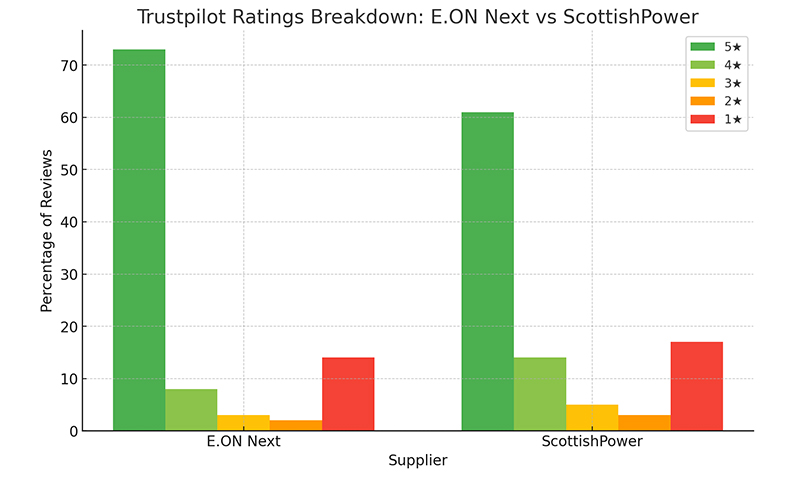
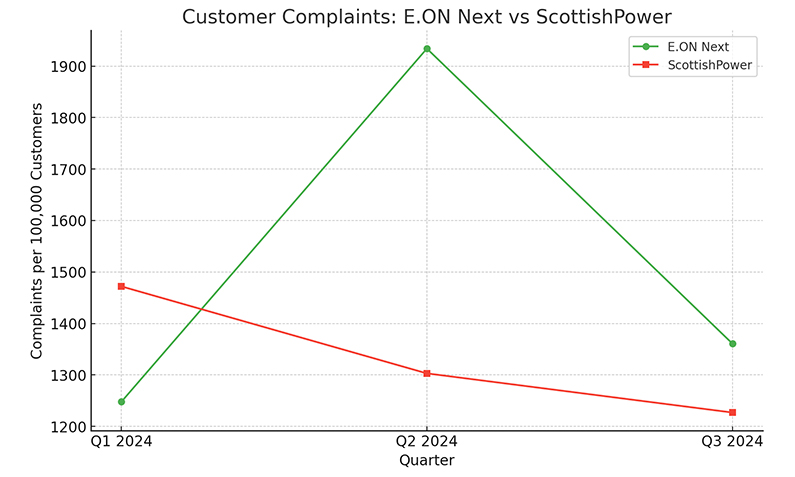
Service records for E.ON Next and Scottish Power differ, and neither consistently tops customer satisfaction rankings among the largest suppliers. E.ON Next generally ranks higher than Scottish Power among the older large suppliers in recent independent scoring, though both trail newer challenger brands on customer satisfaction. Common complaints across both centre on billing accuracy, direct debit reviews and smart meter connection problems, especially for Economy 7 setups. Ofgem’s July to August 2025 Energy Consumer Satisfaction Survey found **82%** of credit meter customers were satisfied with their billing accuracy, and Ofgem’s January 2026 customer service data says this was **80%** in January 2026.[1][2]

Service should sit alongside price when you choose, not above it, because switching for service alone can cost you if the new supplier is dearer. If a large annual saving is on the table, that saving may outweigh a modest service difference for a bill-focused household. To see how E.ON Next stacks up against other large names, our comparisons of British Gas versus E.ON Next and E.ON Next versus OVO Energy add useful context.

Does the energy price cap still matter if I fix?

The energy price cap still matters as a benchmark even when you fix, because it sets the maximum unit rates and standing charges a supplier can charge on a standard variable tariff. Ofgem set the energy price cap at £1,758 a year for a typical dual-fuel household for 1 January to 31 March 2026, and it changes every quarter. The cap limits the rates for a typical user, not a fixed total bill, so your actual cost rises or falls with your usage.

A fixed tariff is only worth taking if it is priced below the current cap once exit fees are factored in and the terms suit your usage. When E.ON Next has advertised its fixes as cheaper than the major suppliers, the comparison has been made against the cap of the day. Because the cap moves quarterly, always check the latest Ofgem figure before deciding whether a fix beats staying on a variable rate. If you are also reviewing your options, our guide to British Gas versus Scottish Power covers how another large supplier prices against the cap.

Check the latest fixed deals against the price cap

What support is available if you are struggling to pay?

Support for households struggling with energy bills includes the Warm Home Discount, the Priority Services Register and supplier hardship schemes, all available whether you are with E.ON Next or Scottish Power. The Warm Home Discount is a one-off credit towards your electricity bill for eligible low-income households, applied through your supplier each winter under a government scheme. The Priority Services Register is a free service that gives extra support to people of pension age, those with disabilities and households with young children, including advance notice of planned outages. Ofgem confirms the Priority Services Register is a free service offering extra support to people of pension age, those with disabilities and households with young children, including advance notice of planned power cuts.

Both suppliers must, under Ofgem rules, offer affordable payment plans if you fall behind, and neither can disconnect a domestic customer without following strict rules first. If a switch has left you facing crossed billing between two suppliers, contact both and, if it is not resolved, escalate through the Energy Ombudsman. For general guidance on charges when moving supplier, our exit fees and switching guide explains what you can and cannot be charged.

What support is available if you are struggling to pay

FAQs about eon next vs scottish power

Is E.ON better than Scottish Power?

E.ON Next currently leads Scottish Power on price in most published 2026 examples and tends to rank higher on independent satisfaction scoring among the traditional large suppliers. Scottish Power can still be the better choice if it offers a cheaper deal for your postcode or a no-exit-fee fix you value for flexibility. Run a quote for your own address before deciding, as regional rates change the outcome.

Is Scottish Power cheaper than E.ON on any tariffs?

Scottish Power can be cheaper on specific tariffs for specific regions, even though E.ON Next led the headline examples in August 2026. Scottish Power's cheapest fixed example also came with no exit fee, which can make it better value if you may want to switch again soon. Compare the actual quotes for your postcode rather than relying on national averages.

Can I switch to a Scottish Power fixed tariff, or are there none?

Scottish Power's available tariffs change over time, and it does offer fixed deals at various points, though the range can be narrower than some rivals. Its cheapest fixed example in August 2026 was a 12-month deal at around £1,776 a year with no exit fee. Check the live tariff list at the point you switch, as availability shifts month to month.

What happens to my credit balance when I switch supplier?

Your old supplier must refund any credit balance on your account after you switch, usually within about six weeks of your final bill. Take a meter reading on your switch date so the final bill is accurate. If a refund is delayed, contact the supplier, and escalate to the Energy Ombudsman if it is not resolved.

How long does switching from Scottish Power to E.ON take?

Switching between suppliers completes within about five working days once you agree to the new deal, under Ofgem's switching rules. You also get a 14-day cooling-off period during which you can cancel without penalty. Your supply is never interrupted, and the same gas and electricity continue to flow through your existing meters.

Will I pay an exit fee to leave Scottish Power?

You will only pay an exit fee if you are on a fixed Scottish Power tariff and leave before it ends; standard variable tariffs have no exit fee. Check your tariff name and end date on a recent bill or in your online account. If a switch saves more than the exit fee, leaving early can still be worthwhile.

Do E.ON Next and Scottish Power both support smart meters?

Both E.ON Next and Scottish Power support second-generation SMETS2 smart meters, which keep their smart functions when you switch supplier. Older SMETS1 meters sometimes lose smart features temporarily after a switch until they reconnect through the national network. If you have an Economy 7 or storage heating setup, confirm the new supplier can read it correctly before you move.

What is the difference between a fixed and variable tariff?

A fixed tariff locks your unit rates and standing charges for a set term, protecting you from price rises but sometimes carrying an exit fee. A variable tariff moves with the market and is capped by Ofgem's price cap, so it can fall as well as rise. Fixing suits households who want certainty; a variable rate suits those who want flexibility.

Does the cheaper supplier always give a lower bill?

Not always, because the cheaper headline figure assumes typical usage that may not match yours. A tariff with a low unit rate but a high daily standing charge can cost a low-usage home more than a rival with the opposite balance. Compare the unit rate and standing charge together against your own consumption for an accurate answer.

Are E.ON Next and Scottish Power owned by the same company?

No, E.ON Next and Scottish Power are separate companies with no shared ownership. E.ON Next is part of the German-owned E.ON group, while Scottish Power is owned by the Spanish utility Iberdrola. They compete directly for domestic customers, and switching between them goes through the standard industry process.

Can I get the Warm Home Discount with either supplier?

Yes, both E.ON Next and Scottish Power participate in the government's Warm Home Discount scheme, which gives eligible low-income households a one-off credit towards their winter electricity bill. Eligibility depends on your circumstances and the benefits you receive, not which of the two suppliers you use. Check with your supplier each autumn to confirm whether you qualify.

What should I do if both suppliers bill me after a switch?

If both suppliers keep billing you after a switch, contact each with your switch confirmation and final meter readings so they can correct their records. Crossed billing usually resolves once the industry data updates. If it is not fixed within eight weeks, you can escalate the dispute to the Energy Ombudsman for a free, binding decision.

Also Read Related Articles


Information correct as of 10 August 2026. Prices, tariffs, policy details and providers change frequently, so please check the latest details before making a decision. This article is for general information only and does not constitute financial advice. Free Price Compare is authorised and regulated by the Financial Conduct Authority (FCA).

4000+ reviews