

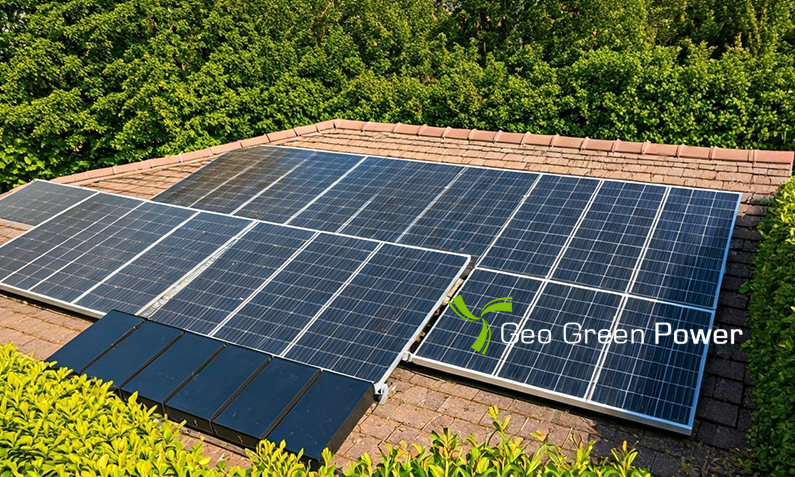




Geo Green Power Solar Panels Battery

Written by Brijesh Patel
Reviewed by Prajesh Manvar
7 min read
Updated: 14 Sep 2026
Geo Green Power Solar Panels Battery

Geo Green Power says a standard domestic solar panel installation generally requires a minimum investment of around £5,000 including VAT, and its premium residential solar PV systems for Midlands homeowners typically cost between £10,000 and £15,000. Geo Green Power is a Midlands-based installer that designs bespoke domestic, business and agricultural solar solutions rather than selling fixed-price online packages, so the figure you pay depends on your roof, your electricity use and the battery size you choose.

For a bill-conscious household stuck on a standard variable tariff above the price cap, the appeal is straightforward: generate your own electricity by day, store the surplus in a battery, and draw on it in the evening when grid prices are highest. This explainer sets out what these systems cost in 2026, how the 0% VAT rule on battery storage changes the maths, what size battery a typical home needs, and how the Smart Export Guarantee lets you earn from spare power.

Quick Answer: Geo Green Power Solar Panels Battery

  • A standard Geo Green Power domestic solar installation starts from around £5,000 including VAT, while a premium residential solar-and-battery system typically costs £10,000 to £15,000 for Midlands homes.
  • Home battery storage installs have carried 0% VAT since 2024, including retrofits to existing solar arrays, which reduces the installed cost of adding a battery (Geo Green Power, 2024).
  • An average UK home usually needs a battery of 5kWh to 10kWh to cover evening demand, according to Geo Green Power’s sizing guidance.
  • Example savings from Geo Green Power range from around £888 a year (5kWh battery plus 3.6kW solar) to about £2,116 a year (15kWh battery plus 9kW solar); these are indicative, not guaranteed.
  • The Smart Export Guarantee (SEG) requires larger licensed electricity suppliers to pay you for surplus solar power you export to the grid, so a battery is not the only way to earn from spare generation.

Last updated: August 2026

Written by the Free Price Compare editorial team | Reviewed August 2026

How much does a Geo Green Power solar panels and battery system cost?

A Geo Green Power solar panels and battery system for a UK home costs from around £5,000 including VAT at the lower end for a standard solar installation, rising to £10,000 to £15,000 for a premium residential solar-and-storage setup for Midlands homeowners. Geo Green Power does not publish fixed bespoke quote prices because each system is sized to your roof, orientation and household electricity use, so these are example bands rather than a set menu. As a rough steer for the storage element, Geo Green Power says an average UK home typically requires a battery between 5kWh and 10kWh to cover evening demand, and its own example systems show how savings vary by battery and solar size. Adding a battery to an existing array usually costs less than a full new installation because the panels and inverter are already in place.

System type Indicative installed cost
Standard domestic solar (starting from) Around £5,000 inc VAT
Premium residential solar and battery £10,000 to £15,000
Battery add-on to existing solar Around £2,500 to £7,000

Figures are indicative and may change.

These bands are the starting point for a conversation, not a final quote. If you want to see how storage-focused installers structure their pricing, our guides to Evergreen Power solar panels and battery storage and Soly solar installation and battery storage give useful comparison points.

Compare home energy options

How much can you save with solar panels and battery storage?

Savings from solar panels with battery storage in a UK home range from around £888 a year for a modest setup to over £2,100 a year for a larger one, based on Geo Green Power’s own example figures. Its illustrations put a 5kWh battery paired with 3.6kW of solar at roughly £888 a year and about £39,934 over 30 years, a 5kWh battery with 5kW of solar at around £1,108 a year, and a 15kWh battery with 9kW of solar at around £2,116 a year and about £86,984 over 30 years. These are marketing estimates that assume particular usage patterns and future prices, so treat them as a guide rather than a promise. Your actual saving depends on how much of your generated power you use directly, how much you store, your tariff, and how energy prices move against the Ofgem price cap over the life of the system. Ofgem says the amount you save depends on how much of your generated power you use directly, how much you store, your tariff, and how energy prices change relative to the price cap over the system’s life.

A battery lifts savings because it lets you use more of your own solar rather than exporting cheap and buying back expensive. Households with high evening demand tend to benefit most, since that is exactly when stored daytime generation is worth the most. For the wider case, our overview of the benefits of installing solar panels in the UK sets out the household economics in more detail.

Is it cheaper to buy solar panels and a battery together?

Buying solar panels and a battery together is usually cheaper than adding a battery later, because you pay for one installation, one set of scaffolding and one commissioning visit rather than two. A combined install also lets the installer size the inverter and battery to work as a single system from day one, which avoids compatibility issues and repeat electrical work. Market price guides in 2026 show the pattern clearly: a 10-panel system quoted at around £6,500 with a battery versus around £5,500 without means the battery adds roughly £1,000 in that example, less than the £2,500-plus you might pay to retrofit later. That said, a retrofit still makes sense if your budget only stretches to panels now, especially since battery installs have carried 0% VAT since 2024, which softens the cost of adding storage down the line. HMRC says electrical storage batteries installed in residential accommodation qualify for the **temporary zero rate of VAT from 1 February 2024 until 31 March 2027**.[5]

Thinking about going solar?

Compare renewable and green energy options for your home in one place.

What battery size do I need for a UK home?

Most UK homes need a solar battery of between 5kWh and 10kWh to cover typical evening demand, according to Geo Green Power’s sizing guidance. A battery’s capacity in kilowatt-hours (kWh) is how much electricity it can store; a 5kWh battery holds enough to run lights, a TV, a fridge and some cooking through an evening, while a 10kWh battery gives more headroom for larger households or those charging an electric car. Oversizing wastes money because you pay for storage you rarely fill on a British winter’s day, and undersizing means you export cheap surplus you could have used yourself. The right size depends on your daily electricity use, your solar array size and how much of your consumption happens after the sun goes down. Ofgem’s Typical Domestic Consumption Value for a medium electricity user is 2,500 kWh per year, effective from 1 July 2026.

  • 3kWh battery: suits small, low-use homes and flats with modest evening demand.
  • 5kWh battery: a common choice for average homes with a small to mid-size array.
  • 9.5kWh to 10kWh battery: better for larger households, high evening use or EV charging.

Because sizing is so individual, a good installer will look at a year of your electricity readings before recommending a capacity. Comparing how different providers size systems, such as in our guide to Clever Energy solar panels and battery storage, helps you judge whether a quote is realistic.

What battery size do I need for a UK home

Does 0% VAT apply to home battery storage?

Home battery storage installs have carried 0% VAT since 2024, including standalone batteries and retrofits added to existing solar arrays, which directly lowers the installed cost of adding storage. The zero rate on energy-saving materials is set by gov.uk and administered by HMRC, and it extended to cover battery storage that is not installed alongside new solar panels. For a household weighing up a battery, this is one of the most useful current policy hooks, because it removes the 20% VAT that would otherwise sit on top of a several-thousand-pound purchase. The relief applies to the installation, so it is worth confirming with any installer that your quote reflects the zero rate.

This tax treatment is one reason retrofitting a battery to an existing solar array has become more attractive than it was a few years ago. If you already have panels and only ever exported your surplus, adding storage at 0% VAT lets you keep more of what you generate.

See how home solar guides compare

What is the Smart Export Guarantee and how do you earn from it?

The Smart Export Guarantee (SEG) is a government scheme that requires larger licensed electricity suppliers to pay small-scale generators for surplus renewable electricity exported to the grid. Introduced by Ofgem, it replaced the closed Feed-in Tariff for new installations and means your spare solar power earns you money rather than being given away. To qualify, your system generally needs to be certified under the MCS (Microgeneration Certification Scheme) and you need an export-capable smart meter so your supplier can measure what you send back. Rates vary between suppliers because each sets its own SEG tariff, so it pays to compare export rates when you choose or switch supplier. Ofgem says suppliers can choose their own Smart Export Guarantee tariff rates, provided the tariff is above zero, which is why export rates vary between suppliers; Ofgem’s SEG annual report is dated December 2025.[6][11]

A battery changes how the SEG works for you. Without storage, you export any surplus and earn the SEG rate on it; with storage, you keep more of that surplus to use yourself in the evening, which usually saves more than the export payment would have earned. The best value often comes from combining a battery with a supplier that offers both a fair export rate and a low overnight import rate for topping up storage. It is also worth understanding the standing charge on your electricity bill: this is a fixed daily amount your supplier charges to cover the cost of connecting your home to the grid, and it applies regardless of how much power you generate or export. Ofgem’s price cap sets a level for standing charges, so even with a solar and battery system you continue to pay this daily fee alongside your reduced unit consumption.

Do solar panels work at night or in a power cut?

Solar panels do not generate electricity at night because they need daylight to produce power, which is exactly why battery storage matters for evening use. During the day your panels generate more than you use; a battery captures that surplus and releases it after dark, so you draw on stored solar rather than buying from the grid at peak prices. On the question of power cuts, a standard grid-tied solar and battery system usually shuts down automatically during an outage for safety reasons, so it will not keep your home running unless it has specific backup functionality fitted. If keeping the lights on during a cut matters to you, ask the installer directly whether the system includes a backup or islanding feature, because most standard setups do not.

This is a common misconception worth clearing up: having a battery does not automatically mean you have emergency backup. Backup capability is a separate design choice that adds cost and complexity, so confirm it in the quote rather than assuming it.

Explore renewable energy guides

How can I tell if I’m using my own solar power?

You can tell whether you are using your own solar power through the app or in-home display that comes with your system, which shows generation, consumption and how much you are importing or exporting in real time. Most modern solar and battery systems include monitoring that breaks down where your electricity is coming from at any moment, so you can see when your home is running on panels, on the battery, or on the grid. Watching this display teaches you to shift high-use tasks such as laundry and dishwashing into daylight hours, which is the simplest way to raise your self-consumption and cut your bills further. If your system lacks clear monitoring, a separate energy monitor can measure the flow at your meter and tell you when you are exporting surplus. Under the Smart Export Guarantee, Ofgem does not set export rates; suppliers set their own tariff (which must be above zero), so there is no single primary-source figure for export payment per unit.

Getting into the habit of checking your monitoring is one of the cheapest ways to improve the return on any solar and battery system, because self-consumption is where most of the saving comes from.

How long is the payback period on solar and battery storage?

Payback on a domestic solar and battery system in the UK depends heavily on your system size, your electricity use and future energy prices, so no single figure fits every home. Geo Green Power’s own examples imply meaningful long-run savings, such as around £888 a year for a 5kWh battery with 3.6kW of solar, but it presents these as illustrations that vary by usage rather than guaranteed payback periods. Broadly, higher electricity prices, higher self-consumption and the 0% VAT relief on batteries all shorten payback, while low usage, poor roof orientation and a large battery you rarely fill lengthen it. Because the Ofgem energy price cap sets the backdrop for what you would otherwise pay per unit, a household above the price cap floor on a standard variable tariff tends to see faster returns than one on a very cheap fixed deal.

The honest answer is that payback is a range, not a fixed number, and the biggest lever you control is how much of your own generation you actually use. To weigh solar against your current supplier costs, it helps to review your solar technology options alongside your existing tariff before committing.

What accreditation and consumer protection should an installer have?

A reputable UK solar and battery installer should be certified under the MCS (Microgeneration Certification Scheme), which is the standard suppliers require before you can claim the Smart Export Guarantee. MCS certification confirms the installation meets recognised quality standards, and it is worth checking an installer belongs to a consumer protection scheme such as the Renewable Energy Consumer Code (RECC) or HIES, which provide dispute resolution and workmanship cover. You should also see clear written quotes, product warranties for panels, inverter and battery, and confirmation that your quote reflects the 0% VAT rate on eligible energy-saving materials. Checking these before you sign protects you if anything goes wrong and ensures your system qualifies for export payments.

Geo Green Power markets bespoke domestic, business and agricultural solar rather than fixed online products, so ask any installer to put the certification, warranties and VAT treatment in writing. The gov.uk guidance on energy-saving materials is a useful reference point when checking the tax treatment of your quote.

What accreditation and consumer protection should an installer have

FAQs about geo green power solar panels battery

Are solar panels with battery storage worth it?

Solar panels with battery storage are worth it for many UK households, especially those with high evening electricity use and homes on a standard variable tariff above the price cap. A battery lets you use more of your own daytime generation instead of exporting it cheaply and buying back expensively at night. The value depends on your usage, system size and how energy prices move, so treat any quoted savings as a range rather than a fixed return.

How much does a solar battery storage system cost?

A domestic solar battery add-on in the UK commonly costs around £2,500 to £7,000 in 2026, depending on capacity, while a full installed solar-and-battery package for a typical home often lands around £8,500 to £14,000. A standard Geo Green Power solar installation starts from around £5,000 including VAT, with premium residential solar-and-battery systems typically £10,000 to £15,000. Prices vary by roof, usage and battery size.

How much upfront investment is needed for a solar battery system?

Upfront costs for a domestic solar battery system vary widely, with standalone battery add-ons starting from a few thousand pounds and full solar-and-battery installations for typical homes often around £8,500 to £14,000. The 0% VAT rate on home battery storage installs since 2024 reduces the upfront cost of adding storage. Getting itemised written quotes helps you see exactly what the panels, inverter and battery each contribute to the total.

Do solar panels work at night?

Solar panels do not generate electricity at night because they need daylight to produce power. This is the main reason households add a battery: it stores surplus solar generated during the day so you can use it in the evening instead of buying from the grid at peak prices. Without a battery, any electricity you use after dark comes from the grid or from an export payment on daytime surplus.

Can battery storage be used during a power cut?

A standard grid-tied solar and battery system usually shuts down automatically during a power cut for safety, so it will not keep your home running unless it has specific backup or islanding functionality fitted. Having a battery does not by itself provide emergency backup. If keeping essential circuits powered during an outage matters to you, ask the installer to confirm the system includes a backup feature, as most standard installations do not.

What battery size do I need for my home?

Most UK homes need a solar battery of between 5kWh and 10kWh to cover typical evening demand, according to Geo Green Power's guidance. Smaller flats and low-use homes may only need around 3kWh, while larger households or those charging an electric car may want closer to 10kWh. The right size depends on your daily electricity use, your solar array size and how much of your consumption happens after dark, so an installer should review a year of readings first.

What is the Smart Export Guarantee and how do I earn from it?

The Smart Export Guarantee (SEG) requires larger licensed electricity suppliers to pay you for surplus renewable electricity you export to the grid. To qualify you generally need an MCS-certified system and an export-capable smart meter. Each supplier sets its own SEG rate, so it pays to compare export tariffs. With a battery you keep more surplus to use yourself, which usually saves more than the export payment would have earned.

Can you rely 100% on solar and batteries alone?

Relying 100% on solar and batteries alone is not practical for most UK homes because British winter daylight is short and generation drops sharply from November to February. Even a large battery will struggle to cover a household through long, dark, low-generation spells without grid support. For nearly all households, solar and storage are best treated as a way to cut grid dependence and bills substantially rather than to disconnect from the grid entirely.

Does 0% VAT apply to adding a battery to existing solar panels?

Yes, the 0% VAT rate on home battery storage since 2024 applies to retrofits added to existing solar arrays, not just batteries fitted alongside new panels. This makes adding storage to an existing installation more cost-effective than it was previously. Confirm with your installer that the quote reflects the zero rate, as the relief applies to eligible energy-saving materials and their installation.

Does Geo Green Power publish fixed prices for solar and battery systems?

Geo Green Power does not publish fixed bespoke quote prices, as it designs each system around your property, usage and future energy needs rather than selling fixed-price online packages. It does share example costs, such as standard domestic solar from around £5,000 and premium residential systems at £10,000 to £15,000, plus illustrative savings figures. For an accurate price you would need a tailored quote based on your roof and electricity use.

Also Read Related Articles


Information correct as of 11 August 2026. Prices, tariffs, policy details and providers change frequently, so please check the latest details before making a decision. This article is for general information only and does not constitute financial advice. Free Price Compare is authorised and regulated by the Financial Conduct Authority (FCA).

4000+ reviews