

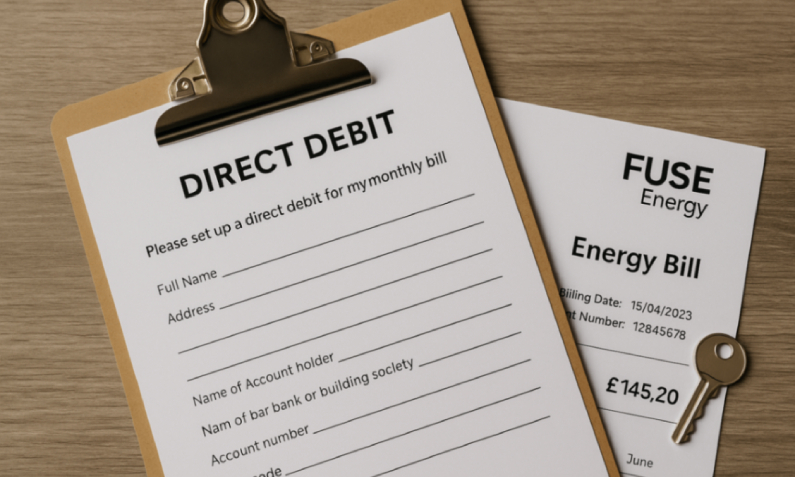





Fuse Energy Direct Debit Explained

Written by Andrea Troy
Reviewed by Shay Ramani
8 min read
Updated: 21 Sep 2026
Fuse Energy Direct Debit Explained

Fuse energy direct debit works on a variable, whole-bill basis: instead of a fixed monthly amount, Fuse charges you for exactly the gas and electricity you used in the previous billing period, then collects that amount by direct debit a few days after the bill is issued. That is the single biggest difference between Fuse and most large suppliers, and it is what trips up bill-conscious households expecting the smooth, fixed monthly payment they are used to.

If you are on a standard variable tariff sitting above the price cap floor and weighing up whether Fuse could cut your gas and electricity costs, the payment model matters as much as the headline unit rate. Free Price Compare sources energy data from Ofgem publications and supplier terms, and this explainer sets out how the direct debit is calculated, when it is taken, what happens if it fails, and the trade-offs versus a traditional fixed direct debit.

Quick Answer: Fuse Energy Direct Debit Explained

  • Fuse collects the whole bill each month by variable direct debit, 3 to 5 working days after issuing the invoice on the second working day of the month.
  • Because you pay for actual usage, a Fuse account rarely builds a large credit balance, so there is little to reclaim under the Direct Debit Guarantee.
  • If a Fuse direct debit fails, it is automatically retried around 10 days later while the balance stays overdue.
  • As of Q3 2026 (1 July to 30 September), the Ofgem price cap for a typical dual-fuel direct debit household is £1,862 a year – Fuse told review sites in June 2026 its variable rates now sit at the cap, not below it.
  • Fuse does not support prepayment meters, cash, cheque, or (as of August 2026) a settled traditional fixed direct debit – variable direct debit and open banking payments are the main options.

Last updated: August 2026

Written by the Free Price Compare editorial team | Reviewed August 2026

How does Fuse energy variable direct debit work?

Fuse energy variable direct debit means the amount taken each month equals your actual bill for the previous billing period, not a fixed estimate averaged across the year. Fuse calculates the bill as your electricity and gas used (kWh multiplied by the unit rate) plus the standing charge multiplied by the number of days in the period. The billing period runs from around the second working day of one month to the second working day of the next. Because you settle each bill in full, your Fuse account rarely sits in large credit or large debit, so there is usually little balance to build up or reclaim. This is the same model some suppliers label “whole bill monthly”, and it puts your payment much closer to real consumption than a smoothed fixed plan.

The practical effect is that your payment rises in winter and falls in summer, tracking your heating and lighting use. For a household happy to see bills move with the seasons, that transparency is the appeal. For anyone budgeting to a flat monthly figure, it is the main drawback, and it is worth weighing against how a fixed direct debit spreads winter costs across the whole year.

If your goal is to cut your overall bill rather than just change how you pay, it helps to understand why some households pay more than their neighbours before you commit to any supplier.

Compare current energy tariffs

When is my Fuse energy direct debit date?

Your Fuse energy direct debit date is not a date you choose. Fuse invoices customers on the second working day of each month and then collects payment by direct debit 3 to 5 working days after the bill is issued. So the money leaves your account in the first week or two of the month, once your usage for the previous period has been calculated. Because the amount reflects actual consumption, the exact figure changes month to month even though the timing stays broadly consistent.

This fixed billing rhythm is a common point of confusion, because most suppliers let you pick a payment day that suits your salary date. With Fuse, the trade-off for whole-bill billing is that the collection date follows the invoice, not your preference. Check your bank balance in the first fortnight of each month to be sure the payment can clear.

Can I change my Fuse energy direct debit date or amount?

You generally cannot change your Fuse energy direct debit date or the amount collected, because both are driven by the billing cycle and your actual usage rather than a fixed plan you control. Fuse has told customers the date cannot be altered, and since the collection is the full outstanding bill, there is no monthly figure to raise or lower the way you would on a fixed direct debit. The only lever you truly control is how much energy you use, which directly reduces the next bill.

If a predictable, adjustable monthly amount is important to you, a whole-bill variable model is a poor match. A traditional fixed direct debit lets you set a level payment and, if it runs high, build a credit balance you can later reclaim. With Fuse, that flexibility is not part of the design. Cutting consumption is the practical route to smaller payments, and small changes add up – our guide to standby power and its hidden cost is a good place to start.

Can I change my Fuse energy direct debit date or amount

Not sure a variable direct debit suits you?

Compare fixed and variable tariffs across the whole market before you switch.

Does Fuse offer a fixed direct debit, or only variable?

Fuse operates primarily on variable direct debit, and as of August 2026 a settled, traditional fixed direct debit is not a confirmed standard option across accounts. Some review sources in mid-2026 reported Fuse was introducing or planning a fixed direct debit option, while others stated only variable direct debit and open banking payments are supported, with prepayment, cash and cheque not available. Because supplier payment options change, confirm the current position directly with Fuse before switching if a fixed monthly amount is essential to your budgeting.

What is consistent across sources is the direction of travel: Fuse was built around variable, whole-bill billing, and any fixed option sits alongside that rather than replacing it. A fixed direct debit is a payment where you pay the same amount every month and your bills are averaged out across the year, which is the model most large suppliers default to. If you need certainty over the exact figure leaving your account each month, treat Fuse’s variable approach as the baseline and check whether a fixed alternative is live for your account.

What happens if my Fuse direct debit fails or I cancel the mandate?

If your Fuse direct debit fails, Fuse automatically retries the collection 10 days later while the balance stays overdue in the meantime. Because Fuse takes the whole bill each month, a failed payment can leave a larger single amount outstanding than a small fixed instalment would, so it is worth making sure funds are available in the first fortnight of the month. Repeatedly missing payments, or not complying with the direct debit terms, can have consequences under Fuse’s conditions.

Cancelling the direct debit mandate does not cancel your energy contract or your liability for the energy you use. Under Fuse’s terms, if you agreed to pay by direct debit but do not comply, Fuse may bill you for the outstanding balance and move you to a different plan, which could carry higher standing charges or unit rates, and it may remove any direct-debit discounts or rewards. You always keep the protections of the Direct Debit Guarantee, which entitles you to a full and immediate refund from your bank if an error is made in a payment. If you are struggling to pay, contact the supplier early and ask about support, and Citizens Advice can help you understand your options.

See ways to cut your energy costs

Are there other ways to pay Fuse besides direct debit?

Beyond variable direct debit, Fuse supports payments made through open banking, which lets you authorise a bank-to-bank payment (handled by a third-party provider) rather than a card or cash transaction. Fuse does not currently support standard credit-style payment on receipt of a bill by card, cash or cheque, and it does not offer prepayment meters where you top up before using energy. That narrow set of options is part of Fuse’s app-first, low-overhead model.

For households used to paying by card or topping up a meter, this is a meaningful limitation to check before switching. If you rely on a prepayment meter, or you want the option to pay a bill manually by cheque, Fuse’s structure will not fit. Households on the Priority Services Register or needing extra payment support should confirm what help is available directly with the supplier, since the standard direct-debit and open-banking routes assume a bank account and regular collections.

How does Fuse pricing compare with the Ofgem price cap?

Fuse’s variable rates now sit at the Ofgem price cap rather than below it, based on what Fuse told review sites in June 2026, having previously marketed its variable tariff as always cheaper than major suppliers. As of Q3 2026 (1 July to 30 September), the price cap for a typical dual-fuel household paying by direct debit is £1,862 a year, confirmed by Ofgem on 27 May 2026 using its Typical Domestic Consumption Values. The price cap limits the unit rate and standing charge for a typical user, not a fixed total bill, so your actual annual cost depends on how much energy you use.

Fuse also offers fixed-rate tariffs that track below the price cap for terms such as 12 or 15 months, and its tariff range combines a rate structure (single-rate or off-peak) with a price type (fixed or variable). A fixed deal can protect you if the cap rises, while a variable rate moves with it. Exit fees apply to Fuse fixed tariffs, and the amount can vary, so confirm the current exit fee with Fuse before you commit. Comparing what sits beyond just the price on an energy tariff – exit fees, standing charges and payment terms – is the difference between a headline saving and a real one.

Because the price cap is a regulatory figure that changes each quarter, treat the £1,862 as the current-period cap and check the latest Ofgem announcement before making a decision. If you are moving off a fixed deal with another supplier, check whether an exit fee applies there too, in the same way you would for British Gas exit fees when switching.

Check whole-of-market energy tariffs

Who are Fuse Energy and is Fuse Energy any good?

Fuse Energy is a UK domestic energy supplier founded in 2022 by former Revolut executives and launched to the public in 2023, becoming the first new entrant to the market after the energy crisis. Alongside supplying households, Fuse invests in renewable generation, operating solar and wind sites in the UK. Its app-first approach, variable whole-bill billing and lower-than-average standing charges are its defining features.

On customer satisfaction, Fuse has scored highly on public review platforms in 2026, with recent reported Trustpilot ratings around 4.8 out of 5 from several thousand reviews as of July 2026, though scores move over time and are worth checking live. The most common criticisms centre on the payment model – the variable direct debit that takes the full bill quickly each month – plus the absence of phone support and prepayment meters. Whether Fuse is a good fit depends on whether you value transparency and app-based control over a fixed, predictable monthly payment. If a settled monthly amount matters more, weigh a fixed-direct-debit supplier before switching.

Who are Fuse Energy and is Fuse Energy any good

FAQs about fuse energy direct debit

Is Fuse Energy any good for bill-conscious households?

Fuse suits households comfortable with bills that rise and fall each month in line with usage, and who value app-based control and lower-than-average standing charges. It is less suitable if you need a fixed, predictable monthly payment, phone support or a prepayment meter. Fuse has scored highly on public review sites in 2026, but the variable whole-bill direct debit is the main point people find hard to adjust to.

Who are Fuse Energy and where do they generate power?

Fuse Energy is a UK domestic energy supplier founded in 2022 by former Revolut executives and launched to the public in 2023. It supplies gas and electricity to households and also invests in UK renewable generation, running solar and wind sites. It operates mainly through its app rather than phone support.

How do I set up or change my bank details on my Fuse direct debit?

You set up and update your direct debit and bank details through the Fuse app or online account, where you enter your bank account information to authorise collections. Because Fuse is app-first and does not offer phone support in the same way as larger suppliers, most account changes are handled digitally. Keep your details current so monthly collections are not missed, as failed payments are retried around 10 days later.

Why does Fuse take my payment so quickly compared with other suppliers?

Fuse takes payment 3 to 5 working days after issuing your bill because it collects the whole bill for actual usage each month, rather than a smoothed fixed instalment. This keeps your account close to a zero balance and means you settle each period soon after it ends. Some suppliers using a smoothed fixed model take longer between billing and collection, but they average your cost across the year instead.

Will I get a credit balance refund with Fuse?

You are unlikely to build a large credit balance with Fuse because its variable direct debit collects the full bill each month, so there is rarely a surplus to reclaim. That is different from a fixed direct debit, where overpayments in summer build credit you can request back. If an error is made in any collection, the Direct Debit Guarantee still entitles you to a full and immediate refund from your bank.

What is the Direct Debit Guarantee and does it apply to Fuse?

The Direct Debit Guarantee is a UK protection that entitles you to a full and immediate refund from your bank if an error is made in the payment of a direct debit. It applies to all direct debit collections, including Fuse. You must be given advance notice of the amount and date of collections, and you can cancel a direct debit at any time by contacting your bank, though this does not cancel the money you owe.

What is the average energy bill in the UK right now?

As of Q3 2026 (1 July to 30 September), the Ofgem price cap for a typical dual-fuel household paying by direct debit is £1,862 a year. This caps unit rates and the standing charge for a typical user rather than setting a fixed total, so your actual bill depends on how much gas and electricity you use. Higher-usage homes pay more than the cap figure and lower-usage homes pay less.

If I turn off the main fuse for a billing cycle, will my bill be zero?

No. Even with no energy used, you still pay the daily standing charge for both gas and electricity, so your bill would not be zero. The standing charge is a fixed daily cost that covers the cost of connecting your home to the network and applies regardless of usage. Only the unit-rate portion of the bill would fall to nil if you used no energy.

Am I still liable for Fuse energy bills after I move out?

You are liable for energy used at a property up to the day your account is closed, so you must give notice and a final meter reading when you move out. If you leave without informing your supplier, charges can continue to accrue against your account. Always provide a moving date and closing reading to end your responsibility cleanly and avoid disputes.

Does Fuse charge exit fees on its fixed tariffs?

Fuse applies exit fees to its fixed-rate tariffs if you leave before the term ends, in line with most suppliers. Reported exit-fee amounts have varied across sources in 2026, so confirm the current figure with Fuse before signing up. Exit fees can generally be avoided by switching to Fuse’s variable tariff during the term, or by leaving in the final weeks of a fix when suppliers typically waive them.

Can I cancel my Fuse direct debit without ending my contract?

Cancelling the direct debit mandate at your bank does not end your Fuse contract or clear what you owe for energy used. Under Fuse’s terms, not complying with the direct debit arrangement can lead to being billed for the outstanding balance, being moved to a plan with higher rates, and losing direct-debit discounts. If you want to leave Fuse, arrange a switch to another supplier rather than just stopping the mandate.

Was I right to be asked for an upfront payment when switching to Fuse?

Fuse’s terms allow it to ask for a reasonable security deposit before or during supply where justified, for example following a credit check flag or to protect against unpaid charges. The amount depends on your circumstances, including estimated monthly billing. If you are asked for an upfront payment and are unsure why, query it with Fuse directly and confirm how and where the money is being collected before agreeing.

Also Read Related Articles


Information correct as of 11 August 2026. Prices, tariffs, policy details and providers change frequently, so please check the latest details before making a decision. This article is for general information only and does not constitute financial advice. Free Price Compare is authorised and regulated by the Financial Conduct Authority (FCA).

4000+ reviews