





EDF Energy Standing Charge Guide: What You Pay

Written by Shay Ramani
Reviewed by Pratik Aghera
8 min read
Updated: 7 Sep 2026
EDF Energy Standing Charge Guide: What You Pay

The EDF energy standing charge is a fixed daily cost you pay for gas and electricity regardless of how much energy you use, covering the cost of keeping your home connected to the network. On EDF’s standard variable tariff it sits close to the Ofgem price cap, though EDF applies a small daily discount and the exact rate varies by region, meter type and payment method.

If you are on a standard variable tariff and want to cut your gas and electricity costs, understanding what the standing charge is, why it applies even when you use nothing, and how to check your own postcode rate puts you in a stronger position before you compare tariffs. Free Price Compare sources the figures below from Ofgem and EDF’s own published rate cards.

Quick Answer: EDF Energy Standing Charge Guide

  • The average GB electricity standing charge under the Ofgem price cap is 57.19p per day and gas is 29.04p per day (Direct Debit, incl. VAT), for the period 1 July to 30 September 2026 (Ofgem).
  • Standing charges vary sharply by region: from 1 July 2026, the electricity standing charge is around £271 a year in London but around £366 a year in North Wales and Mersey (Ofgem).
  • EDF applies a daily discount of 6.85p per fuel on its standard variable tariff, cutting around £50 a year off the combined standing charge, the same in every region.
  • EDF’s Low Standing Charge Trial, launched in July 2026, gives eligible FreePhase customers a £6.25 monthly discount per fuel with no exit fees, but higher unit rates apply.
  • You still pay a standing charge on zero usage because it funds network maintenance, meter servicing and the cost of keeping supply available on demand.

Last updated: August 2026

Written by the Free Price Compare editorial team | Reviewed August 2026

What is a standing charge on your EDF bill?

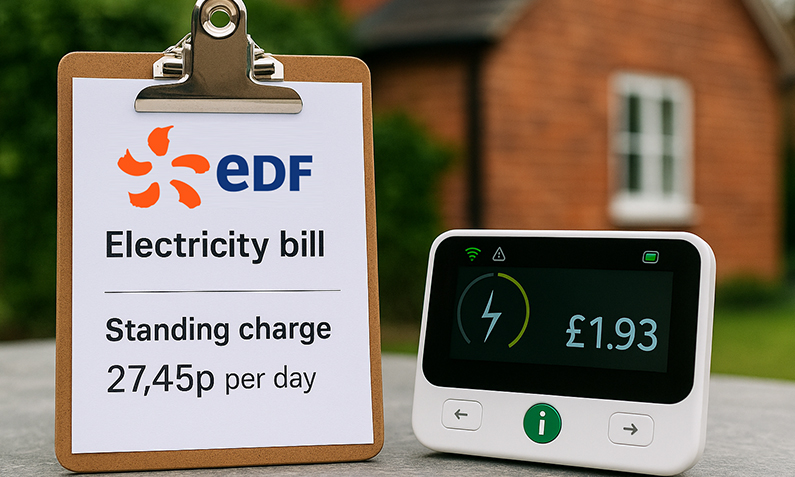
A standing charge is a fixed daily fee you pay to your energy supplier for gas and electricity whether or not you use any energy that day. On an EDF bill it appears as two separate lines, one for electricity and one for gas, each shown in pence per day and each including VAT at 5%. According to Ofgem, the standing charge recovers the costs required to provide energy company services, including maintaining the gas and electricity networks, servicing your meter, and government schemes that keep the wider system running. The standing charge is entirely separate from your unit rate, which is the price you pay for each kilowatt hour (kWh) of energy you actually use.

Two households in the same street can pay a different total bill even on the same tariff, because one uses more energy. The standing charge portion, however, is the same for both while they remain on that tariff in that region.

What is EDF’s current daily standing charge for gas and electricity?

EDF does not publish one single national standing charge, because the rate on its standard variable tariff varies by region, meter type and payment method, then tracks close to the Ofgem price cap. As a benchmark, the average GB standing charge under the price cap for 1 July to 30 September 2026 is 57.19p per day for electricity and 29.04p per day for gas, for a Direct Debit customer including VAT, according to Ofgem. That is around 86p a day combined for a dual-fuel home.

EDF reduces this by applying a daily discount of 6.85p per fuel on its standard variable tariff, which works out at around £25 a year off electricity and £25 off gas, or £50 across both. EDF states this discounted standing charge is the same in all regions and applies no matter how much energy you use. To see the exact pence-per-day figure for your home, you need to check EDF’s regional rate card for your area or run a live quote, because the pre-discount base rate still differs by distribution region.

Compare current energy tariffs by postcode

Why do I still pay a standing charge if I use no energy?

You still pay a standing charge on zero usage because it funds the fixed cost of keeping your property connected and ready to draw energy on demand, not the energy itself. According to Ofgem, the charge covers maintaining and upgrading the gas and electricity networks, taking meter readings, and the cost of certain social and environmental schemes. Suppliers are required to keep supply available whenever you switch something on, so the standing charge acts as an availability fee for that guaranteed connection.

This matters most for empty properties, second homes and very low users, who can end up paying tens of pounds a month for little or no consumption. For example, a dual-fuel home paying around 86p a day in combined standing charges would owe roughly £26 in a 30-day month before using a single kWh. If your property is empty, contact EDF to check whether a deemed tariff applies and to keep meter readings up to date, because standing charges continue to accrue on an unoccupied home.

Why do I still pay a standing charge if I use no energy

How does the Ofgem price cap affect EDF’s standing charges?

The Ofgem price cap sets the maximum unit rate and standing charge a supplier can charge on a standard variable tariff, so EDF’s standing charges cannot exceed the cap for your region. The price cap is not a cap on your total bill, it caps the rates and the standing charge for a typical Direct Debit user, so your actual bill still rises and falls with how much you use. From 1 July to 30 September 2026, the price cap is set at £1,862 a year for a typical dual-fuel Direct Debit household, a rise of around 13% on the previous period, according to Ofgem.

Standing charges have stayed broadly stable through 2026 while unit rates have moved more, so most of the recent bill increases came from the price per kWh, not the daily charge. Ofgem reviews the cap every three months, and the levels for 1 October to 31 December 2026 are due to be confirmed by 26 August 2026, so the figures here should be checked against the latest Ofgem announcement. One helpful change already confirmed: from April 2026 the cost of funding the Warm Home Discount moved from standing charges to unit rates, which the government estimated would cut standing charges by around £39 a year on average. You can read more in our explainer on how the energy price cap affects fixed tariff pricing.

Not sure if your EDF tariff is above the cap floor?

Compare live gas and electricity tariffs for your postcode in minutes.

Do standing charges differ by region and meter type?

Standing charges differ by region, meter type and payment method, and the regional gap can be substantial. Ofgem sets a separate cap for each of the 14 distribution regions because it costs more to transport energy to some parts of Great Britain than others. From 1 July 2026, the electricity standing charge worked out at around £271 a year in the London region but around £366 a year in North Wales and Mersey, according to Ofgem. EDF’s standard variable standing charge follows these regional caps before its £50 discount is applied.

Meter type also affects what you pay. Since April 2024, prepayment and Direct Debit customers pay the same standing charge under a policy called levelisation, so switching to a smart prepayment meter no longer means a higher daily charge. Paying by cash, cheque or quarterly Direct Debit costs more overall than monthly Direct Debit, which is one reason the standard cap of around £1,795 for the July 2026 period sits below the equivalent Direct Debit figure only on a like-for-like basis. Economy 7 and other multi-rate meters may show a different standing charge again on EDF’s rate card.

Can I get a no standing charge tariff or lower standing charge with EDF?

EDF launched a Low Standing Charge Trial in July 2026 that gives eligible customers a £6.25 monthly discount per fuel on their standing charges, with no exit fees, available through EDF’s existing FreePhase tariffs and aimed at lower-energy users. That works out at up to around £150 a year off the combined standing charge for a dual-fuel home, but the trade-off is higher unit rates, so the saving only holds if you use relatively little energy. There is no fully zero standing charge domestic tariff from EDF at present, its zero standing charge product is a small-business tariff, not a household option.

The trial follows a September 2025 requirement from Ofgem that major suppliers offer at least one low standing charge tariff, with these tariffs sitting outside the price cap. Whether a low or no standing charge deal saves you money depends heavily on your consumption. As a rough guide, low standing charge tariffs tend to benefit households using under around 1,800 kWh of electricity or 7,500 kWh of gas a year, because the higher unit rates can otherwise cancel out the saving. Our guide on the hidden costs of no standing charge tariffs explains where these deals can backfire, and if you rent, our page on no standing charge tariffs for renters covers your options.

See low standing charge and fixed deals side by side

Where can I check the exact standing charge for my postcode?

Check your exact EDF standing charge by looking at the region-specific rate card on EDF’s website for your current tariff, or by logging in to your EDF account where your live daily rate is shown for both fuels. Your most recent bill also states the pence-per-day standing charge you are paying for gas and electricity, including VAT. Because EDF publishes a separate rate card PDF for each price cap period and each distribution region, the same tariff name can show a different standing charge depending on where you live.

To compare EDF against other suppliers on a like-for-like basis, run a whole-of-market comparison using your postcode and recent usage, so the quotes reflect your real standing charge and unit rates rather than a national average. When you compare, look at the annual estimated cost rather than the standing charge alone, because a lower daily charge paired with higher unit rates can leave you worse off. Our guide on what matters beyond just price walks through what else to weigh up, and if you are set on EDF, see our EDF Energy tariffs guide for the current range.

How to reduce what you pay towards standing charges

Reducing the impact of standing charges starts with comparing tariffs on total annual cost, not the daily rate in isolation, because the cheapest overall deal for your usage is what actually cuts your bill. A bill-conscious household on a standard variable tariff sitting at or above the price cap can often move to a competitive fixed deal or a low standing charge tariff and pay less across the year.

  • Compare a fixed tariff against the standard variable tariff, since fixed deals from larger suppliers sometimes pair lower unit rates with a similar standing charge.
  • Match the tariff to your usage: low or no standing charge deals suit very low users, while higher-usage homes usually save more from a low unit rate.
  • Pay by monthly Direct Debit, which is the cheapest payment method under the price cap.
  • Keep meter readings up to date, especially on an empty property, so you are billed on actual usage rather than estimates.
  • Check whether you qualify for support such as the Warm Home Discount or the Priority Services Register if you are on a low income or have additional needs.

Because standing charges are broadly fixed across suppliers on standard variable tariffs, the biggest saving usually comes from cutting the unit rate you pay or moving off an expensive default tariff altogether. If you want to stay with EDF, our guide on switching to EDF Energy explains the process, and Ofgem’s switching guarantee means a switch completes within a set timeframe with protections if anything goes wrong. For the wider regulatory picture, see our overview of Ofgem’s role in enforcing the price cap.

How to reduce what you pay towards standing charges

Compare EDF against the whole market

FAQs about edf energy standing charge

What is the average EDF standing charge for 2026?

EDF does not publish one national figure because the rate varies by region, meter and payment method, but its standard variable standing charge tracks close to the Ofgem price cap. As a benchmark, the average GB price cap standing charge for July to September 2026 is 57.19p per day for electricity and 29.04p per day for gas on Direct Debit, including VAT. EDF then applies a discount of 6.85p per fuel per day, saving around £50 a year.

Why have standing charges gone up in recent years?

Standing charges rose largely because of increased network costs, the cost of failed supplier bailouts being spread across bills, and social and environmental scheme funding. More recently, standing charges have actually stayed broadly stable through 2026 while unit rates have moved more. From April 2026 the Warm Home Discount cost was shifted from standing charges to unit rates, which the government estimated cut standing charges by around £39 a year on average.

Does EDF charge a standing charge on an empty property?

Yes, EDF charges a standing charge on an empty property because you are still connected to the gas and electricity networks and supply is kept available on demand. Even with zero usage, a dual-fuel home paying around 86p a day would owe roughly £26 over a 30-day month in standing charges alone. If a property is unoccupied, contact EDF, keep submitting meter readings, and ask whether a deemed tariff applies.

Is EDF's Low Standing Charge Trial worth joining?

EDF's Low Standing Charge Trial can be worth joining for low-energy households, offering a £6.25 monthly discount per fuel with no exit fees, up to around £150 a year off combined standing charges. The catch is higher unit rates, so it only saves money if you use relatively little energy, roughly under 1,800 kWh of electricity or 7,500 kWh of gas a year. Higher users usually pay more overall on this type of tariff.

Does EDF offer a no standing charge tariff for households?

EDF does not currently offer a fully zero standing charge tariff for households. Its zero standing charge product is a small-business tariff, not a domestic option. For homes, EDF's Low Standing Charge Trial reduces rather than removes the daily charge, and a genuine no standing charge deal only suits very low users because the higher unit rates can outweigh the saving.

How does the price cap affect the standing charge I pay EDF?

The Ofgem price cap sets the maximum standing charge EDF can apply on a standard variable tariff for your region, so it acts as a ceiling rather than a fixed amount. The cap is reviewed every three months and caps rates for a typical user, not your total bill. For July to September 2026 the cap is £1,862 a year for a typical dual-fuel Direct Debit home, with the next period due to be confirmed by 26 August 2026.

Why is my standing charge different from my neighbour's?

Standing charges can differ between nearby homes because of meter type, tariff, payment method and the exact tariff each household is on. Within the same distribution region, two people on the same EDF standard variable tariff pay the same standing charge, but someone on a fixed deal, a low standing charge trial or an Economy 7 meter will see a different rate. Payment method also matters, as monthly Direct Debit is cheaper than cash or cheque.

How can I find the exact standing charge for my address?

Find your exact standing charge by checking your latest EDF bill, logging in to your EDF account, or viewing the region-specific rate card for your tariff on EDF's website. Each shows the pence-per-day standing charge for gas and electricity including VAT. For a like-for-like comparison against other suppliers, run a whole-of-market comparison using your postcode and recent usage.

Do prepayment customers pay a higher standing charge than Direct Debit customers?

No, prepayment and Direct Debit customers covered by the price cap pay the same standing charge, following a change called levelisation introduced in April 2024. Before that, prepayment meters often carried a higher daily charge. Paying by cash, cheque or quarterly Direct Debit still costs more overall than monthly Direct Debit, but that difference is spread across the whole bill, not just the standing charge.

Should I switch tariff just to get a lower standing charge?

Not on the standing charge alone. Compare tariffs on the total estimated annual cost, because a lower daily standing charge paired with higher unit rates can leave you paying more overall. Low standing charge deals suit very low users, while most households save more from a competitive unit rate or by moving off an expensive standard variable tariff. Always check your usage against the tariff's break-even point before switching.

How much does the standing charge add to a typical EDF bill each year?

Standing charges add several hundred pounds a year to a typical dual-fuel bill. Using the July to September 2026 price cap averages of 57.19p a day for electricity and 29.04p for gas, the combined standing charge is around 86p a day, or roughly £315 a year before any supplier discount. EDF's £50 standard variable discount and the shift of Warm Home Discount costs to unit rates both slightly reduce that figure.

Does EDF's standing charge include VAT?

Yes, the standing charge figures EDF shows on rate cards and bills include VAT at 5% for domestic energy. From 1 October 2026 a change to electricity VAT is due to take effect, which affects headline comparisons, so check the most current rate card when comparing. Always compare figures on the same basis, as some sources quote rates before VAT.

Also Read Related Articles


Information correct as of 24 August 2026. Prices, tariffs, policy details and providers change frequently, so please check the latest details before making a decision. This article is for general information only and does not constitute financial advice. Free Price Compare is authorised and regulated by the Financial Conduct Authority (FCA).

4000+ reviews