





How a Write-Off Value Is Calculated in the UK

Written by Brijesh Patel
Reviewed by Pratik Aghera
6 min read
Updated: 21 Aug 2026
How a Write-Off Value Is Calculated in the UK

How a write-off value is calculated comes down to one figure: your car’s market value immediately before it was damaged or stolen, minus your excess. A write-off, also called a total loss, happens when your insurer decides it is not economic or safe to repair your car and pays you a cash settlement instead. The Financial Ombudsman Service describes this market value as the amount your vehicle would have been worth just before it was stolen or damaged.

Insurers do not simply look up a single price. They weigh the car’s make, model, age, mileage and condition, then compare the repair cost against that value using a repair-to-value ratio. If repairs cost too much relative to the car’s worth, it is written off.

  • The starting point is the pre-accident market value (PAV): make, model, spec, age, mileage and condition.
  • Most UK insurers write a car off when repair costs reach roughly 60-70% of its value, though some use 50% for older cars.
  • Your payout is the market value minus your policy excess.
  • You do not have to accept the first offer, and the Financial Conduct Authority says offering below fair market value breaches its rules.

What counts as a write-off in the first place

A car is written off when your insurer decides repairing it costs more than the car is worth, or the damage makes it unsafe to put back on the road. The terms write-off and total loss mean the same thing. Once a vehicle is declared a total loss, the insurer pays a cash settlement based on its market value rather than funding the repairs.

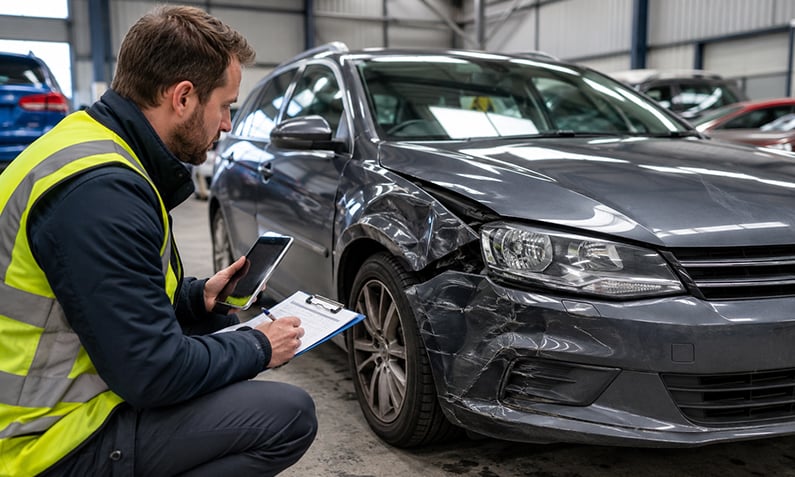
The decision is made by an engineer who inspects the damage or reviews a damage report. They weigh up more than the bare repair bill. The Road Traffic Act 1988 underpins the safety side of this: a structurally compromised car cannot simply be patched up and returned to the road without proper repair and inspection.

Repair cost is rarely the only factor. As one motor claims assessment sets out, insurers also account for recovery, transport, inspection and storage of the vehicle, plus any courtesy car and administrative costs. Once all of those are added together, the engineer decides whether repair makes economic sense.

How is a write-off determined using the repair-to-value ratio?

A write-off is determined by comparing the repair cost against the car’s pre-accident value using a repair-to-value ratio. Most UK insurers set this threshold at around 60-70% of the car’s market value. If the repair bill crosses that line, the car is declared a total loss and you receive a settlement instead.

Here is how the maths works in practice. If your car is worth £10,000 and your insurer uses a 70% threshold, repairs costing more than £7,000 would tip it into write-off territory. On a £5,000 car with a 60% threshold, anything over £3,000 of repairs would do the same.

Car market value Threshold used Repair cost that triggers write-off
£3,000 50% Over £1,500
£5,000 60% Over £3,000
£10,000 70% Over £7,000

Figures are indicative and may change. The exact percentage is not an industry-fixed rule. It varies by insurer and by car, and some insurers apply a lower threshold of around 50% for older vehicles where parts are harder to source. That is why two drivers with similar damage can get different outcomes.

This is also why a car can be written off when the damage looks minor. A small structural fault, an airbag deployment or a hard-to-source part can push the repair bill past the threshold on a lower-value car, even though the dents look superficial.

How is a write-off determined using the repair-to-value ratio

Compare car insurance quotes

How insurers work out the pre-accident market value

The pre-accident market value (PAV) is your car’s market value immediately before the accident, and it is the single most important number in any write-off. Insurers build this figure from the make, model and specification, the age, the mileage, the day-to-day wear and tear, any previous accident repairs, and the general market price for similar cars on sale right now.

Insurers do not pull this out of thin air. The majority use trade valuation guides such as Glass’s Guide for vehicles up to around nine years old, with older or specialist guides used beyond that. CAP HPI is another major data provider that analyses large volumes of real transaction data, and consumer guides feed in as a cross-check on what similar cars actually sell for.

Mileage and condition move the figure noticeably. A car with below-average mileage and a full service history will value higher than the same model with high mileage and patchy paperwork. If your car’s value is a big part of why your premium is set where it is, our guide on how car value affects insurance premiums explains the link.

Repair costs themselves are climbing, which pushes more cars over the write-off line. According to the ABI, in Q1 2026 the average accidental damage claim rose to £3,699, up 8% on the previous quarter, driven by higher parts prices and increasingly complex vehicles. Of the £2.9 billion insurers paid in claims that quarter, £1.9 billion went on vehicle repairs.

Write-off categories and what they mean for value

Write-off categories describe the severity of the damage, not the size of your payout, but they affect what happens to the car afterwards. Since October 2017 the categories have been A, B, S and N, replacing the older C and D system after an ABI update that put structural integrity ahead of repair cost alone.

  • Category A – the most severe. The car can only be scrapped and nothing may be salvaged.
  • Category B – the body shell must be crushed, but parts can be salvaged for reuse.
  • Category S – structural damage that is repairable. The car can return to the road once properly repaired and re-registered.
  • Category N – non-structural damage that still needs repair before the car is roadworthy.

The older categories still appear on vehicle history checks. Under the pre-2017 system, Category C meant repairs cost more than the car’s value, while Category D meant the car was cheaper to repair than replace. The ABI Code of Practice on Vehicle Salvage governs how salvage is categorised and handled.

How the excess and salvage value affect your payout

Your write-off payout is the pre-accident market value minus your policy excess, and if you keep the car the salvage value is deducted too. So a £6,000 car with a £350 excess produces a £5,650 settlement if the insurer keeps the wreck.

Salvage value is what the damaged car is worth as scrap or for parts. Normally the insurer takes ownership of the wreck and sells the salvage to recover some cost. If you want to keep your written-off car, the insurer deducts the salvage value from your settlement and you keep the vehicle. On a Category S or N car, that can let you buy it back and repair it, subject to the proper checks and re-registration with the DVLA.

You cannot legally buy back a Category A or B car to drive. A Category A must be destroyed entirely, and a Category B body shell must be crushed even though parts can be reused. Always tell your insurer if you want to retain salvage, because once they dispose of the car the option is gone.

Check your cover before you need to claim

Comparing quotes across the market helps you see what your car is insured for.

What to do if the write-off offer is too low

You do not have to accept your insurer’s first offer if you believe it undervalues your car. The Financial Conduct Authority states plainly that offering a price lower than fair market value is not allowed under its rules, and its Consumer Duty requires firms to treat total-loss claims fairly.

This is a real and recognised problem. An FCA multi-firm review of insurers covering an estimated 70% of the market found some firms made low initial offers and only increased them when a customer challenged or complained. The review also found most firms automatically deducted 20% from the settlement if a car had ever been a previous total loss, with no sign of considering individual circumstances.

The scale of underpayment became clear in December 2025, when the FCA announced an estimated 270,000 motorists would receive £200m in compensation for historic claims that were underpaid. The cause was automatic deductions for assumed pre-existing damage, which particularly disadvantaged careful drivers who had looked after their cars. By that date £129m had been paid to almost 150,000 customers, with the remainder due to follow into 2026. The FCA confirmed this redress is automatic and warned drivers they do not need a claims management company to receive it.

To challenge a low valuation yourself, gather evidence of what your car was worth.

  • Collect adverts for the same make, model, age, mileage and specification on sale near you.
  • Note any extras: full service history, low mileage, recent tyres or work, optional spec.
  • Put your case in writing to the insurer and ask them to justify their figure against the trade guides.
  • If you cannot agree, escalate a formal complaint, then take it to the Financial Ombudsman Service if the insurer’s final response does not resolve it.

Citizens Advice and the Financial Ombudsman Service both handle a steady stream of valuation disputes, so a well-evidenced challenge is worth making. The Ombudsman can direct an insurer to pay more if it finds the original offer was below fair market value.

See what cover is available for your car

What still owing finance means for your payout

If you still owe finance on a written-off car, the insurer normally pays the settlement to the finance company first, up to the amount outstanding. Any balance left after the loan is cleared comes to you. If the settlement is lower than what you owe, you are left with the shortfall to pay.

This gap is where guaranteed asset protection, known as GAP insurance, comes in. GAP cover pays the difference between the market-value settlement and either the outstanding finance or the original purchase price, depending on the policy. It is an optional add-on, not part of standard motor cover, so check whether you bought it when the car was financed.

Most drivers who comprehensively insure their car do so to protect against exactly this kind of loss. According to Free Price Compare’s own data from early 2026, around nine in ten car insurance buyers through the site choose comprehensive cover rather than third party options. If you are weighing up cover types and running costs, our EV and hybrid insurance comparison may help.

What still owing finance means for your payout

Compare comprehensive car insurance

FAQs about how a write-off value is calculated

How do insurers calculate the payout for a written-off car?

Insurers calculate the payout as your car’s pre-accident market value minus your policy excess. The market value is built from the make, model, specification, age, mileage and condition, cross-checked against trade valuation guides and the price of similar cars currently on sale. If you keep the wreck, the salvage value is also deducted from your settlement.

Do I have to accept the insurer’s first offer?

No, you do not have to accept the first offer if you think it is too low. The Financial Conduct Authority says offering below fair market value breaches its rules, and its 2024 review found some insurers only increased offers when customers challenged them. Gather adverts for similar cars and any evidence of low mileage, full service history or extras, then put your case in writing.

Why was my car written off when the damage looks minor?

A car can be written off even with minor-looking damage when the repair bill crosses the insurer’s repair-to-value threshold, usually around 60-70% of the car’s value. On a lower-value or older car, a small structural fault, a deployed airbag or a hard-to-source part can push repairs past that line. The decision is about cost relative to value, not how the damage looks.

How is the excess handled in the settlement?

Your excess is deducted from the market value before you receive the payout. So a £6,000 car with a £350 excess produces a £5,650 settlement. If your accident was not your fault and the other driver’s insurer settles, you may be able to recover the excess, so keep a record of it.

Can I keep or buy back my written-off car?

You can keep a Category S or N write-off if your insurer agrees, with the salvage value deducted from your settlement, after which it must be properly repaired and re-registered with the DVLA before use. You cannot legally drive a Category A or B car: a Category A must be scrapped entirely and a Category B body shell must be crushed, though its parts can be reused.

How can I find out the salvage value of my car?

The salvage value is what your damaged car is worth as scrap or for parts, and the insurer’s engineer assesses it during the claim. You can ask your insurer to tell you the salvage figure they have used, especially if you want to retain the vehicle. As a rough guide, salvage on a written-off car is a small fraction of its pre-accident value, with the exact amount depending on demand for the parts and the scrap price.

What happens if the payout is lower than my outstanding finance?

If your settlement is lower than the finance still owed, the insurer pays the finance company first and you are left to cover the shortfall. GAP insurance is an optional add-on that covers this difference, paying the gap between the market-value settlement and either the outstanding finance or the original price. Standard comprehensive cover does not include it, so check whether you bought it separately.

Which valuation guides do insurers use to value my car?

Most insurers use trade valuation systems, with Glass’s Guide widely used for vehicles up to around nine years old and older or specialist guides beyond that. CAP HPI is another major provider that analyses large volumes of real transaction data. Consumer pricing guides act as a useful cross-check, but insurers rely mainly on the trade data when setting their offer.

What are the current UK write-off categories?

Since October 2017 the categories have been A, B, S and N. Category A means scrap only with nothing salvageable, Category B means the body shell is crushed but parts can be reused, Category S means repairable structural damage, and Category N means non-structural damage that still needs repair. The older C and D categories still appear on vehicle history checks for cars written off before the change.

How long does it take to receive a write-off settlement?

There is no fixed legal timescale, but a straightforward write-off settlement is often agreed within a few weeks once the engineer has assessed the car and a value is accepted. Disputes over the valuation can extend this, and escalating to the Financial Ombudsman Service adds further time. To speed things up, respond promptly and provide evidence of comparable cars if you want to challenge the figure.

Also Read Related Articles


Information correct as of 25 June 2026. Prices, tariffs, policy details and providers change frequently, so please check the latest details before making a decision. This article is for general information only and does not constitute financial advice.

4000+ reviews