

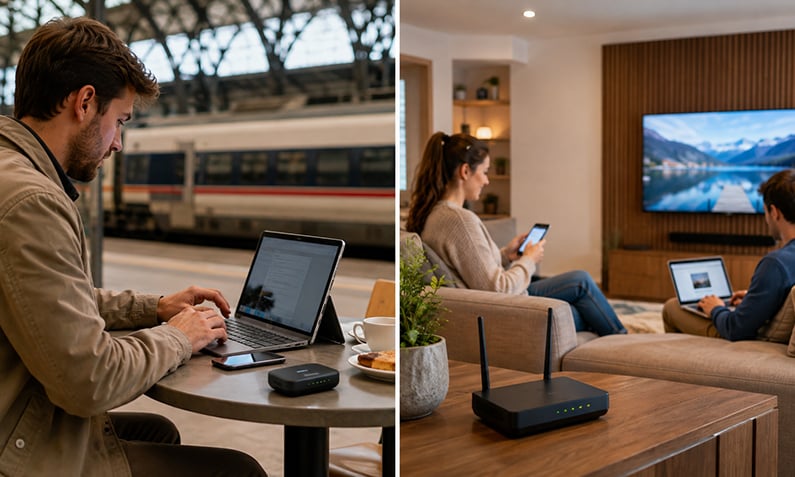

Mobile Broadband vs Home Broadband Explained (UK Guide)

Written by Pratik Aghera
Reviewed by Andrea Troy
6 min read
Updated: 19 Aug 2026
Mobile Broadband vs Home Broadband Explained (UK Guide)

Mobile broadband vs home broadband comes down to one core difference: mobile broadband sends your internet over a 4G or 5G mobile network, while home broadband runs over a fixed line into your property. Both can power a whole household, but they behave differently on speed, upload performance, reliability and price.

This guide explains how each one works, what they cost in the UK in 2026, and who each suits best, using the latest Ofcom coverage data and current provider pricing.

  • Mobile broadband (also called 5G or 4G home broadband, a type of fixed wireless access) uses a SIM and a router to connect over the mobile network, with no engineer visit.
  • Home broadband uses a fixed line (full fibre, part-fibre or cable) and usually offers faster, more consistent speeds and far better upload performance.
  • 5G home broadband can be cheaper and quicker to set up, but speeds depend on local signal. Fibre wins on reliability and uploads where it is available.
  • Full fibre now reaches 82% of UK homes (24.9 million premises) as of January 2026, per Ofcom’s Spring 2026 update.

How each type of broadband actually connects you

Mobile broadband connects your home to the internet over a mobile phone network using a 4G or 5G signal, picked up by a router with a SIM card inside it. This is a form of fixed wireless access (FWA), so there is no cable running into your property and no engineer visit needed.

Home broadband connects your property through a physical line, usually full fibre (FTTP), part-fibre (FTTC) or cable. The connection terminates at a router in your home and delivers a more predictable speed because it does not rely on a mobile mast or local signal strength.

The practical difference matters most for set-up and consistency. Mobile broadband can be live the day your router arrives, while a new fixed line may need an Openreach or cable appointment. In return, a fixed line is far less affected by congestion, weather or where you place the router.

Is mobile broadband the same as a phone hotspot or tethering?

No, mobile broadband is not the same as tethering, although both use the mobile network. Tethering shares one phone’s data connection with another device, which drains the phone battery and is limited by your phone plan’s data allowance.

Mobile broadband uses a dedicated router with stronger internal antennas and, usually, a much larger or unlimited data allowance. It is built to serve a whole household across many devices at once, where tethering is better suited to short-term or single-device use.

James Ford Broadband Deals Reviewed by James Ford, TV and Broadband Expert

Superior

  • New customers only
900Mb average* speed
Unlimited Downloads
£0.00 Setup costs
24 Month contract
Pay as you goCalls
£29.99per month

Full Fibre 150

  • New customers only
  • Switch to Fibrus and they'll cover up to £400 of your switching fees
  • No mid-contract price rises
159Mb average* speed
Unlimited Downloads
£0.00 Setup costs
18 Month contract
Pay as you goCalls
£34.99per month

Extra

  • New customers only
500Mb average* speed
Unlimited Downloads
£0.00 Setup costs
24 Month contract
Pay as you goCalls
£27.99per month

5G home broadband vs fibre: which is faster?

Fixed full fibre is generally faster and far more consistent than 5G home broadband, especially on uploads. Ofcom’s data shows the average UK fixed-line download speed is around 163Mbps, while full fibre packages commonly advertise 150Mbps to 1Gbps.

5G home broadband can still be quick. Three advertises average download speeds of around 150Mbps on its 5G Home Broadband, and Opensignal testing (September 2024) recorded average 5G download speeds ranging from around 80Mbps to 209Mbps across UK networks. The catch is that real speeds depend on your distance from a mast and local congestion.

Upload speed is where the two diverge most. Full fibre typically offers strong upload performance, often 100Mbps or more, while 5G uploads commonly sit in the region of 7Mbps to 50Mbps. If you work from home, back up large files, or stream video, that upload gap is the single biggest reason many households choose fibre.

Feature 5G / mobile broadband Fixed fibre broadband
Connection Mobile network (4G/5G SIM) Fixed line (fibre or cable)
Typical download Around 80–209Mbps (signal-dependent) Around 150Mbps to 1Gbps
Typical upload Around 7–50Mbps Often 100Mbps or more on full fibre
Set-up Self-install, live in days May need an engineer visit
Best for Quick set-up, renters, poor fixed-line areas Heavy use, working from home, gaming

Figures are indicative and may change.

5G home broadband vs fibre: which is faster

Compare broadband deals in your area

How reliable is mobile broadband compared with fixed line?

Mobile broadband is less consistent than fixed fibre because its speed and stability depend on the mobile signal reaching your home. The same congestion, building materials and distance-to-mast factors that affect your phone signal can affect a 5G home router.

Ofcom’s Spring 2026 update reports that 76% to 94% of UK premises can now get an outdoor 5G signal from each mobile operator, up from 64% to 89% a year earlier. Outdoor coverage does not guarantee a strong indoor signal, though, which is why some providers offer an outdoor antenna or hub for homes with weaker reception.

Fixed full fibre tends to deliver a more stable, latency-friendly connection. Latency (the delay before data starts moving) is typically lower on fibre, which matters for video calls and online gaming. If you rely on a rock-solid connection for work, fixed fibre is the safer choice where you can get it.

Can mobile broadband work in rural areas with no fibre?

Yes, mobile broadband can be a strong option in rural areas where fixed full fibre has not yet arrived, provided there is a usable 4G or 5G signal. For homes that can only get slow copper-based broadband, a 5G or 4G router, sometimes paired with an external antenna, can deliver a much faster connection.

Ofcom plans show full fibre could reach 92% of UK homes (28.1 million premises) by the end of 2028, and around 6,950 additional fixed wireless masts are planned or set for upgrade between January 2026 and January 2029. Until fibre reaches you, checking both fixed and mobile options side by side is the sensible move.

Is mobile broadband cheaper than home broadband?

Mobile broadband can be cheaper than home broadband, but not always, and the lowest fibre deals are very competitive. As of June 2026, lower-cost fast fibre packages start from around £14 to £16 a month, while ultrafast connections of 900Mbps and above average around £30.73 a month.

On the mobile side, Three was advertising its 24-month 5G Home Broadband at £18 a month as of early June 2026, with prices stepping up at later April increases. Vodafone’s 5G home broadband starts from around £29 a month for up to 50Mbps. So the cheapest 5G deals undercut mid-range fibre, but premium 5G can cost as much as good fibre.

One cost difference to plan for is mid-contract price rises. Under rules in force since January 2025, providers must state any in-contract increase in pounds and pence before you sign. Ofcom’s 2026 figures put announced fixed broadband rises at between £2 and £4, and mobile service rises at between £1.80 and £2.50.

See current fibre and 5G prices

Are there cheaper tariffs for low-income households?

Yes, social tariffs offer discounted broadband for households on qualifying benefits, and they exist for both fixed and mobile connections. Fibre social tariffs start at around £12.50 a month and some 5G social tariffs from around £10 a month.

Take-up of social broadband and mobile tariffs reached 532,000 customers by June 2025, according to Ofcom, up from 506,000. If you receive Universal Credit or certain other benefits, it is worth asking providers directly, as these tariffs are not always advertised prominently.

Not sure which suits your home?

Compare fixed fibre and 5G home broadband side by side and check what’s available at your postcode.

Can mobile broadband fully replace home broadband?

Mobile broadband can replace home broadband for many households, particularly where the 5G signal is strong and uploads are not a priority. With truly unlimited data plans and routers supporting dozens of devices, a good 5G connection can handle streaming, browsing and most everyday use across a family.

It is less suited to households that depend on consistent uploads or the lowest possible latency, such as heavy remote workers, content creators or competitive gamers. For these users, fixed full fibre’s stronger upload speeds and steadier latency make it the better long-term fit where available.

A useful middle path is to treat mobile broadband as a flexible or stop-gap option. It works well for renters, short tenancies, new-build homes waiting on a fixed line, or as temporary internet while a new connection is set up. You can compare both routes through our broadband comparison hub before committing to a contract.

What advertising claims should you watch out for?

Be cautious with broadband adverts that imply a mobile connection matches fixed-line performance. The Advertising Standards Authority has ruled that an unqualified “superfast mobile broadband” claim can mislead, because mobile speeds are often well below the fixed-line “superfast” definition.

Advertised speeds must also be achievable for at least 50% of customers at peak time (8–10pm) and described as an “average” figure. Treat headline speeds as a guide rather than a guarantee, and check the upload speed and any contract price rises before signing. If you also use a mobile contract, you can compare mobile deals and contracts separately to manage total cost.

Can mobile broadband fully replace home broadband

Check broadband options at your postcode

FAQs about mobile broadband vs home broadband

Can mobile broadband replace home broadband?

Yes, mobile broadband can replace home broadband for many households where the 5G or 4G signal is strong and uploads are not a priority. It comfortably handles streaming, browsing and dozens of devices on unlimited plans. It is less suitable if you need the highest, steadiest upload speeds or the lowest latency, where fixed full fibre remains the better choice.

Is mobile broadband fast enough for streaming and video calls?

Mobile broadband is usually fast enough for HD streaming and video calls when you have a solid 5G signal, with download speeds often well over 100Mbps. Video calls also depend on upload speed, which is weaker on mobile, typically around 7Mbps to 50Mbps. That is enough for most calls, but several people uploading at once can strain it more than fibre would.

Is 5G home broadband as fast as fixed fibre?

5G home broadband can match mid-range fibre on download speed, but it rarely matches full fibre on consistency or upload performance. 5G downloads vary with signal and congestion, while fibre delivers a steadier speed and far higher uploads. For top-tier and gigabit speeds, fixed full fibre remains faster and more reliable.

What is the difference between tethering and mobile broadband?

Tethering shares your phone’s data connection with another device and is limited by your phone plan’s allowance and battery. Mobile broadband uses a dedicated router with a separate SIM, stronger antennas and usually a much larger or unlimited data allowance. Tethering suits short-term, single-device use, while mobile broadband is built to serve a whole household.

How reliable is mobile broadband and will I lose signal?

Mobile broadband reliability depends on the mobile signal reaching your home, so it is less consistent than fixed fibre. Thick walls, distance from a mast and network congestion can all reduce speed or drop the connection. Homes with weaker indoor signal can often improve things with an outdoor antenna or hub, but fixed fibre stays more dependable where available.

Is mobile broadband cheaper than home broadband?

Mobile broadband can be cheaper than home broadband, but the lowest fibre deals are very competitive. As of June 2026, the cheapest 5G home broadband plans and the cheapest fast fibre packages both sit in a similar low monthly range, while premium 5G can cost as much as good fibre. Always compare both alongside any mid-contract price rises stated in pounds and pence.

Do I need a landline for mobile or fixed broadband?

Mobile broadband never needs a landline because it runs entirely over the mobile network. Most fixed broadband no longer needs an active phone line either, as full fibre and cable connections do not use the old copper phone wiring. You can usually take broadband-only without paying for a landline you do not use.

Is mobile broadband good for online gaming?

Mobile broadband can work for online gaming when the signal is strong, but latency is usually higher than on fixed fibre. Fibre typically offers lower, steadier latency, which matters more than raw download speed for responsive gaming. Competitive or latency-sensitive gamers will generally prefer full fibre where it is available.

Can I get mobile broadband in a rural area with poor fixed-line broadband?

Yes, mobile broadband is often a strong option in rural areas with slow copper broadband, as long as there is a usable 4G or 5G signal. A 5G or 4G router, sometimes with an external antenna, can deliver far faster speeds than ageing copper lines. Check the mobile coverage at your postcode before committing, as performance depends on signal strength.

Is mobile broadband a good temporary internet option?

Yes, mobile broadband is a practical temporary option because it can be live within days of the router arriving, with no engineer visit. It suits renters, short tenancies, new-build homes waiting on a fixed line, or covering the gap while a new fixed connection is set up. Look for a short rolling contract if you only need it for a brief period.

Also Read Related Articles


Information correct as of 22 June 2026. Prices, tariffs, policy details and providers change frequently, so please check the latest details before making a decision. This article is for general information only and does not constitute financial advice.

4000+ reviews



