

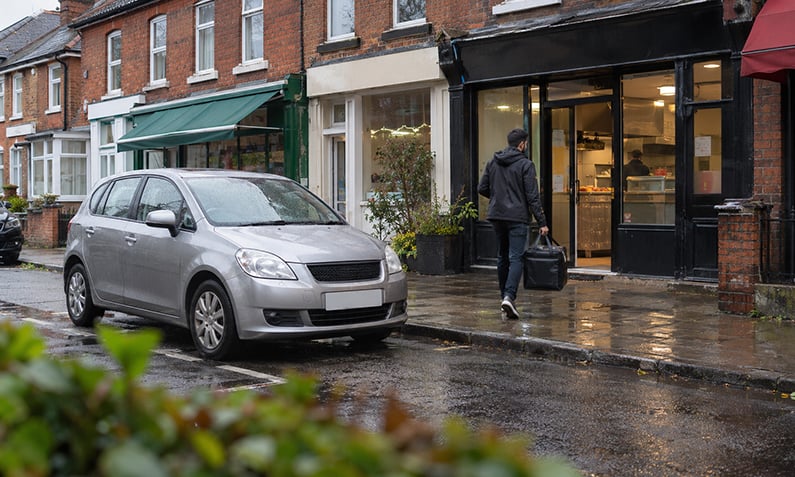



Car Insurance for Delivery and Food Couriers

Written by Tim Bailey
Reviewed by Shay Ramani
5 min read
Updated: 4 Nov 2026
Car Insurance for Delivery and Food Couriers

Car insurance for delivery and food couriers almost always needs hire and reward cover, not standard social, domestic and pleasure or ordinary business use. If you deliver takeaways, groceries or parcels for payment and your policy does not include hire and reward, your insurer can refuse a claim and treat the cover as invalid, leaving you personally liable for damage, injury and third-party costs.

Delivery work means carrying goods for reward, which is a different risk from driving yourself and passengers around. That distinction is the single most common reason couriers end up uninsured without realising it, often after being told that “business use” would be enough. It usually isn’t for food delivery.

Here is what the correct class of use actually is, what it costs in 2026, and how to make sure your policy covers you while you work for platforms like Deliveroo, Uber Eats, Just Eat or a local restaurant.

Quick Answer: Car Insurance for Delivery and Food Couriers

  • Food delivery needs hire and reward cover, not standard business use.
  • Pay-as-you-go car delivery cover starts from around £3.29 an hour (2026).
  • Delivering on a personal-only policy can void your insurance entirely.
  • The ABI average all-driver motor premium was £560 in Q1 2026.
  • You usually need SD&P plus hire and reward on the same policy.

Last updated: November 2026

Written by the Free Price Compare editorial team | Reviewed November 2026

Can you deliver food on standard car insurance?

No, you cannot legally deliver food for payment on a standard car insurance policy. Standard social, domestic and pleasure cover, and even ordinary commuting or business use, insures you for driving yourself and passengers, not for carrying goods for reward. Food delivery is classed as “hire and reward” work, so delivering takeaways on a personal-only policy means driving without valid insurance under the Road Traffic Act 1988.

This catches a lot of new couriers out because “business use” sounds broad enough. Business use typically covers driving between workplaces or to clients as part of a non-delivery job. It does not cover transporting goods, meals or parcels on behalf of a platform or restaurant. If you check your schedule or certificate and it lists taxi, courier and food delivery as excluded, that exclusion applies even if you only do a few runs a week.

Driving uninsured carries serious consequences: a minimum £300 fixed penalty and 6 licence points, or an unlimited fine and disqualification if the case goes to court, plus the risk of your vehicle being seized. If you cause a crash while uninsured, the Motor Insurers’ Bureau may step in to compensate the victim, then pursue you for the full cost.

What car insurance do I need to deliver food?

To deliver food in the UK you need a policy that includes hire and reward cover alongside your normal social, domestic and pleasure (SD&P) cover. Hire and reward insurance is cover for carrying goods or passengers in return for payment, and it is the specific element that makes food delivery legal. Most delivery policies bundle SD&P and hire and reward together so you are covered both when working and when using the car privately.

Hire and reward is not the same as a standard “business use” add-on. Business use extends your personal cover to work-related driving such as visiting different offices, but it still excludes the carriage of goods for reward. Platforms that engage couriers typically require SD&P plus hire and reward precisely because business use alone leaves a gap.

You can usually choose a cover level the same way you would with any car policy, and you can also influence the premium through the excess you agree to carry. Your excess is split into a compulsory part set by the insurer, which you cannot change, and a voluntary part you choose to add on top. Agreeing a higher voluntary excess typically lowers your premium because you are accepting more of the cost of any claim yourself, so it is a trade-off between a cheaper policy now and a larger out-of-pocket payment if you need to claim.

  • Comprehensive covers your own vehicle plus third-party injury and damage, and is by far the most common choice. Around 88-89% of car insurance quotes through Free Price Compare are for comprehensive cover.
  • Third-party, fire and theft covers others plus fire and theft of your car, but not accidental damage to your own vehicle.
  • Third-party only is the legal minimum and covers injury and damage you cause to others, with no cover for your own car.

Because you spend far more time on the road as a courier, and often in congested areas at peak times, the risk profile is higher, which is reflected in the price. If you are weighing whether a car or a van suits your work better, our guide to van insurance for delivery drivers explains how cover differs for larger loads.

Compare delivery and courier car cover

Does business use car insurance cover food delivery?

Business use car insurance does not cover food delivery in almost all cases. Business use (often sold as Class 1, 2 or 3) extends your cover to driving connected with your job, such as travelling between sites or visiting clients, but it specifically excludes carrying goods for hire and reward. Food delivery is the carriage of goods for payment, so it falls outside what business use is designed to cover.

The confusion is common because the word “business” implies all work driving is included. Check the wording on your own certificate or schedule: a typical business-use policy will state that cover excludes use for “hire or reward” and often lists courier, taxi and fast-food delivery as excluded activities outright. If those exclusions are present, any delivery claim can be rejected.

Where business use does matter is making sure your personal, non-delivery driving is also insured on the same policy. The right setup for a courier is SD&P plus hire and reward on one policy, so you are covered whether you are working a shift or doing the school run. For broader context on how work-related classes of use are priced and defined, see our guide to business car insurance.

Does business use car insurance cover food delivery

How much does food delivery insurance cost in 2026?

Zego states that car-based food-delivery cover can start at up to £3.29 per hour for pay-as-you-go insurance. Zego states that its car-based food-delivery cover can start from £138.69 for 30-day hire and reward cover, £149.84 for 30-day combined cover, and £1,392.69 for combined annual cover; actual prices vary by driver, vehicle and location.

For comparison, the ABI average motor premium across all policies sold was £560 in Q1 2026, which was £20 lower than Q1 2025, according to the Association of British Insurers (ABI). That £560 figure covers ordinary private motorists, not couriers, so it is not a like-for-like delivery price. Specialist delivery cover sits well above it because the risk is higher, but the two populations are not directly comparable.

Cover type Indicative 2026 price (car) Best for
Pay-as-you-go (per hour) From around £3.29/hr Occasional, flexible shifts
30-day hire and reward From around £139/month Short-term or seasonal work
30-day combined (delivery + personal) From around £150/month Regular couriers wanting one policy
Annual combined policy From around £1,390/year Full-time delivery work

Price valid as of 02/11/2026

Figures are indicative and may change.

These are starting prices from one specialist insurer reported for 2026, not a market average. Your quote could be lower or materially higher depending on your profile. Comparing across a panel of 130+ insurers is the practical way to see where your own price lands rather than relying on a single headline rate.

Working as a courier?

Check hire and reward and pay-as-you-go cover side by side in minutes.

What should I know about pay as you go food delivery insurance?

Pay-as-you-go food delivery insurance is hire and reward cover you switch on only for the hours you actually work, usually billed per hour or per shift. For car-based delivery, published 2026 examples start from around £3.29 an hour, so you pay nothing when you are not delivering. This suits couriers who work irregular or part-time hours and do not want to pay for a full annual delivery policy.

The arithmetic is the key thing to understand. Pay-as-you-go is cost-effective at low hours but becomes expensive once you work a lot. Using a £3.29 hourly example, five hours a week annualises to roughly £855, eight hours to around £1,369, and fifteen hours a week to around £2,566 over a year. At higher hours, an annual combined policy is usually cheaper than paying by the hour.

A few points worth checking before you buy pay-as-you-go:

  • Whether your personal, non-working driving is covered when the delivery cover is switched off, or whether you need separate SD&P in place.
  • The cover level on offer, since pay-as-you-go can be third-party only, third-party fire and theft, or comprehensive.
  • How your details are recorded on the Motor Insurance Database, so your vehicle shows as insured during working hours.

Zego is one of the main specialist names in this space. If you want product-specific detail, our Zego car insurance guide answers common 2026 questions about how its cover works.

Can you have two insurance policies on the same car?

You can technically hold two policies on the same car, but it is rarely the right approach for food delivery and can cause claims problems. If two insurers each cover the same risk, they may apply contribution rules and reduce or dispute a payout, and you must declare the existence of any other policy. A single policy that combines SD&P and hire and reward is the cleaner, insurer-recommended setup.

Some couriers assume they can keep their existing personal policy and simply add a cheap second “delivery-only” policy on top. In practice, most mainstream insurers set terms that prevent a personal policy being used for courier work, and a separate third-party delivery policy does not fix the exclusion on your main cover. If you deliver on the personal policy, the courier exclusion still applies even if the second policy exists.

The safer route is one combined policy, or a dedicated delivery policy plus clarity on what happens to your private driving when the delivery element is off. Always tell both insurers the full picture, because non-disclosure is grounds to void cover. If you ever disagree with how a claim is handled, the Financial Ombudsman Service can review complaints about FCA-regulated insurers.

See car insurance quotes for courier work

Delivering for Deliveroo, Uber Eats and Just Eat: what cover applies

Delivering for Deliveroo, Uber Eats or Just Eat in a car requires both social, domestic and pleasure cover and hire and reward cover, because you are carrying food for payment on behalf of a platform. The platforms themselves typically provide limited free personal-injury or third-party liability cover during active deliveries, but this does not replace your own motor insurance and does not cover damage to your car or your legal responsibility to insure the vehicle.

Treat any platform-provided cover as a top-up, not your main insurance. You still need a valid hire and reward motor policy in your own name for the vehicle to be legally insured whenever you are working. Read what each platform includes, but never assume it removes the need for your own courier car insurance.

A practical tip: insurers price delivery cover partly on the hours and areas you work, so being accurate about your typical shift pattern avoids a mismatch at claim time. Older, more experienced drivers often find courier cover more affordable than younger ones. If you are a newer driver, our guidance for younger drivers seeking car insurance explains why age and experience weigh so heavily on the price.

What happens if you deliver without hire and reward insurance?

Delivering food without hire and reward insurance means driving without valid cover, so an insurer can refuse any claim and you become personally liable for all costs. If you crash while delivering on a personal-only or business-use policy, the insurer can decline to pay for third-party injury, third-party property damage and your own vehicle, potentially leaving you facing tens of thousands of pounds.

Beyond the financial risk, driving uninsured is a criminal offence under the Road Traffic Act 1988. Penalties include a fixed penalty of £300 and 6 points, or an unlimited fine, a driving ban and vehicle seizure if the matter reaches court. Police use automatic number-plate recognition checked against the Motor Insurance Database, so a vehicle showing no valid cover for the activity can be stopped and seized.

There is also a future cost. A refused delivery claim or an uninsured-driving conviction must be declared when you next buy insurance and will push up future premiums for years. Getting the correct class of use from the start is far cheaper than any of these outcomes. You can compare car insurance with the right cover for courier work before you take on any shifts.

What happens if you deliver without hire and reward insurance

Get the right class of use for delivery

FAQs about car insurance

Do I need special insurance to deliver food in the UK?

Yes. Delivering food for payment in a car requires hire and reward insurance in addition to your normal social, domestic and pleasure cover. Standard personal policies and ordinary business use exclude carrying goods for reward, so delivering on them leaves you uninsured. The correct setup is one policy combining SD&P and hire and reward.

Can I deliver food on standard car insurance just occasionally?

No. The exclusion for courier and food delivery applies even if you only do a handful of runs a week. A standard policy does not cover the carriage of goods for reward at any volume, so a single delivery on it could invalidate a claim. Pay-as-you-go cover exists precisely for occasional or part-time delivery work.

What is the difference between hire and reward and business use?

Business use extends your personal cover to work-related driving such as visiting clients or different offices, but excludes carrying goods for payment. Hire and reward specifically covers transporting goods or passengers in return for money, which is what food delivery is. For couriers, business use alone is not enough; you need hire and reward.

Does the platform's free insurance cover my car?

No. Delivery platforms typically provide limited personal-injury or third-party liability cover only during active deliveries. This does not cover damage to your own vehicle and does not satisfy the legal requirement to insure the car yourself. You still need a valid hire and reward motor policy in your own name to drive legally.

How much does pay as you go food delivery insurance cost?

Pay-as-you-go car delivery cover starts from around £3.29 an hour based on published 2026 examples, and you only pay for the hours you work. It is cost-effective at low hours but gets expensive at scale; fifteen hours a week can annualise to over £2,500. Beyond moderate hours, an annual combined policy is usually cheaper.

What happens if I crash while delivering without the right cover?

Your insurer can refuse the claim entirely, leaving you personally liable for third-party injury, property damage and repairs to your own car. You could also face a £300 fine and 6 points, or an unlimited fine and a ban if prosecuted, plus vehicle seizure. A refused claim or conviction then raises your premiums for years.

Is courier car insurance more expensive than normal car insurance?

Yes, because couriers spend far more time on the road, often in busy areas at peak times, which raises the risk. The ABI average all-driver motor premium was £560 in Q1 2026, while annual combined delivery policies can start from around £1,390. The two are not like-for-like, as they cover very different risk profiles.

What insurance do restaurants need if drivers use their own cars?

If a restaurant's drivers use their own cars for deliveries, each driver generally needs their own hire and reward motor insurance to be legally covered. The restaurant should also hold employers' liability and public liability cover, and confirm that drivers carry valid delivery cover, as the individual's personal motor policy will not include it.

Do I need commercial insurance to deliver newspapers or parcels?

Delivering newspapers, parcels or any goods for payment counts as hire and reward work, so you need hire and reward cover, not just standard business use. The exact level depends on the vehicle and volume, but the carriage of goods for reward is excluded from ordinary personal and business-use car policies regardless of what you are delivering.

Can I switch pay-as-you-go cover off when I'm not working?

Yes, that is the point of pay-as-you-go: delivery cover applies only for the hours you activate. Check whether your personal, non-working driving remains insured when the delivery element is off, because some products require separate social, domestic and pleasure cover to keep the car legal between shifts.

Does my address affect how much delivery insurance costs?

Yes, significantly. Insurers price delivery cover on postcode, vehicle, your age, claims history, cover level and the hours and areas you work. Two couriers doing identical work can pay very different prices based on where they live and park. Comparing multiple insurers is the practical way to find where your own price lands.

Also Read Related Articles


Information correct as of 2 November 2026. Prices, tariffs, policy details and providers change frequently, so please check the latest details before making a decision. This article is for general information only and does not constitute financial advice. Free Price Compare is authorised and regulated by the Financial Conduct Authority (FCA).

4000+ reviews