







Sky vs Plusnet Broadband: Which Should You Pick?

Written by Shay Ramani
Reviewed by Tim Bailey
10 min read
Updated: 25 Aug 2026
Sky vs Plusnet Broadband: Which Should You Pick?

Sky vs Plusnet broadband comes down to a simple trade-off: Sky bundles more (a better router, easy TV add-ons and its own extras), while Plusnet consistently prices its full fibre tiers lower and scores well for value. Both run mainly on the Openreach network, so in most UK postcodes the underlying line and headline speeds are the same.

For a UK household choosing a home broadband deal, that means the real decision is about price, router quality, customer service and how you feel about mid-contract price rises, not raw speed. Free Price Compare checks live deals across whole-of-market broadband providers so you can see both side by side for your own address before committing.

Quick Answer: Sky vs Plusnet Broadband

  • Both Sky and Plusnet mostly use the Openreach network, so full fibre speeds (74Mbps up to 900Mbps+) are identical at the same address, per each provider’s availability data (14/08/2026).
  • Plusnet often prices its full fibre tiers lower, with Full Fibre 900 seen from around £29.99/month on a 24-month deal, while Sky tends to bundle a better WiFi router and TV extras (14/08/2026).
  • Sky confirmed broadband price rises of £3 a month from 1 April 2026 on affected tariffs., so check the in-contract and out-of-contract price, not just the intro price.
  • Full fibre (FTTP) is now available to 82% of UK homes and gigabit-capable broadband to 89% of premises, per Ofcom’s Connected Nations update (Spring 2026, data as of January 2026).
  • You cannot get Sky TV bundled into a Plusnet broadband contract, but you can stream Sky content via NOW or add a Sky TV package separately alongside Plusnet.

Last updated: August 2026

Written by the Free Price Compare editorial team | Reviewed August 2026

How Sky and Plusnet broadband differ at a glance

Sky and Plusnet differ most on bundling and price, not speed: Sky includes a more capable WiFi router and easy TV add-ons at a slightly higher price, while Plusnet strips things back and prices its full fibre tiers lower. Both providers deliver broadband over the Openreach network in the vast majority of UK homes, which means the download and upload speeds you can order are set by the line to your property, not the brand on the bill. Sky’s own broadband page shows its full fibre packages reaching around 79% of homes as of 14/08/2026, while Plusnet’s full fibre spans 74Mbps to 900Mbps on the same infrastructure. The practical difference is what you get around the connection: router, extras, contract terms and support.

Feature Sky Plusnet
Network Mainly Openreach FTTP / FTTC Mainly Openreach FTTP / SOGEA
Full fibre range 75Mbps to Gigafast (900Mbps+) 74Mbps to 900Mbps
Router Sky WiFi router, mesh boosters available Plusnet Hub, simpler spec
TV bundling Sky TV, Sky Stream, Netflix add-ons No integrated TV
Typical positioning More extras, mid-market price Value pricing, no-frills

Figures are indicative and may change.

If you want a wider view before you decide, our Sky vs BT broadband comparison and Plusnet vs BT broadband guide show how each provider stacks up against their sister and rival brands.

Compare Sky and Plusnet deals for your postcode

Sky and Plusnet Broadband Deals

Full Fibre 75

  • New customers only
  • Prices may change during 24-month minimum term | Get up to £200 switching credit
75Mb average* speed
Unlimited Downloads
£0.00 Setup costs
24 Month contract
Pay as you goCalls
£24.00per month

Sky Stream, Essential TV, Netflix & Full Fibre 75

  • New customers only
  • Prices may change during 24-month minimum term | Get up to £300 switching credit
75Mb average* speed
TV channels
£0.00 Setup costs
24 Month contract
Pay as you goCalls
£35.00per month

Full Fibre 145

  • New customers only
145Mb average* speed
Unlimited Downloads
£20.00 Setup costs
24 Month contract
Pay as you goCalls
£22.99per month

Full Fibre 300

  • New customers only
300Mb average* speed
Unlimited Downloads
£20.00 Setup costs
24 Month contract
Pay as you goCalls
£23.99per month

Sky Stream, Ultimate TV, Netflix, Disney+, HBO Max, Hayu & Full Fibre 75

  • New customers only
  • Prices may change during 24-month minimum term | Get up to £300 switching credit
75Mb average* speed
TV channels
£0.00 Setup costs
24 Month contract
Pay as you goCalls
£41.00per month

Fibre

  • New customers only
66Mb average* speed
Unlimited Downloads
£20.00 Setup costs
24 Month contract
Pay as you goCalls
£22.99per month

Which is faster, Sky or Plusnet?

Neither Sky nor Plusnet is faster than the other at the same address, because both order the same Openreach line and the maximum speed is fixed by the fibre available to your property. On full fibre (FTTP), both offer tiers from around 74Mbps up to 900Mbps download, and Sky quotes example speeds of 300Mbps download / 40Mbps upload on Full Fibre 300 and 500Mbps download / 60Mbps upload on Full Fibre 500 (Sky, 14/08/2026). Gigabit-capable broadband now reaches 89% of UK residential premises, according to Ofcom‘s Connected Nations update (Spring 2026, data as of January 2026), so most households can now order these top tiers from either provider.

The one nuance is older part-fibre lines. On FTTC / SOGEA “fibre to the cabinet” connections, small differences in how each provider provisions the line can produce a few Mbps of variation, but this is minor and disappearing as full fibre rolls out. If you have a choice, pick a full fibre (FTTP) tier from either provider for symmetrical, reliable speeds rather than a legacy fibre-to-the-cabinet product.

Which is faster, Sky or Plusnet

Sky vs Plusnet broadband comparison on price

Plusnet is usually the cheaper of the two on full fibre, while Sky prices are offset by the router and TV extras it includes. On Sky’s own deals page, Full Fibre 900 is shown at £17/month for 24 months, with a standard price of £52/month after the minimum term; Plusnet’s own residential price guide shows Full Fibre 74 at £34.99 and higher tiers priced accordingly. According to Ofcom‘s Pricing Trends report, the average UK monthly spend on a standalone broadband service was around £27 a month. Prices shift constantly and vary by address, so treat these as illustrative rather than a live quote.

That gap explains why checking whole-of-market matters: the headline Sky or Plusnet promo is not always the cheapest gigabit deal at your postcode.

Tier (indicative) Sky (promo, indicative) Plusnet (promo, indicative)
Around 74/75Mbps From around the mid £20s From around £21.99
Around 145/150Mbps From around £23 From around £22.99
Around 300Mbps Promo-dependent From around £24.99
Around 500Mbps From around £26 From around £27.99
Around 900Mbps Promo from around £29, standard around £52 From around £29.99

Figures are indicative and may change.

Check what full fibre costs at your address

See live Sky and Plusnet prices side by side before you commit.

Which broadband provider is better for customer service?

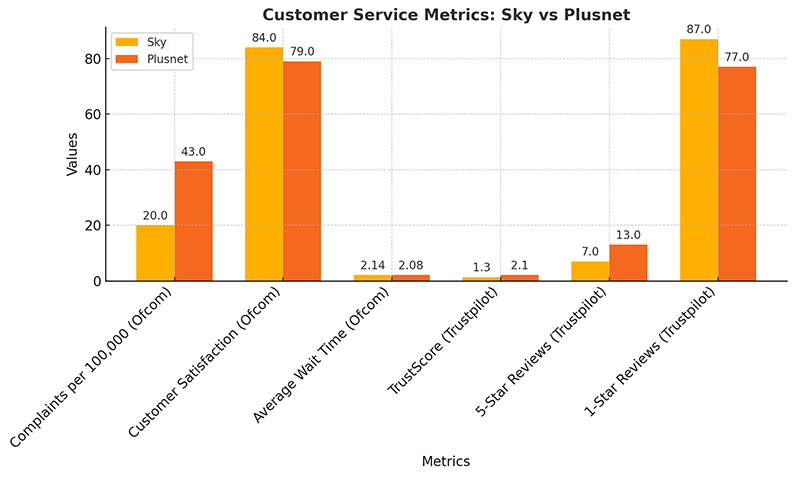
Plusnet is the provider that has historically built its reputation on customer service, with UK-based support that has repeatedly ranked well for value and helpfulness, while Sky tends to sit around mid-table in industry satisfaction. Neither is consistently poor, and experience varies by region and issue type. Ofcom publishes regular comparisons of complaints and satisfaction for the largest UK broadband providers on its site, and checking the latest edition for the two brands is the most reliable way to judge current performance rather than relying on anecdote. According to Ofcom’s complaints report for Q1 2026 (January to March 2026), TalkTalk was the most complained-about broadband provider while Plusnet had the fewest at four complaints per 100,000 customers, against an industry average of six per 100,000.

In day-to-day terms, both providers handle installation, faults and moves through Openreach, so the physical work is the same. What differs is the phone and chat experience: Plusnet leans on straightforward, value-focused support, while Sky offers broader online account tools and app-based management alongside its call centres. If reliable, human support matters most to you, Plusnet is worth shortlisting; if you want a slicker app and TV in one account, Sky has the edge.

What router do you get with Sky and Plusnet?

Sky includes a more capable WiFi router (its current Sky WiFi hardware, with mesh WiFi boosters available on higher tiers), while Plusnet supplies a simpler, functional Hub that covers most homes but is less feature-rich. For a typical two to three-bedroom home, either router handles everyday streaming, video calls and browsing without issue. The difference shows up in larger or multi-storey properties, where Sky’s mesh options and newer hardware give more consistent whole-home coverage out of the box. Sky’s WiFi Max add-on promises **up to 25Mbps in every room** for eligible full-fibre customers, according to Sky’s published WiFi Max terms dated July 2023 (as reported by Choose).[8]

If coverage is a concern with either provider, you can add your own mesh system or ask about the provider’s boosters rather than switching brand for the router alone. Both routers support the speeds of the plan you order, so the router affects WiFi coverage inside your home, not the raw line speed coming in. For very fast tiers, using a wired connection or a modern mesh matters more than which of the two hubs you have.

See which router comes with your broadband deal

Can I get Sky TV with Plusnet broadband?

No, you cannot bundle Sky TV inside a Plusnet broadband contract, because they are separate companies with separate billing, but you can still watch Sky content alongside Plusnet broadband. The straightforward route is streaming: a NOW subscription or Sky Stream / Sky Glass runs over any broadband connection, including Plusnet’s, and needs no dish. You would simply pay Plusnet for broadband and Sky (or NOW) separately for the TV. Sky says Sky Glass and Sky Stream work without a satellite dish, stream via broadband, and require a minimum recommended speed of 25Mbps; Sky Glass also has no separate box and can be used with broadband from other providers, per Sky’s current product pages. [4][10]

If you want everything on one bill and one account, that is Sky’s advantage, since Sky broadband, Sky TV and add-ons like Netflix can sit together. With Plusnet you save on the broadband line but manage TV as a standalone service. For households that watch a lot of live sport or Sky exclusives, weigh the convenience of a single Sky bill against the lower broadband cost of pairing Plusnet with a streaming subscription.

How do mid-contract price rises compare?

Both Sky and Plusnet apply price changes during a contract, so the in-contract and out-of-contract price matters as much as the intro deal. Sky confirmed broadband price rises of £3 a month from 1 April 2026 on affected tariffs., illustrating how quickly the monthly cost can climb once you’re signed up. Under the Ofcom rules on in-contract price rises, providers must now set out any increase in pounds and pence at the point of sale rather than tying it to inflation, which makes it easier to compare the true cost across Sky and Plusnet.

Before you sign, note three prices: the promotional monthly cost, any scheduled in-contract rise, and the standard price you’ll pay once the deal ends. Sky’s Full Fibre 900 standard price of around £52/month after the promo (Sky, 14/08/2026) is a reminder that letting a deal roll on is where households overpay. Setting a reminder to compare again when your contract ends is the single most effective way to keep your bill down.

Coming to the end of a broadband deal?

Compare current Sky, Plusnet and whole-of-market prices in minutes.

Which should you choose, Sky or Plusnet?

Choose Sky if you want a better router, one account for broadband and TV, and app-based extras; choose Plusnet if your priority is the lowest sensible full fibre price with solid, value-focused support. Because both run on Openreach, the speed you can order is the same at your address, so this is a decision about bundling, budget and how much the router and TV matter to you. A single-person or couple household chasing the cheapest reliable line usually suits Plusnet; a family wanting whole-home WiFi and Sky content in one place usually suits Sky.

  • Pick Plusnet for the lowest full fibre monthly price and straightforward, UK-based support.
  • Pick Sky for a stronger router, mesh options and easy TV and streaming add-ons on one bill.
  • Either way, order a full fibre (FTTP) tier where available for the most reliable speeds.
  • Always check the in-contract rise and out-of-contract price, not just the intro deal.

Whichever you lean towards, run both through a live comparison first. Free Price Compare checks deals across whole-of-market broadband providers, so you can confirm the real price at your postcode and see whether a third provider beats both. Our Plusnet vs Virgin Media comparison and Sky vs Virgin broadband guide are useful if a cable option is available on your street, and our TalkTalk vs Sky guide covers another value-focused alternative.

Which should you choose, Sky or Plusnet

Compare whole-of-market broadband deals now

FAQs about sky vs Plusnet broadband

Is Plusnet faster than Sky broadband?

No, Plusnet is not faster than Sky at the same address because both providers use the Openreach network, so the maximum speed is fixed by the fibre line to your property. At a given postcode, ordering Full Fibre 300 or 900 gives the same download speed on either brand. Small differences only appear on older fibre-to-the-cabinet lines, and those are minor.

Which is cheaper, Sky or Plusnet broadband?

Plusnet is usually cheaper than Sky on full fibre tiers, often pricing gigabit broadband a few pounds a month lower, while Sky’s higher price includes a better router and TV options. Prices change constantly and vary by address, so the only reliable answer is to compare live deals for your own postcode before deciding.

Do Sky and Plusnet use the same network?

Yes, both Sky and Plusnet deliver broadband over the Openreach network in the vast majority of UK homes, which is why speeds and line reliability are effectively the same at a given address. The difference between them is the router, extras, customer service and price rather than the underlying connection.

Which has better customer service, Sky or Plusnet?

Plusnet has historically ranked well for value-focused, UK-based customer service, while Sky tends to sit around mid-table in industry satisfaction, though experience varies by region and issue. Checking the latest Ofcom comparison of complaints and satisfaction for the largest providers is the most reliable way to judge current performance.

How does switching from Sky to Plusnet or back work?

Switching between two Openreach providers like Sky and Plusnet is handled through the One Touch Switch process, where you sign up with the new provider and they arrange the changeover. More than 2 million customers used One Touch Switch to change broadband or landline provider between its September 2024 launch and the end of 2025, according to Ofcom. No new wires are usually needed if you already have an Openreach line.

Do Sky or Plusnet raise prices mid-contract?

Both Sky and Plusnet apply price changes during a contract, and Sky confirmed broadband rises of £3 a month from 1 April 2026 on affected tariffs. Providers must now show any in-contract rise in pounds and pence at the point of sale, so check the intro price, any scheduled increase and the standard price after the deal ends.

Is full fibre available from Sky and Plusnet at my address?

Full fibre (FTTP) is available to 82% of UK homes and gigabit-capable broadband to 89% of premises, according to Ofcom’s Connected Nations update (Spring 2026, data as of January 2026). Availability still varies street by street, so the only way to confirm which full fibre tiers Sky or Plusnet can offer you is a postcode check on a live comparison.

Should I choose a longer contract with Sky or Plusnet?

Longer 24-month contracts from Sky or Plusnet usually carry lower monthly prices than shorter deals, but they lock you in for two years and often include an in-contract price rise. If you may move home or want flexibility, weigh a slightly higher monthly cost against the freedom to leave sooner, and always note the price you’ll pay once the deal ends.

Is a rolling monthly broadband contract worth it with these providers?

A rolling monthly broadband contract can be worth it if you need short-term flexibility, such as renting or expecting to move soon, but it usually costs more per month than a fixed-term Sky or Plusnet deal. If you plan to stay put for a year or more, a 12 or 24-month full fibre plan is normally better value.

Can I keep my phone number if I switch between Sky and Plusnet?

Yes, you can usually keep your landline number when switching between Sky and Plusnet, as number portability is standard on Openreach-based services. Tell the new provider you want to retain your number during sign-up, and it is carried across as part of the switch rather than being lost.

Also Read Related Articles


Information correct as of 14 August 2026. Prices, tariffs, policy details and providers change frequently, so please check the latest details before making a decision. This article is for general information only and does not constitute financial advice. Free Price Compare is authorised and regulated by the Financial Conduct Authority (FCA).

4000+ reviews