





Fuse Energy vs OVO Energy: Which Should You Pick?

Written by Shay Ramani
Reviewed by Pratik Aghera
6 min read
Updated: 18 Sep 2026
Fuse Energy vs OVO Energy: Which Should You Pick?

Fuse Energy vs OVO Energy comes down to a straightforward trade-off: in a recent August 2026 tariff snapshot, Fuse Energy’s cheapest fixed deal came in more than £240 a year lower than OVO’s cheapest fixed deal, but OVO offers established dual-fuel supply and bundled extras that Fuse’s cheaper headline price does not include. If you want the lowest fixed price and are comfortable with a newer supplier, Fuse looks strong; if you value a longer track record or want boiler cover built in, OVO has the edge.

Both suppliers charge standard variable tariffs that track the Ofgem price cap, so on a like-for-like variable deal the difference between them is small. Free Price Compare sources tariff and market data from Ofgem publications and live supplier rate cards, and the figures below are a dated snapshot rather than a permanent ranking, because energy prices change every few months.

Quick Answer: Fuse Energy vs OVO Energy

  • Fuse Energy is a newer, app-based supplier that now offers dual-fuel gas and electricity, not electricity only as it did at launch.
  • In an August 2026 snapshot, Fuse’s cheapest fixed tariff (July 2026 Fixed 15m V17) was around £1,683/year versus OVO’s cheapest fixed at around £1,923/year, but OVO’s fixed deal includes boiler cover so it is not a like-for-like comparison.
  • Both suppliers’ standard variable tariffs cost about the same under identical price-cap assumptions, so the real gap is on fixed deals.
  • Both Fuse and OVO charge a £100 exit fee on the fixed tariffs in this snapshot, so factor that in if you might switch again before the term ends.
  • If Fuse or OVO stopped trading, Ofgem’s Supplier of Last Resort process protects your credit balance and moves you to a new supplier automatically.

Last updated: August 2026

Written by the Free Price Compare editorial team | Reviewed August 2026

Fuse Energy vs OVO Energy: which is cheaper right now?

Fuse Energy was the cheaper of the two on fixed tariffs in an August 2026 pricing snapshot, with its cheapest overall deal around £1,683 a year against OVO’s cheapest at roughly £1,805 to £1,923 a year depending on the product compared. Fuse’s July 2026 Fixed (15m) V17 was reported at £1,683/year on a 15-month term with a £100 exit fee, while OVO’s 1 Year Fixed with Boiler Cover was around £1,923/year on a 12-month term, also with a £100 exit fee. Those two fixed deals are not directly comparable, because the OVO price includes boiler cover and the Fuse price does not. On standard variable tariffs the picture is different: Fuse’s Variable Import and OVO’s Simpler Energy both came in around £1,805/year under the same price-cap assumptions, so a variable-to-variable switch between them would barely move your bill.

These figures are a dated snapshot for typical dual-fuel use, not a permanent market ranking. Both suppliers reprice regularly, and your actual annual cost depends on your usage, region, meter type and payment method.

Tariff (Aug 2026 snapshot) Fuse Energy OVO Energy
Cheapest fixed deal Around £1,683/year (July 2026 Fixed 15m V17) Around £1,923/year (1 Year Fixed + Boiler Cover)
Standard variable tariff Around £1,805/year (Variable Import) Around £1,805/year (Simpler Energy)
Exit fee on fixed deal £100 £100
Boiler cover included on fixed? No Yes (on the deal above)

Figures are indicative and may change.

Compare live energy tariffs for your postcode

Who are Fuse Energy?

Fuse Energy is a newer UK domestic energy supplier built around a mobile app, positioned as a low-price challenger with competitive fixed tariffs. It launched as an electricity-only supplier and has since expanded to offer dual-fuel gas and electricity, plus multi-rate products aimed at electric vehicle owners and homes with time-of-use meters. Fuse is regulated by Ofgem, the same regulator that oversees every licensed GB energy supplier, so the standard consumer protections apply to it exactly as they do to larger, longer-established firms.

Fuse’s appeal is price and app-based account management. Press coverage in 2026 reported Fuse electricity unit rates undercutting the price cap, including standard variable pricing around 23.20p/kWh for electricity with a standing charge near 57.36p/day, though those are publisher-reported estimates rather than independently verified rate cards. If you want a fuller picture of how Fuse stacks up against the market, our Fuse Energy vs Octopus Energy comparison covers another popular head-to-head.

Does Fuse Energy supply gas as well as electricity?

Yes, Fuse Energy now supplies gas as well as electricity, so it can offer dual-fuel deals rather than electricity only. Fuse originally launched as an electricity-only supplier, which is why some older comparisons and reviews still describe it that way, but it has expanded into dual fuel. This matters directly for the Fuse Energy vs OVO Energy decision, because OVO has always supplied both gas and electricity, and dual-fuel supply from a single company is simpler to manage and can carry a small dual-fuel discount.

If your home has both a gas meter and an electricity meter, always compare dual-fuel prices rather than mixing an electricity-only quote with a separate gas deal, as it changes the total cost materially. Some of the very cheap Fuse figures reported in the press were electricity-only, so check whether a headline price includes gas before you treat it as a like-for-like comparison. Our guide on avoiding hidden costs on dual-fuel deals explains what to check before you commit.

Is Fuse Energy any good, and can you trust a newer supplier?

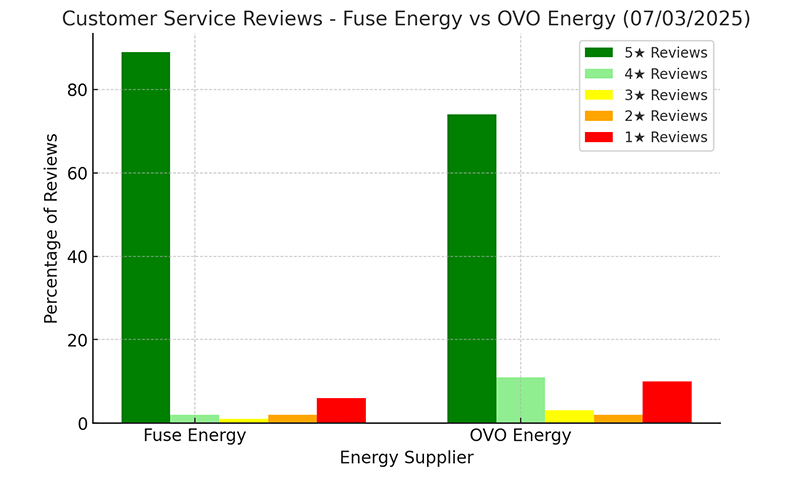
Fuse Energy scores well for its app and customer reviews and is a fully licensed, Ofgem-regulated supplier, so a newer name does not mean weaker consumer protection. Every domestic supplier in Great Britain, new or established, operates under the same Ofgem licence conditions, and the same rules on billing accuracy, complaint handling and credit-balance protection apply. Independent review scores for Fuse in 2026 have been strong, particularly for its app-based account management, though its overall review volume is smaller than OVO’s simply because it is a younger company.

The reasonable caution with any challenger supplier is that its track record is shorter, so there is less history to judge how it handles problems at scale. If that concerns you, weigh Fuse’s lower fixed price against OVO’s longer operating history and larger customer base. The key protection to understand is what happens to your money if a supplier fails, which the next section covers.

Is Fuse Energy any good, and can you trust a newer supplier

Not sure which supplier fits your usage?

See how Fuse, OVO and the big suppliers compare on price and service.

What happens to your credit if Fuse or OVO goes bust?

Your credit balance is protected if either Fuse or OVO stops trading, because Ofgem’s Supplier of Last Resort (SoLR) process automatically moves you to a new supplier and safeguards the money you are owed. Under this process, run by Ofgem, your gas and electricity supply continues without interruption, your account is transferred to an appointed replacement supplier, and any credit balance on your account is honoured. You do not need to do anything in the moment except take meter readings and wait to be contacted by the new supplier.

This protection is identical for a newer supplier like Fuse and an established one like OVO, which is why supplier size alone should not drive your choice. The practical tips are to keep your account in modest credit rather than large credit, and to keep photos of recent meter readings, so any transfer is settled accurately. Ofgem’s consumer protection rules mean losing a supplier is an administrative event, not a loss of your energy or your money.

Are there exit fees for leaving Fuse or OVO?

Both Fuse and OVO charge exit fees on their fixed tariffs, with the fixed deals in this August 2026 snapshot each carrying a £100 exit fee, while their standard variable tariffs are exit-fee free. An exit fee is a charge you pay for leaving a fixed-term contract early, before the agreed end date. Standard variable tariffs never carry exit fees, so if you are on either supplier’s variable deal you can switch away at any time without penalty. Ofgem rules also let you switch away from a fixed tariff penalty-free in the final 49 days before it ends.

The exit fee matters most if you might want to switch again before the fixed term is up, for example if cheaper deals appear. On a 15-month Fuse fix, a £100 exit fee is a small fraction of a typical annual bill, so it rarely outweighs a genuine saving, but always weigh the fee against the saving from moving. Our explainer on how the price cap affects fixed tariff pricing helps you judge whether a fix is worth locking in.

See fixed and variable tariffs side by side

Fixed vs variable: which tariff type suits you?

A fixed tariff locks your unit rates and standing charge for the term, while a standard variable tariff moves with the Ofgem price cap and can rise or fall each cap period. On the Fuse Energy vs OVO Energy comparison this is the pivotal choice, because the two suppliers’ variable tariffs are priced almost identically, so the meaningful price gap between them only appears on fixed deals, where Fuse was cheaper in the August 2026 snapshot. The Ofgem price cap limits the maximum unit rates and standing charge a supplier can charge a typical direct-debit customer on a variable tariff, and it is reviewed every three months, so a variable bill is never fixed.

Choose a fixed tariff if you want price certainty and dislike bill surprises, and choose variable if you think cap rates will fall or you want the freedom to switch with no exit fee. A fix from Fuse at around £1,683/year would sit below both suppliers’ variable pricing of around £1,805/year in this snapshot, which is the core argument for locking in a Fuse fix if the price certainty appeals to you.

Which supplier has better customer service and reviews?

OVO has a far larger review base built over years of trading, while Fuse tends to score highly for its app and switching experience despite being a younger supplier with fewer reviews. Independent 2026 review scores put Fuse ahead on satisfaction in some roundups, driven largely by its app-based account management, though its smaller sample size makes those scores less settled than OVO’s. OVO grew substantially after taking on SSE’s domestic accounts and now serves a large customer base, so its service is judged across a much wider spread of situations.

Service quality is personal, so weigh recent, verified reviews rather than any single score, and consider how you prefer to manage your account, whether by app, phone or online. If app-first management appeals, Fuse is built around that; if you want a large established provider with broad phone and online support, OVO fits that better. For wider context on how the biggest suppliers compare on service, see our big suppliers comparison guide.

How to switch to Fuse or OVO with confidence

Switching to Fuse or OVO takes a few minutes online and completes within around 21 days under Ofgem’s switching rules, with a 14-day cooling-off period during which you can cancel. Start by taking a current meter reading and finding a recent bill, so you can enter your annual usage in kilowatt hours (kWh) for an accurate quote rather than a rough estimate. Compare dual-fuel prices for your postcode, because energy rates vary by region and a national headline price may not match your area.

Check three things before you commit: whether the quote is fixed or variable, whether it includes both gas and electricity, and the exit fee if it is a fixed deal. A smart meter is not required to switch, and you keep the same physical supply and pipes, so there is no interruption to your gas or electricity. If you are weighing Fuse against other suppliers as well, our Fuse Energy vs E.ON Next comparison is a useful next read.

How to switch to Fuse or OVO with confidence

Get a switching quote for your home

FAQs about fuse energy vs ovo energy

Is Fuse Energy cheaper than OVO on fixed and variable tariffs?

In an August 2026 snapshot, Fuse's cheapest fixed tariff came in around £240 a year lower than OVO's cheapest fixed deal, though OVO's included boiler cover so it was not a like-for-like comparison. On standard variable tariffs both suppliers cost about the same under identical price-cap assumptions, so the real price gap appears on fixed deals rather than variable ones.

Is Fuse Energy any good?

Fuse Energy scores highly for its app and switching experience in independent 2026 reviews and is a fully licensed, Ofgem-regulated supplier. Its overall review volume is smaller than OVO's because it is a newer company, but the same consumer protections and licence conditions apply to it as to larger suppliers.

What happens to my credit if Fuse Energy or OVO goes bust?

Your credit balance is protected because Ofgem's Supplier of Last Resort process automatically transfers you to a new supplier and honours money you are owed. Your gas and electricity supply continues without interruption. Take meter readings and wait to be contacted by the new supplier, and keep your account in modest rather than large credit as a precaution.

Which is better for dual fuel, Fuse or OVO?

OVO has always supplied both gas and electricity and has a longer dual-fuel track record, while Fuse now offers dual fuel too and was cheaper on fixed pricing in the August 2026 snapshot. For dual fuel, compare the total annual cost for both fuels together, plus whether extras like boiler cover are bundled in.

How long does it take to switch to Fuse or OVO?

A switch to either supplier usually completes within around 21 days under Ofgem's switching rules, and you get a 14-day cooling-off period during which you can cancel. Your physical supply and pipes stay the same, so there is no interruption to your gas or electricity while the switch processes.

Do I need a smart meter to switch to Fuse or OVO?

No, you do not need a smart meter to switch to Fuse or OVO. A smart meter can make billing more accurate and get access to some time-of-use tariffs, but a standard meter is fine for most tariffs. If you switch to a multi-rate or EV tariff, you may need a smart or Economy 7 meter to record usage by time of day.

Is a fixed or variable tariff the better choice with these suppliers?

A fixed tariff locks your rates for the term and suits people who want bill certainty, while a variable tariff tracks the Ofgem price cap and can rise or fall. With Fuse and OVO the variable prices are nearly identical, so a fixed deal, where Fuse was cheaper in the snapshot, is where the two suppliers actually differ on price.

Why do some Fuse Energy prices look extremely cheap?

Some very low Fuse prices reported in the press were electricity-only figures or multi-rate tariffs, not dual-fuel prices, so they are not comparable with a standard dual-fuel deal. Always confirm whether a headline price includes gas and whether it is a single-rate or time-of-use tariff before treating it as a like-for-like comparison.

Will my supply be interrupted if I switch supplier?

No, your gas and electricity supply is never interrupted when you switch supplier, because you keep the same physical connection, meter and pipes. Only the company that bills you changes. Take a meter reading on your switch date so your old and new suppliers settle the account accurately.

Can I get help with bills if I am on a low income?

Support such as the Warm Home Discount may be available depending on your circumstances and your supplier's scheme, and Citizens Advice offers free, impartial help with energy debt and complaints. Check directly with your chosen supplier about which support schemes it runs, as eligibility and availability vary between companies and change each year.

Also Read Related Articles


Information correct as of 10 August 2026. Prices, tariffs, policy details and providers change frequently, so please check the latest details before making a decision. This article is for general information only and does not constitute financial advice. Free Price Compare is authorised and regulated by the Financial Conduct Authority (FCA).

4000+ reviews