





Fuse Energy Smart Meters Explained

Written by Andrea Troy
Reviewed by Ankit Sureja
6 min read
Updated: 21 Aug 2026
Fuse Energy Smart Meters Explained

Fuse Energy smart meters are free SMETS2 electricity meters that record your usage every half-hour and send readings automatically, so you no longer submit manual meter readings and can access lower off-peak rates. Fuse Energy is a UK supplier established in 2022. and regulated by Ofgem, meaning it must follow the same consumer protection rules and price cap as every other domestic supplier.

If you are an engaged switcher trying to pick the right tariff type and use cheaper overnight electricity, the smart meter is the piece that makes it possible. Fuse’s time-of-use tariffs, including its off-peak variable tariff, only work with a compatible smart meter, while single-rate tariffs do not need one. Free Price Compare draws on Ofgem publications and supplier data to help you weigh up whether a smart meter and an off-peak tariff suit how you actually use energy.

Quick Answer: Fuse Energy Smart Meters Explained

  • Fuse Energy smart meters are free to install, and installation usually takes around 1.5 to 2 hours.
  • You do not need a smart meter to switch to Fuse, but you do need one for its time-of-use tariffs such as the off-peak variable tariff.
  • Fuse’s off-peak window runs from 12:30am to 7:30am, a 7-hour period where electricity is charged at a lower rate.
  • The Ofgem price cap for a typical dual-fuel direct debit household is £1,862 from 1 July to 30 September 2026 on pre-July 2026 consumption values (Ofgem, announced 27 May 2026).
  • Smart meters are not compulsory in the UK; you can decline one and stay on a single-rate tariff.

Last updated: August 2026

Written by the Free Price Compare editorial team | Reviewed August 2026

Who are Fuse Energy?

Fuse Energy is a UK domestic energy supplier established in 2022 that supplies households across England, Scotland and Wales and is regulated by Ofgem. Fuse positions itself as a low-cost provider, with tariffs designed to compete on price, partly through lower than average standing charges. It began as an electricity-focused supplier and now offers gas alongside electricity to eligible homes. Because it is Ofgem-regulated, Fuse must follow the same rules as larger suppliers, including the price cap on standard variable tariffs and the guaranteed switching standards that protect you if a switch goes wrong.

Fuse holds a strong customer rating in independent customer reviews. Its app gives you half-hourly usage data once a connected smart meter is in place, which is central to managing an off-peak tariff.

What is a Fuse Energy smart meter and how does it work?

A Fuse Energy smart meter is a SMETS2 electricity meter that measures your usage in half-hourly intervals and sends those readings to Fuse automatically over a mobile signal, not your home broadband. SMETS2 is the second-generation smart meter standard used across the national rollout, and it communicates through the Data Communications Company network rather than a supplier-specific system, so it keeps working if you switch away. Each meter records how much electricity you use and when, which is what allows a time-of-use tariff to charge different rates at different times of day.

Smart meters do not use your home WiFi. They connect through a dedicated wireless network, and some newer units use a 4G comms hub where older signals are weak. This matters if you have poor coverage indoors, because connectivity is the most common reason a smart meter shows offline or stops sending readings.

  • Records electricity use every half hour and sends readings automatically.
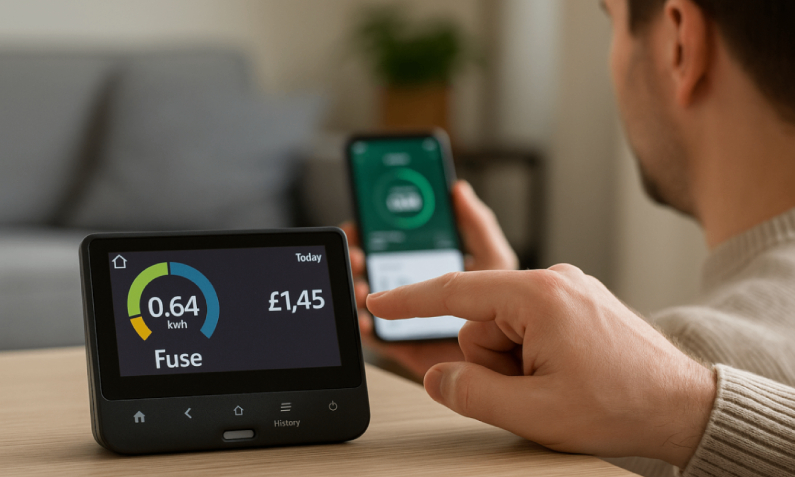
  • Comes with an in-home display (IHD) showing usage and estimated cost.
  • Feeds real-time data into the Fuse app for hourly, daily, weekly and yearly views.
  • Uses a mobile network connection, never your household broadband.

For a broader look at how these meters interact with pricing, our guide on smart meters and the energy price cap explains how usage data and capped unit rates fit together.

Compare live energy tariffs for your postcode

Is smart meter installation free with Fuse?

Smart meter installation is free with Fuse Energy, in line with the national rollout, and it typically takes around 1.5 to 2 hours. A trained engineer visits your home, turns off the power for a short period, fits the meter near your consumer unit and shows you how to use the in-home display before leaving you with access to usage insights in the Fuse app. There is no upfront charge for the meter or the fitting, because the cost of the rollout is spread across energy bills nationally rather than billed to you directly.

Installation is free, but it is not compulsory, and you do not need a smart meter to become a Fuse customer. You only need one if you want a time-of-use tariff. If you stay on a single-rate tariff, a traditional meter is fine, though you will keep submitting manual meter readings and miss the half-hourly usage data.

Is smart meter installation free with Fuse

Can I switch to Fuse first and get a smart meter later?

Yes, you can switch to Fuse Energy first on a single-rate tariff and arrange a smart meter afterwards. A smart meter is not a requirement to join, and many households switch supplier, settle in, then book a free installation once they decide they want the usage data or an off-peak tariff. Ofgem’s switching rules mean your switch should complete within a few working days once your cooling-off period ends, and your existing meter keeps working throughout.

Once your smart meter is installed and connected, you can then move onto a time-of-use tariff such as the off-peak variable tariff. Doing it in this order suits people who want to compare their actual usage pattern in the app before committing to overnight rates. If you are weighing up a switch generally, our tips on cutting energy costs in the UK cover what to check before you move.

How do Fuse’s off-peak and time-of-use tariffs work?

Fuse’s off-peak variable tariff charges a lower electricity rate during an overnight window, with a higher rate during the rest of the day. A time-of-use tariff is any tariff that varies the unit rate by time of day, and Fuse offers this as a way to reward households that can shift usage to the cheaper overnight period. To be eligible you need a dual-rate compatible smart meter; there is no requirement for a specific EV or charger model, so households without an electric vehicle can use it too.

Fuse offers four tariff combinations overall: single-rate fixed, single-rate variable, off-peak fixed and off-peak variable, across contract lengths that have included 13 and 15-month terms. Off-peak tariffs pay off when a meaningful share of your electricity can move overnight, such as charging an EV, running a heat pump or scheduling a dishwasher and washing machine overnight.

Tariff type Needs a smart meter? Best for
Single-rate fixed No Predictable pricing, no overnight shifting
Single-rate variable No Tracking the price cap without a fixed term
Off-peak fixed Yes Overnight users wanting price certainty
Off-peak variable Yes EV owners and heavy overnight users

Figures are indicative and may change.

Off-peak rates change over time. Fuse has changed its off-peak and peak rates over time, so live pricing should be checked before publishing. That volatility is a reminder to check the live rate for your address rather than assume a headline number holds.

Not sure which tariff suits your usage?

See what actually drives your bill before you choose off-peak.

Does Fuse install gas smart meters?

Fuse Energy began as an electricity-only supplier and now supplies gas as well as electricity, though smart meter arrangements can vary by setup and region. If you take both fuels, arrangements for a gas smart meter depend on your setup and region, and it is worth confirming with Fuse directly before you assume a single dual-fuel meter install. Where you have a smart electricity meter and a traditional gas meter, you will still submit manual gas meter readings, and the in-home display may only reflect electricity.

Households that split fuels across two suppliers, for example gas with one provider and electricity with Fuse, should expect each meter to report to its own supplier. The in-home display in that case may not show both fuels as you would expect, because it is tied to how the meters are commissioned. If accurate dual-fuel billing matters to you, keeping both fuels with one supplier avoids that complication.

How does the energy price cap affect Fuse tariffs?

The Ofgem energy price cap sets the maximum unit rates and standing charge a supplier can charge on a standard variable tariff for a typical household, and it applies to Fuse just as it does to every domestic supplier. From 1 July to 30 September 2026, the cap for a typical dual-fuel direct debit household is £1,862 on pre-July 2026 consumption values, according to Ofgem, announced on 27 May 2026. The cap limits rates and the standing charge, not a fixed total bill, so what you actually pay depends on how much energy you use.

Fuse’s variable tariff rates fluctuate in line with the price cap and aim to undercut it by a few percent, partly through lower standing charges. Its fixed tariffs are designed to track below the cap for the contract term. Ofgem also updated its Typical Domestic Consumption Values from 1 July 2026 to reflect lower use for a medium home. Because these figures move quarterly, always check the current cap before comparing tariffs. Our guide to smart meters and the price cap goes deeper on how the two interact.

See how Fuse compares against the price cap

Why is my Fuse smart meter offline or not working?

A Fuse smart meter usually shows offline or stops sending readings because of a weak mobile signal at the meter’s location, not a fault with the meter itself. Smart meters connect through a dedicated wireless network rather than your home WiFi, so poor mobile coverage indoors, a meter tucked in a basement or a cupboard, or a temporary network outage are the most common causes. Newer 4G comms hubs help in areas where older signals struggle, and some customers may be offered a connectivity upgrade to improve performance.

Where a smart meter has not connected since installation, it can sometimes take a few days to commission fully as the network registers it. If readings still fail after that, contact Fuse to check the connection and arrange support. In the meantime, submit manual meter readings so your bills stay accurate rather than estimated. Keep an eye on the in-home display too, because a blank or frozen IHD often signals the same underlying connection problem.

  • Weak mobile signal at the meter is the most common cause of an offline meter.
  • Newly installed meters can take a few days to commission and connect.
  • Submit manual readings while a meter is offline to avoid estimated bills.
  • A blank in-home display usually points to the same connectivity issue.

Do smart meters have to be compulsory, and can I refuse one?

Smart meters are not compulsory in the UK, and you can refuse installation and stay on a traditional meter. No energy supplier can force a smart meter on you, and declining one does not stop you switching supplier or staying on a single-rate tariff. The trade-off is that you keep submitting manual meter readings, miss the half-hourly usage data in the app, and cannot access Fuse’s time-of-use tariffs, which need a dual-rate compatible smart meter.

Some households worry that a smart meter can be used to cut off supply remotely or that it overcharges. In practice the meter records usage and reports it; the readings feed your bill under the same capped unit rates any meter would. If you are on the Priority Services Register or have accessibility needs, you can ask your supplier for extra support around installation. Whether a smart meter suits you comes down to whether you want the usage insight and off-peak access, or prefer to keep things as they are.

Do smart meters have to be compulsory, and can I refuse one

Compare energy suppliers and tariffs

FAQs about fuse energy smart meters

Is Fuse Energy any good?

Fuse Energy holds a Trustpilot score of around 4.8 out of 5 as of mid-2026, with customers frequently praising punctual engineers and a fast switching process. It is regulated by Ofgem, so it must meet the same consumer protection and switching standards as larger suppliers. As with any provider, check the live rates for your postcode and read the tariff terms, including exit fees, before you commit.

Do Fuse smart meters use my home WiFi?

No, Fuse smart meters do not use your home WiFi. They connect through a separate national wireless network run by the Data Communications Company, and some newer units use a 4G comms hub. This means a smart meter can go offline in areas with weak mobile signal even if your broadband works perfectly.

How long does a Fuse smart meter installation take?

A Fuse smart meter installation usually takes around 1.5 to 2 hours. A trained engineer turns off the power briefly, fits the meter near your consumer unit and shows you how to use the in-home display. The meter can then take a few days to fully commission and start sending readings automatically.

Does Fuse charge an exit fee if I leave a fixed tariff?

Yes, Fuse fixed tariffs carry an exit fee if you leave before the final 49 days of your contract, set at around £50 as of July 2026. You can switch away in the last 49 days of a fixed term without paying it. Variable tariffs do not usually carry exit fees, so check your tariff type before switching.

Can I have a Fuse smart meter with two different suppliers?

Yes, you can have your gas with one supplier and electricity with Fuse, but each meter reports to its own supplier. In that situation your in-home display may not show both fuels as expected, because the display is tied to how the meters were commissioned. Keeping both fuels with one supplier avoids this.

Do I need a smart meter for Fuse’s off-peak tariff?

Yes, you need a dual-rate compatible smart meter for Fuse’s off-peak variable tariff. The tariff charges a lower rate during the 7-hour window from 12:30am to 7:30am, and only a smart meter can record when you use electricity to apply those different rates. Single-rate tariffs do not need a smart meter.

What happens to my smart meter if I switch away from Fuse?

A SMETS2 smart meter keeps working if you switch away from Fuse, because it communicates through the shared national network rather than a Fuse-only system. Your new supplier can take over readings without a new meter. Some very early first-generation meters may temporarily lose smart features on switching, but Fuse fits second-generation SMETS2 units.

Is it worth getting a smart meter with Fuse if I don’t have an EV?

A smart meter can be worth it without an EV if you can shift a meaningful share of usage overnight, such as running a washing machine, dishwasher or heating on a timer after 12:30am. Even without an off-peak tariff, the half-hourly usage data in the app helps you spot where energy is being wasted. If your usage is spread evenly through the day, a single-rate tariff may suit you better.

Why does my Fuse in-home display show no data?

A blank or frozen Fuse in-home display usually points to a connection problem with the smart meter rather than a broken display. The most common cause is weak mobile signal at the meter, or a meter that has not finished commissioning after installation. Restarting the display can help, and if data still does not appear, contact Fuse to check the meter connection.

Can Fuse read my gas meter automatically if only my electricity is smart?

No, if only your electricity meter is smart, Fuse cannot read your gas usage automatically, so you will need to submit manual gas meter readings. Sending regular readings keeps your gas bills accurate rather than estimated. To have both fuels read automatically, you would need a smart gas meter linked to the same supply.

Do energy companies own your smart meter?

Your energy supplier is responsible for the meter and arranges its installation and maintenance, but you do not own it outright and are not charged upfront for it. Under the national rollout the cost is spread across bills across the country. You can decline a smart meter, as they are not compulsory in the UK.

Also Read Related Articles


Information correct as of 18 August 2026. Prices, tariffs, policy details and providers change frequently, so please check the latest details before making a decision. This article is for general information only and does not constitute financial advice. Free Price Compare is authorised and regulated by the Financial Conduct Authority (FCA).

4000+ reviews