





EDF Energy Direct Debit Guide: Payments, Refunds & Rules

Written by Shay Ramani
Reviewed by Prajesh Manvar
7 min read
Updated: 17 Sep 2026
EDF Energy Direct Debit Guide: Payments, Refunds & Rules

An EDF Energy direct debit is a monthly payment set by dividing your expected yearly energy cost by 12, so you pay the same amount each month rather than a large bill in winter and a small one in summer. EDF looks at your recent usage, your account balance and your current tariff prices to work out that figure, then reviews it periodically to keep it on track.

Paying by direct debit gets you the lowest of Ofgem’s price-cap rates. From 1 July to 30 September 2026, the price cap for a typical dual-fuel household paying by direct debit is around £1,663 a year under Ofgem’s revised typical-usage figures, according to Ofgem. That is a cap on unit rates and the standing charge, not a fixed bill, so what you actually pay still depends on how much gas and electricity you use.

This is the part that trips people up: your direct debit is an estimate, and you have clear rights to challenge it if EDF sets it too high. Below is how the amount is calculated, why it changes, how to get credit back, and how to keep your payments fair.

Quick Answer: EDF Energy Direct Debit Guide

  • EDF sets your direct debit by estimating your total energy cost for the year ahead, then dividing it by 12 for equal monthly payments (EDF).
  • Under Ofgem’s supply licence rules, your supplier must set direct debits based on the best available information and must refund credit if you ask, subject to a check (Ofgem).
  • Direct debit is capped cheaper than standard credit: Ofgem’s July–September 2026 cap is around £1,663 for direct debit versus around £1,796 for standard credit.
  • Submit a meter reading before any payment review so EDF works from actual usage, not an estimate, which is a common reason payments are set too high.
  • If EDF will not lower an unfair payment, you can complain, then escalate to the Energy Ombudsman after eight weeks or a deadlock letter.

Last updated: August 2026

Written by the Free Price Compare editorial team | Reviewed August 2026

Why paying EDF by direct debit is cheaper

Paying EDF by direct debit gets you the lowest set of price-cap rates because Ofgem caps direct-debit tariffs below standard credit (paying on receipt of a bill). For the price cap running 1 July to 30 September 2026, the direct-debit cap for a typical dual-fuel household is around £1,663 a year, compared with around £1,796 for standard credit, according to Ofgem. That difference of roughly £130 a year reflects the lower cost to suppliers of collecting payments automatically. The cap rose 13% from the previous period, driven mainly by higher wholesale gas prices, so gas-heavy homes feel the increase most.

The price cap sets a maximum on the unit rate and daily standing charge, not a fixed total bill. On the July 2026 direct-debit cap, electricity averages 26.11p per kWh with a 57.19p daily standing charge, and gas averages 7.33p per kWh with a 29.04p daily standing charge (Ofgem, 1 July 2026). Your real annual cost depends entirely on how much energy you use, which is why two households on the same tariff can pay very different amounts.

If you are on EDF’s Standard (Variable) tariff, that is the default, price-capped rate, so it moves each time Ofgem changes the cap. Fixed deals can undercut it, so it is worth checking whether a fix or a cheaper tariff suits your usage. Our EDF Energy tariffs guide breaks down the current options.

Compare current energy tariffs

How do I set up a direct debit with EDF?

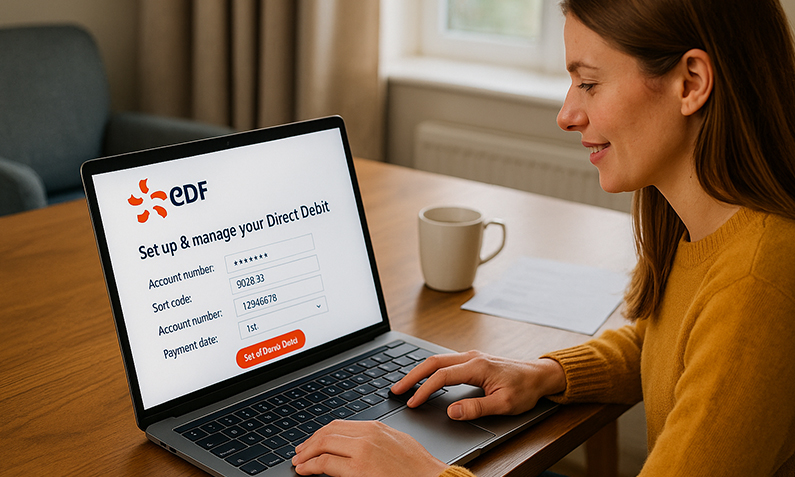
You set up an EDF direct debit online through your MyEDF account, over the phone, or automatically when you switch to EDF. When you join EDF, the direct debit is normally arranged close to your supply start date, with written confirmation of the amount and date sent within a few working days. You will need your bank account number, sort code, and the name on the account you want payments taken from.

You can choose either fixed monthly direct debit, where you pay the same amount every month across the year, or a variable direct debit (sometimes called whole-amount or exact-amount), where EDF takes only what you actually used in the previous period. Fixed monthly spreads winter costs evenly and is the most common choice; variable suits households happy to pay more in cold months and less in summer. Whichever you pick, the Direct Debit Guarantee under the Bacs scheme protects you, so you are entitled to a full and immediate refund from your bank if EDF ever takes the wrong amount.

How does EDF work out my monthly direct debit amount?

EDF works out your monthly direct debit by estimating your total energy cost for the year ahead, then dividing that figure by 12 so you pay the same amount each month. To build the estimate, EDF looks at your most recent energy usage, your current account balance (whether you are in credit or debit), and your tariff prices. Building in an even spread means your summer payments effectively pre-pay for the higher winter usage, so you are not hit with a large bill in the coldest months.

Because the amount is an estimate, its accuracy depends on the usage data EDF holds. If your meter readings are estimated rather than actual, the figure can drift away from what you truly use. Submitting regular meter readings, or having a working smart meter that sends readings automatically, is the single most effective way to keep your direct debit at the right level. If you want to understand what drives your consumption in the first place, our guide on what uses the most energy in the home is a useful starting point.

How does EDF work out my monthly direct debit amount

Keep your energy bills under control

Compare tariffs and check whether a fixed deal beats your current direct-debit rate.

Why does my EDF direct debit keep changing?

Your EDF direct debit changes when EDF’s review shows your expected yearly cost has moved, usually because your energy use has gone up or down, your tariff prices have changed, or your account balance is drifting into credit or debt. EDF states it tries not to change payments more than four times a year, and it will only adjust when a review flags a genuine change. A price-cap change, like the 13% rise from 1 July 2026, is a common trigger, as is a cold winter that pushes actual usage above the earlier estimate.

A large jump can also happen when your payments have been set too low for a while and a real meter reading reveals the account is in debt. In that case EDF may raise the monthly figure to clear the shortfall over the coming year, which can feel steep. Under Ofgem’s supply licence rules, any direct debit must be based on the best available information about the energy you use, so a sudden large increase should be backed by evidence you can ask to see. If you think a rise is unjustified, you have the right to challenge it, covered below.

Can I get a refund if my EDF account is in credit?

Yes, you can request a refund of accumulated credit on your EDF account, and under Ofgem’s supply licence rules your supplier must return credit you ask for. Some seasonal credit is normal and expected, because summer payments are meant to build a buffer for winter, so a balance in credit during warmer months is not automatically money owed back to you. EDF will normally check your usage and account first, and may keep a reasonable amount to cover the months ahead if you pay a fixed monthly amount.

To claim a refund, submit an up-to-date meter reading so your balance reflects real usage, then request the refund through your MyEDF account or by contacting EDF. If a large credit has built up and your payments look too high for your actual usage, ask EDF to both refund the surplus and lower your monthly direct debit going forward. Requesting one without the other often leaves the same over-payment building straight back up.

See how to cut your energy costs

How to lower your EDF direct debit if it is too high

To lower an EDF direct debit you believe is too high, submit a current meter reading, then contact EDF and ask it to recalculate your payment based on your actual usage. Around a fifth of billpayers reported their direct debit had been set too high at some point in the past year, according to a survey referenced by consumer bodies, and estimated meter readings are a frequent cause. Providing a real reading removes the guesswork and is the fastest route to a fair figure.

  • Send an up-to-date meter reading before asking for a review, so EDF works from actual consumption rather than an estimate.
  • Ask EDF to clearly explain how it reached your payment figure, which suppliers must do on request under Ofgem’s rules.
  • If your account is in healthy credit and payments outstrip usage, request both a refund and a lower monthly amount.
  • Consider switching to a variable direct debit if you would rather pay only for what you use each month.

If EDF refuses to lower a payment that clearly exceeds your usage, you can make a formal complaint. Should the complaint stay unresolved after eight weeks, or you receive a deadlock letter, you can take it free of charge to the Energy Ombudsman, whose decision is binding on the supplier. Citizens Advice also runs a free consumer helpline that can advise on unfair direct-debit disputes.

Can I choose or change my direct debit payment date?

Yes, you can usually change your EDF direct debit payment date through your MyEDF account or by contacting EDF, and picking a date shortly after payday is a practical way to avoid a failed payment. When you set up a new direct debit, EDF confirms the amount and the collection date in writing, and you can request a different day that suits your budgeting. Aligning the date with when your wages, pension or benefits land reduces the risk of the payment bouncing.

If a payment is ever taken on the wrong date or for the wrong amount, the Direct Debit Guarantee entitles you to an immediate refund from your bank while the error is sorted out. Keep in mind that changing the date can occasionally mean two collections fall close together in the transition month, so check your statement after any change and query anything unexpected with EDF straight away.

What happens if my EDF direct debit payment fails?

If your EDF direct debit fails, EDF will normally try to collect the payment again or contact you to arrange payment, and your account moves into debt until the amount is cleared. A single missed payment does not immediately affect your supply, but repeated failures can lead to EDF adjusting your future payments upward to recover the arrears, and in serious, sustained cases to debt-recovery action. Getting in touch early is far better than ignoring it.

If you are struggling to pay, contact EDF as soon as possible to agree an affordable repayment plan. You may also be able to get help through the Fuel Direct scheme, which takes energy payments and a small amount towards arrears directly from certain benefits, or check whether you qualify for the Warm Home Discount. Vulnerable customers can also register on EDF’s Priority Services Register for extra support. Our Warm Home Discount guide explains how that support works across suppliers.

Explore ways to reduce your energy bills

Your rights on direct debit levels under Ofgem rules

Ofgem’s energy supply licence conditions require your supplier to set fair direct debits, explain them on request, and refund credit you ask for. In practice this means EDF must base your monthly payment on the best information available about how much gas and electricity you use, must give a clear explanation of how it reached the figure if you ask, and must return accumulated credit when you request it, subject to a reasonable check of your account and usage. These protections apply to every domestic customer paying by direct debit, not just those in dispute.

Knowing these rights matters because a direct debit is only ever an estimate, and estimates can be wrong. Ofgem has pointed out that around 8 million accounts still pay by standard credit and could save roughly £136 a year by switching to direct debit (Ofgem). If your payment ever feels detached from your real usage, you are entitled to evidence, a recalculation, and, where appropriate, your money back. Regular meter readings keep the whole system honest, and comparing your rate against the wider market ensures you are not overpaying on the tariff itself.

Your rights on direct debit levels under Ofgem rules

FAQs about EDF energy direct debit

How long does an EDF direct debit refund take?

Once EDF approves a credit refund, the money is usually returned to your bank account within a few working days. EDF may first ask for an up-to-date meter reading to confirm your balance reflects actual usage. If a large credit has built up, ask for both a refund and a lower monthly payment so the surplus does not build straight back up.

Is it better to pay EDF by fixed or variable direct debit?

Fixed monthly direct debit spreads your yearly cost into 12 equal payments, so winter bills do not spike, and it is the most common choice for budgeting. Variable direct debit takes only what you actually used each period, so you pay less in summer and more in winter. Choose variable if you prefer paying for real usage and can absorb higher cold-month payments.

Why did EDF increase my direct debit even though I am in credit?

EDF may raise your direct debit despite an existing credit if its review shows your expected yearly cost has risen, for example after a price-cap increase or higher usage. Some summer credit is normal and meant to cover winter. If the increase looks larger than your usage justifies, ask EDF to explain the calculation, which it must do under Ofgem’s rules.

Can EDF take two direct debit payments in one month?

EDF should normally take one direct debit a month, but two collections can fall close together in the month you change your payment date, as the old and new schedules overlap. If you see an unexpected second payment for the same period, contact EDF to check, and remember the Direct Debit Guarantee entitles you to an immediate bank refund for any incorrect collection.

What is the Direct Debit Guarantee and does it cover EDF?

The Direct Debit Guarantee is a Bacs scheme protection that covers all UK direct debits, including EDF. It entitles you to an immediate and full refund from your bank if the wrong amount is taken or a payment is collected on the wrong date. You are also entitled to advance notice of any change to the amount or date of your payment.

How often can EDF change my direct debit amount?

EDF states it tries not to change your direct debit more than four times a year, and only adjusts it when a review shows your expected costs have changed. Triggers include a shift in usage, a tariff or price-cap change, or your balance drifting into credit or debt. You are always entitled to an explanation of any change if you ask.

Do I still need to send meter readings if I pay EDF by direct debit?

Yes, sending regular meter readings keeps your direct debit accurate even when you pay automatically. Without actual readings, EDF relies on estimates, which is a common reason payments are set too high or too low. A working smart meter sends readings automatically, but if you have a standard meter, submit a reading before any payment review.

Can I cancel my EDF direct debit?

You can cancel an EDF direct debit at any time through your bank, but doing so does not clear what you owe for the energy you use. Cancelling can move you onto a more expensive standard-credit rate and may lead to debt building on your account. If you are struggling to pay, contact EDF to agree an affordable plan rather than cancelling.

What happens to my EDF credit balance if I switch supplier?

If you switch away from EDF, any credit on your account should be refunded to you after your final bill is settled, usually within a few weeks. Provide a closing meter reading on your switch date so the final bill is accurate. If EDF does not return the credit after settling the account, you can request it and, if needed, complain.

Does paying EDF by direct debit affect my credit score?

Paying your EDF energy bills by direct debit does not directly build your credit score, as regular utility payments are not always reported to credit reference agencies. Missing payments and falling into arrears can be reported and may harm your credit file. Keeping your direct debit paid on time avoids that risk and helps you stay on the cheaper capped rate.

How much cheaper is direct debit than standard credit with EDF?

Direct debit is capped cheaper than standard credit because Ofgem sets lower price-cap rates for it. For the 1 July to 30 September 2026 cap, a typical dual-fuel household pays around £1,663 by direct debit versus around £1,796 by standard credit, a difference of roughly £130 a year. Ofgem estimates around 8 million standard-credit accounts could save by switching to direct debit.

Also Read Related Articles


Information correct as of 7 August 2026. Prices, tariffs, policy details and providers change frequently, so please check the latest details before making a decision. This article is for general information only and does not constitute financial advice. Free Price Compare is authorised and regulated by the Financial Conduct Authority (FCA).

4000+ reviews