


What Is a Good Broadband Speed for a Household? (UK Guide)

Written by Andrea Troy
Reviewed by Pratik Aghera
6 min read
Updated: 17 Aug 2026
What Is a Good Broadband Speed for a Household? (UK Guide)

A good broadband speed for a household depends on how many people use the internet at once and what they do with it, but most UK homes are well served by 100Mbps, and many smaller households are comfortable on 30 to 67Mbps. Speed is measured in megabits per second (Mbps), and the right figure for you comes down to simultaneous streaming, video calls, gaming and the number of connected devices.

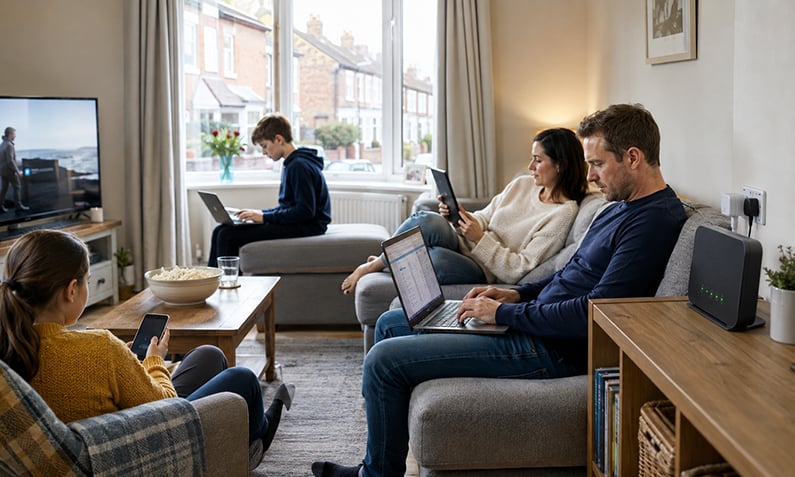
There is no single “correct” number. A couple who mainly browse and stream in HD need far less than a family of five with several 4K TVs, two people working from home and a games console downloading updates.

  • 1-2 people, browsing and HD streaming: 30 to 50Mbps is usually plenty.
  • 3-4 people, some 4K streaming and home working: aim for 100Mbps or more.
  • 5+ people or heavy 4K and gaming: 100 to 300Mbps gives comfortable headroom.
  • Most UK households do not need gigabit (1,000Mbps) – reliability and consistent speeds matter more than the headline number.

How to work out the right speed for your home

The right broadband speed for your home is the speed that comfortably covers everything your household does online at the same time, with some headroom to spare. The simplest way to size it is to add up your peak simultaneous use, not your total monthly use.

A practical rule of thumb is to allow around 20Mbps per person for everyday use, and roughly double that to 40Mbps per person for anyone who regularly streams in 4K or games online. A four-person household where two people stream 4K while another games would therefore want comfortably over 100Mbps.

Three factors decide what “good” means for you:

  • Number of users: more people online at once means more total bandwidth needed.
  • What they do: 4K streaming, large game downloads and frequent video calls are far more demanding than browsing or email.
  • Number of devices: phones, tablets, smart TVs, speakers and security cameras all draw a share, even when no one is actively using them.

Compare broadband deals by speed

James Ford Broadband Deals Reviewed by James Ford, TV and Broadband Expert

Full Fibre 150

  • New customers only
  • Switch to Fibrus and they'll cover up to £400 of your switching fees
  • No mid-contract price rises
159Mb average* speed
Unlimited Downloads
£0.00 Setup costs
18 Month contract
Pay as you goCalls
£34.99per month

Superior

  • New customers only
900Mb average* speed
Unlimited Downloads
£0.00 Setup costs
24 Month contract
Pay as you goCalls
£29.99per month

Extra

  • New customers only
500Mb average* speed
Unlimited Downloads
£0.00 Setup costs
24 Month contract
Pay as you goCalls
£27.99per month

What speed do you need for streaming, gaming and home working?

For streaming, you need around 5Mbps per HD stream and around 25Mbps per 4K stream, according to typical provider and streaming-service guidance. Standard-definition video needs only about 1.5Mbps. These figures are per stream, so two 4K TVs running at once need roughly 50Mbps between them before you add anything else.

For home working, 10Mbps download is enough for general tasks, but video calls and large file uploads run more smoothly with 20Mbps or more of upload. Upload speed matters here, and it is where full fibre helps, since full-fibre (FTTP) connections often offer symmetrical speeds where upload matches download.

For gaming, the speed needed to play is modest, but downloads are large. Modern game files frequently exceed 100GB, so a 140GB title would take around ten hours on a 30Mbps line versus a few minutes on a gigabit connection. Latency (ping) matters more than raw speed for smooth online play, which is another reason consistency beats headline numbers.

Activity (per stream/device) Recommended download speed
SD video streaming around 1.5Mbps
HD video streaming around 5Mbps
4K / UHD streaming around 25Mbps
Video calls around 3 to 5Mbps (plus upload)
Online gaming (play) under 10Mbps, low latency matters most
Large game downloads as fast as you can get – 100Mbps+ helps

Figures are indicative and may change.

What speed do you need for streaming, gaming and home working

Good speeds by household size

A good broadband speed scales with the number of people who use the internet at the same time, so household size is the clearest starting point. The guide below assumes typical mixed use of streaming, browsing, calls and the occasional game download.

1-2 people

For one or two people, 30 to 50Mbps is usually a good broadband speed. That comfortably covers HD and occasional 4K streaming, browsing, video calls and several smart devices. A single person who only emails and shops online could manage on less, but the slowest 10 to 30Mbps tiers can feel tight as soon as two devices stream at once.

3-4 people

For a family of three or four, 100Mbps is a sensible target. It gives enough headroom for two or three simultaneous 4K streams, home working with video calls, and a games console downloading in the background without everyone else slowing down. Many homes do run happily on a 67Mbps part-fibre line, but 100Mbps gives more breathing room as 4K use grows.

5+ people

For five or more people, 100 to 300Mbps suits most large households. The aim is enough capacity that several heavy activities can run at once without contention. Going beyond this into gigabit territory is rarely necessary unless you regularly move very large files or have an unusually device-dense home.

Not getting the speed you pay for?

A weak signal in some rooms is often the router, not the line

What is the average broadband speed in the UK?

The UK average maximum download speed reached 285Mbit/s in 2025, up almost 30% from 223Mbit/s in 2024, according to Ofcom’s Connected Nations 2025 report (published 19 November 2025). This figure is the mean of the maximum speeds providers can deliver to the router, so it reflects line capability rather than the typical real-world speed every household experiences.

Northern Ireland had the highest average maximum download speed at 325Mbit/s, ahead of England at 288Mbit/s, Scotland at 273Mbit/s and Wales at 243Mbit/s (Ofcom Connected Nations 2025). Average speeds keep rising mainly because full fibre is spreading: full-fibre (FTTP) reached 82% of homes by January 2026, up from 78% in July 2025, according to Ofcom’s spring 2026 coverage data.

Despite faster lines being available, take-up of full fibre and gigabit services remains well below availability, which tells you something useful: most households comfortably meet their needs well short of the fastest tiers on the market. If you want to understand how advertised “average” speeds are measured, our broadband speed explained guide breaks it down.

Check speeds available at your address

Understanding broadband speed tiers

UK broadband is grouped into tiers defined partly by Ofcom and partly by common usage, ranging from the 10Mbps regulatory floor to gigabit connections of 1,000Mbps and beyond.

Decent broadband (10Mbps)

Decent broadband under the Universal Service Obligation (USO) is defined as at least 10Mbps download and 1Mbps upload. Every UK premises has a legal right to request a connection meeting this floor, with BT (and KCOM in Hull) as the universal service providers. Ofcom set 10Mbps as the level that lets a typical household stream in HD, watch catch-up TV, make a video call and browse at the same time.

Superfast broadband (30Mbps+)

Superfast broadband is technology capable of speeds of 30Mbit/s or more, the threshold Ofcom uses for “superfast”. Around 98% of UK residential premises can get a superfast connection. For most smaller households, superfast is enough for streaming and multiple connected devices.

Ultrafast broadband (100Mbps+)

Ultrafast broadband means speeds of 100Mbps or more, suited to multi-user homes doing simultaneous 4K streaming, video calls, gaming downloads and remote working. This is the comfortable sweet spot for many busy families in 2026.

Gigabit broadband (1,000Mbps+)

Gigabit broadband delivers 1,000Mbps (1Gbps) or more, fast enough to download a 100GB 4K film in under 15 minutes. Gigabit-capable broadband reached 89% of UK homes by January 2026 (Ofcom spring 2026 data), but most households do not need it. Our 900Mb broadband guide looks at who benefits from the fastest tiers.

Connection type matters as much as the number

The connection type behind your broadband often decides whether you get the speed you pay for, because the underlying technology sets the ceiling. The same advertised number can perform very differently depending on whether your line is copper, part-fibre or full fibre.

  • ADSL: uses existing copper phone lines and is available almost everywhere, but is slow by modern standards – often 3 to 10Mbps in practice depending on distance from the exchange.
  • FTTC (part-fibre): fibre to the street cabinet and copper to your home, usually delivering 30 to 80Mbps. Good for streaming, gaming and several people online at once.
  • FTTP (full fibre): fibre all the way to the property, offering the most consistent speeds and often symmetrical upload, with tiers from tens of Mbps up to gigabit.
  • Cable (HFC): hybrid fibre-coax networks that deliver fast download speeds, with much of recent gigabit availability coming from upgrades to this technology.

WiFi inside your home is a separate matter. Even a fast line can feel slow in a back bedroom if the signal is weak, and older devices without WiFi 6 or 7 may not reach the highest speeds wirelessly. If your speed test by the router looks fine but rooms further away struggle, the fix is usually your home setup, not your plan. If you are not getting what you pay for, our guide on complaining about broadband speed explains your rights.

Why faster is not always better value

Paying for more speed than you use rarely improves your experience, because once your line comfortably covers your peak simultaneous activity, extra Mbps sit unused. A household that never exceeds 60Mbps of real demand will notice no difference between a 100Mbps and a 500Mbps plan in day-to-day use.

Reliability and consistency usually matter more than the headline figure. A steady, low-latency connection that holds up during evening peak hours feels better than a high-rated line that drops or slows under load. Upload speed and a router that covers your whole home are often more impactful upgrades than a bigger download number.

Why faster is not always better value

Find a plan that fits your usage

FAQs about what is a good broadband speed for a household

What broadband speed do I need?

You need enough speed to cover everything your household does online at the same time, plus a little headroom. As a guide, allow around 20Mbps per person for everyday use and around 40Mbps per person for anyone who regularly streams 4K or games. Most one to two person homes are fine on 30 to 50Mbps, while families usually want 100Mbps or more.

Is 100Mbps fast enough for a family?

Yes, 100Mbps is fast enough for most families. It comfortably supports two or three simultaneous 4K streams, home working with video calls and a games console downloading in the background. Very large households with several heavy 4K users at once may prefer 200 to 300Mbps for extra headroom, but 100Mbps suits the majority of UK families.

Is 50Mbps a good broadband speed?

50Mbps is a good broadband speed for small households of one or two people who stream in HD, browse and make video calls. It can stretch to a family that rarely uses bandwidth-heavy apps at the same time. If two people stream 4K while another games and someone works from home, you may notice slowdowns and would be better on 100Mbps.

What is the average broadband speed in the UK?

The UK average maximum download speed reached 285Mbit/s in 2025, according to Ofcom’s Connected Nations 2025 report, up almost 30% on the previous year. This is the mean of the fastest speed providers can deliver to each premises, so it reflects line capability rather than the typical speed every home actually experiences. Northern Ireland leads the UK nations at 325Mbit/s.

Is 150Mbps broadband necessary for most people?

150Mbps is not necessary for most people, though it is comfortable headroom for a busy family. The majority of UK households have their needs fully met by 100Mbps or less, and many smaller homes are fine on 30 to 67Mbps. Choosing 150Mbps mainly makes sense if you have many heavy simultaneous users or want faster large downloads.

Is 30Mbps enough for a household?

30Mbps is enough for a small household that browses, streams in HD and makes occasional video calls. It is the level Ofcom classes as superfast, and around 98% of UK homes can get it. It becomes tight if several people stream 4K at the same time or you regularly download very large game files, where 100Mbps would serve you better.

What is the minimum broadband speed I am entitled to in the UK?

Every UK premises has a legal right under the Universal Service Obligation to request a decent connection of at least 10Mbps download and 1Mbps upload. BT, and KCOM in Hull, are the universal service providers responsible for fulfilling eligible requests, up to a cost threshold of £3,400 per premises. Ofcom set 10Mbps as the level that meets a typical household’s basic needs.

Does upload speed matter for a household?

Upload speed matters most if you work from home, make frequent video calls, upload large files or back up to the cloud. For general use, around 10Mbps upload is sufficient, but 20Mbps or more makes calls and file transfers smoother. Full-fibre connections often offer symmetrical speeds, so your upload matches your download, which part-fibre and copper lines cannot do.

Why is my broadband slower than the speed I pay for?

Broadband is often slower than the advertised figure because of WiFi limitations inside your home, distance from the router, older devices, or the type of line you are on. Copper-based ADSL and part-fibre lines lose speed over distance, and walls or interference weaken WiFi. Testing with a wired connection at the router shows your true line speed and helps you tell a home setup issue from a line problem.

Do most households need gigabit broadband?

Most households do not need gigabit broadband of 1,000Mbps. While gigabit-capable services now reach the majority of UK homes, take-up stays well below availability because typical use rarely demands that capacity. Gigabit is worth considering only if you regularly move very large files, have an unusually device-dense home or simply want the fastest possible downloads.

Also Read Related Articles


Information correct as of 23 June 2026. Prices, tariffs, policy details and providers change frequently, so please check the latest details before making a decision. This article is for general information only and does not constitute financial advice.

4000+ reviews



