





Vodafone vs Virgin Media Broadband Compared

Written by Shay Ramani
Reviewed by Pratik Aghera
8 min read
Updated: 12 Aug 2026
Vodafone vs Virgin Media Broadband Compared

Vodafone vs Virgin Media broadband comes down to a simple trade-off: Vodafone leads on full-fibre reliability and lower monthly prices, while Virgin Media leads on top-end speeds and its own cable network. For most households, the right choice depends on which technology reaches your postcode and how much speed you need.

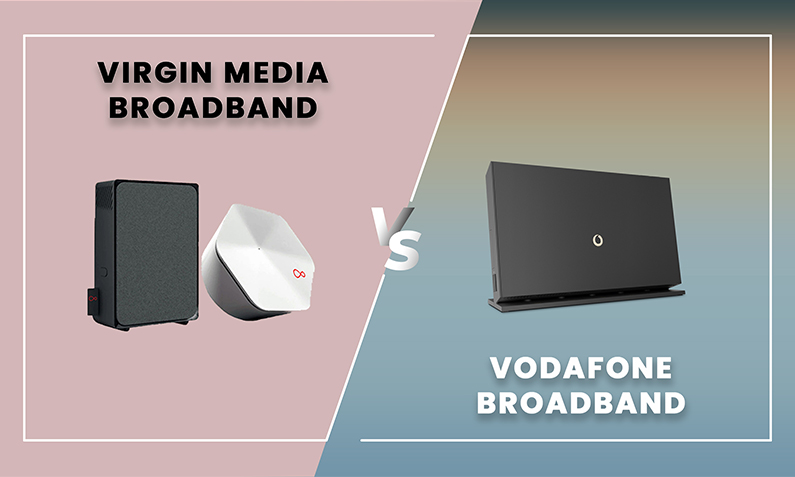
Both providers are widely available across the UK, but they run on different networks. Vodafone delivers full fibre over the Openreach and CityFibre networks, while Virgin Media uses its own cable and full-fibre network. That difference shapes speed consistency, upload performance and how your price changes each April.

Free Price Compare checks live deals from both providers by postcode, so you can see the real prices and speeds available at your address rather than headline national rates. Below we weigh speed, price, contract length and reliability so you can decide which fits your household.

Quick Answer: Vodafone vs Virgin Media Broadband Compared

  • Vodafone full fibre starts from £24 a month on a 24-month contract, with prices shown increasing to £27.50 on 1 April 2027 and £31 on 1 April 2028, according to Vodafone’s own broadband page.
  • Virgin Media’s Gig1 plan delivers around 1130 Mbps average download, ahead of most Vodafone full-fibre tiers on raw top-end speed.
  • Mid-contract price rises differ: Vodafone’s broadband page shows annual increases of £3.50 each April on some plans, while Virgin Media plans are set to rise by £4 each April.
  • Full fibre now reaches 82% of UK homes and gigabit-capable broadband reaches 89% of premises (Ofcom Connected Nations, Spring 2026, data as of January 2026).
  • Both offer social tariffs for eligible low-income households: Vodafone’s Essentials Broadband is £20 a month for up to 73 Mbps, and Virgin Media Essential Broadband is £12.50 a month for 15 Mbit/s.

Last updated: August 2026

Written by the Free Price Compare editorial team | Reviewed August 2026

Which is better or faster, Vodafone or Virgin Media?

Virgin Media leads on top-end speed, but Vodafone leads on speed consistency. Virgin Media’s fastest home package, Gig1, delivers around 1130 Mbps average download, faster than most Vodafone full-fibre tiers. Vodafone runs on full fibre (FTTP) all the way to the property, which delivers steadier speeds and better upload performance than Virgin Media’s part-cable network. So the honest answer is that “faster” depends on the metric: Virgin Media wins on peak download numbers, while Vodafone wins on reliability, latency and symmetrical upload on its top plans. For gaming, video calls and uploading large files, full fibre’s stable connection usually matters more than a headline peak figure.

Full fibre is now available to 82% of UK homes, or 24.9 million premises, according to Ofcom’s Connected Nations update (Spring 2026, data as of January 2026), so more households than ever can access Vodafone-style full fibre. Whether you can get Virgin Media’s cable network depends on whether their infrastructure reaches your street.

How Vodafone full fibre and Virgin Media cable differ

Vodafone full fibre (FTTP) runs fibre-optic cable directly to your home, while Virgin Media uses a hybrid cable network for most of its footprint. Full fibre delivers matched or near-matched upload and download speeds and holds up better at peak times. Virgin Media’s cable has historically offered very high download speeds but lower upload, for example M350 at around 362 Mbps download and 36 Mbps upload. If you upload a lot, whether that is video, backups or working from home, Vodafone’s full-fibre upload is usually the stronger option.

Free Price Compare shows the exact technology and speed available at your postcode, so you can see whether you can get Vodafone full fibre, Virgin Media cable, or both.

Check speeds available at your postcode

Vodafone Broadband Packages

Fibre 2 + Super WiFi

  • New customers only
  • Switch to Vodafone, and get up to £200 switcher credit
  • 4G Broadband Backup
  • Super WiFi Boosters
67Mb average* speed
Unlimited Downloads
£0.00 Setup costs
24 Month contract
Pay as you goCalls
£31.00per month

Fibre 2

  • New customers only
  • Switch to Vodafone, and get up to £200 switcher credit
67Mb average* speed
Unlimited Downloads
£0.00 Setup costs
24 Month contract
Pay as you goCalls
£24.00per month

Pro 2 Fibre 2

  • New customers only
  • Switch to Vodafone, and get up to £200 switcher credit
  • Includes Ultra Hub router
67Mb average* speed
Unlimited Downloads
£0.00 Setup costs
24 Month contract
Pay as you goCalls
£37.00per month

Virgin Media Broadband Packages

M250 fibre broadband + phone

  • New customers only
  • Exclusive Access to Priority from O2
  • Up to £300 Contract Buyout
264Mb average* speed
Unlimited Downloads
£0.00 Setup costs
24 Month contract
Weekend callsincluded
£33.99per month

M350 fibre broadband + phone

  • New customers only
  • Exclusive Access to Priority from O2
  • Up to £300 Contract Buyout
362Mb average* speed
Unlimited Downloads
£0.00 Setup costs
24 Month contract
Weekend callsincluded
£36.99per month

M125 fibre broadband + phone

  • New customers only
  • Exclusive Access to Priority from O2
  • Up to £300 Contract Buyout
132Mb average* speed
Unlimited Downloads
£0.00 Setup costs
24 Month contract
Weekend callsincluded
£31.99per month

Which is cheaper, Vodafone or Virgin Media?

Vodafone is generally the cheaper option on full fibre, with entry plans from £24 a month on a 24-month plan, according to Vodafone’s own broadband page, though some promotional Virgin Media deals undercut Vodafone on specific tiers. On Vodafone’s own broadband page, Full Fibre starts from £24 a month on a 24-month plan, with prices shown rising to £27.50 on 1 April 2027 and £31 on 1 April 2028. Virgin Media’s entry plan pricing should be checked on Virgin Media’s own website before publication, as broadband prices are promotional and postcode dependent. The bigger difference shows up over the full contract because of how each provider raises prices mid-term.

Independent full-fibre providers were offering 900Mbit to 1Gbit deals from around £26/month, versus about £39/month for the cheapest comparable deal from a larger provider, according to Ofcom’s Pricing Trends for Communications Services in the UK report (pricing data October 2024). That gap illustrates why checking full-fibre alternatives at your address is worthwhile, not just the two big brands.

Plan Provider Approx. monthly price Average download
Full Fibre 74 Vodafone around £26 around 74 Mbps
M125 Virgin Media around £24 around 132 Mbps
Full Fibre 150 Vodafone around £26 around 150 Mbps
M350 Virgin Media around £27 to £29 around 362 Mbps
Full Fibre 500 Vodafone around £31 around 500 Mbps
Gig1 Virgin Media around £30 to £37 around 1130 Mbps

Figures are indicative and may change. Prices vary by postcode and promotional period.

How do mid-contract price rises compare?

Mid-contract price rises are a genuine differentiator between the two. Vodafone plans rise by fixed pounds-and-pence amounts each April, and Virgin Media also uses fixed annual price rises set out before you sign. Both providers now use fixed pounds-and-pence increases rather than inflation-linked percentages, in line with Ofcom’s rules that require mid-contract price rises to be set out clearly in pounds before you sign. Over a 24-month contract, two April rises add up, so a plan that looks cheaper on day one is not always cheaper across the full term.

If price stability matters most, compare the total cost across the whole contract, not just the first-month price. You can weigh the total against other options like Vodafone Full Fibre 150 or a full-fibre alternative from another provider.

Compare full broadband deals by price

Is Vodafone broadband more reliable than Virgin Media?

Vodafone full fibre tends to be more consistent than Virgin Media’s part-cable network, because fibre runs the whole way to the property. Full fibre (FTTP) avoids the shared-cable congestion that can slow Virgin Media connections at peak evening times in some areas. Vodafone’s full-fibre plans also offer better latency, which matters for online gaming and video calls. Virgin Media’s network still delivers strong download speeds and works well for many households, but performance can vary more depending on how busy your local cable segment is.

Both providers fall under the Ofcom Broadband Speeds Code of Practice and the Automatic Compensation Scheme, which means you are entitled to compensation for certain faults and missed appointments without having to claim. If reliability is your priority and full fibre reaches your home, Vodafone’s FTTP is usually the safer choice.

Not sure which network reaches you?

See live Vodafone and Virgin Media deals at your address in minutes.

Which contract length and setup suits you?

Vodafone and Virgin Media both mainly sell 18 or 24-month contracts, with Vodafone advertising £0 upfront setup fees on its full-fibre plans. A 24-month contract usually gets you the lowest monthly price, but it also locks you in through two annual April price rises. Shorter or rolling deals cost more per month but give you freedom to switch sooner. If you rent or expect to move, a shorter term or a provider with easier relocation terms is worth prioritising over the very cheapest headline rate.

Switching between broadband providers is now handled through One Touch Switch, and over 2 million customers used it to change broadband or landline provider between its September 2024 launch and the end of 2025, according to Ofcom. One Touch Switch means you contact only your new provider, and switching between two Openreach-based providers usually causes no downtime, though moving to or from Virgin Media’s own network can involve an engineer visit.

Can I overlap my broadband switch to avoid downtime?

Overlapping your broadband switch is possible when your new service runs on a different network from your old one, which is often the case moving between Vodafone and Virgin Media. Because Virgin Media uses its own cable and Vodafone uses Openreach or CityFibre, you can sometimes keep both active briefly so there is no gap in connection. When both providers share the Openreach network, One Touch Switch coordinates the changeover on a single day with minimal downtime. Check the exact switch date with your new provider and avoid cancelling your old service before the new one is confirmed live.

Which should you choose for your household?

Choose Vodafone if you want lower monthly prices, smaller annual price rises and the consistency of full fibre, and choose Virgin Media if its cable network reaches you and you want the highest peak download speeds. A household streaming on a few devices is well served by Vodafone Full Fibre 150 at around £26/month. A large household with heavy simultaneous use, or one that wants the fastest single figure available, may prefer Virgin Media’s Gig1 at around 1130 Mbps. The decisive factor is usually availability: not every home can get both, so your postcode narrows the choice for you.

It is also worth checking full-fibre alternatives beyond these two, since independent providers often match or beat both on price. If you want to compare across the wider market, our guides on BT vs Virgin broadband, Plusnet vs Virgin Media broadband and Sky vs Virgin broadband put the same trade-offs alongside other big names.

What if you are on a low income or budget?

Both providers offer social tariffs for eligible low-income households, with Vodafone’s Essentials Broadband is £20 a month for up to 73 Mbps, and Virgin Media Essential Broadband is £12.50 a month for 15 Mbit/s. Social tariffs are discounted broadband plans for people receiving Universal Credit and certain other benefits, and they are exempt from the annual April price rises. Around 532,000 UK households were on a broadband social tariff as of June 2025, according to Ofcom, but take-up remains far below the number of eligible households. If money is tight, check your eligibility before signing a standard contract, as a social tariff can be less than half the price.

Which should you choose for your household

See Vodafone and Virgin Media deals near you

FAQs about vodafone vs virgin media broadband

Is Vodafone better than Virgin Media for broadband?

Vodafone is often better for reliability, upload speed and lower monthly prices thanks to its full-fibre network, while Virgin Media is better for top-end download speeds through plans like Gig1. The best choice depends on which network reaches your address and how much speed you need. If both are available, weigh Vodafone’s consistency against Virgin Media’s peak speed.

Which is cheaper, Vodafone or Virgin Media broadband?

Vodafone is generally cheaper on full fibre, with plans from around £26 a month and £0 setup fees. Virgin Media’s entry M125 plan is close at around £24 a month, and some promotional Virgin deals undercut Vodafone on specific tiers. Vodafone’s smaller annual price rises usually make it cheaper across a full 24-month contract.

Does Vodafone use Openreach or its own network?

Vodafone delivers full fibre over the Openreach and CityFibre networks rather than running its own cable infrastructure. Virgin Media uses its own separate cable and full-fibre network. Because they use different networks, switching between the two can sometimes be overlapped to avoid downtime, and moving to or from Virgin Media may involve an engineer visit.

Which Vodafone plan is closest to Virgin Media M125?

Vodafone Full Fibre 150 is the closest equivalent to Virgin Media M125, offering around 150 Mbps average download versus M125’s roughly 132 Mbps. Both sit at similar monthly prices around £24 to £26. If you want matched upload speeds and full-fibre consistency, the Vodafone plan is usually the stronger like-for-like swap.

How much do prices rise mid-contract with each provider?

Vodafone plans typically rise by around £3 to £3.50 a month each April, while Virgin Media plans are shown rising by around £4 a month each April. Both use fixed pounds-and-pence increases set out before you sign. Over a two-year contract these annual rises add up, so compare the total cost across the whole term rather than just the first month.

Is Virgin Media faster than Vodafone?

Virgin Media is faster on peak download speed, with Gig1 delivering around 1130 Mbps average download, ahead of most Vodafone full-fibre tiers. However, Vodafone’s full fibre offers steadier speeds, better latency and stronger upload performance. So Virgin Media wins on raw top-end numbers while Vodafone wins on consistency and upload.

Can I switch from Virgin Media to Vodafone without losing my connection?

You can usually switch from Virgin Media to Vodafone with little or no downtime because they run on different networks, which allows a brief overlap. Contact Vodafone as your new provider and it will coordinate the switch. Do not cancel your Virgin Media service until your new Vodafone connection is confirmed live to avoid a gap.

Should I switch away from Virgin Media before my price doubles?

Many Virgin Media customers see prices increase sharply once their contract ends, so it is worth comparing deals about 30 days before your contract expires. Switching before the out-of-contract price kicks in can save a large amount. Check whether Vodafone full fibre or another provider is available at your address before deciding to stay or move.

Do I need an engineer visit to install either provider?

Virgin Media installation on its own cable network often requires an engineer visit, especially at a new address. Vodafone full fibre may need an Openreach or CityFibre engineer if there is no existing fibre connection, but a straight swap between Openreach providers is often self-install. Your provider confirms whether a visit is needed when you order.

What upload speeds do Vodafone and Virgin Media offer?

Vodafone full fibre offers stronger upload speeds because fibre runs the whole way to the home, giving near-matched upload and download on higher tiers. Virgin Media’s cable network offers lower upload, for example around 36 Mbps on M350 and M500. If you upload video, run backups or work from home, Vodafone’s upload is usually the better fit.

Are social tariffs available with Vodafone and Virgin Media?

Both providers offer social tariffs for eligible low-income households on Universal Credit and certain other benefits. Vodafone’s Essentials Broadband is £20 a month for up to 73 Mbps, and Virgin Media Essential Broadband is £12.50 a month for 15 Mbit/s. Social tariffs are exempt from the annual April price rises, so they can cost less than half a standard plan.

How do I know which providers are available at my postcode?

Enter your postcode on a comparison tool to see the exact networks and plans available at your address, since neither Vodafone nor Virgin Media covers every home. Full fibre now reaches 82% of UK homes and gigabit broadband reaches 89% of premises, but availability varies street by street. A postcode check shows real prices and speeds rather than headline national rates.

Also Read Related Articles


Information correct as of 11 August 2026. Prices, tariffs, policy details and providers change frequently, so please check the latest details before making a decision. This article is for general information only and does not constitute financial advice. Free Price Compare is authorised and regulated by the Financial Conduct Authority (FCA).

4000+ reviews