
Ofcom Broadband Complaints and What They Show

December 12th, 2025
Ofcom Broadband Complaints and What They Show

Content in this article

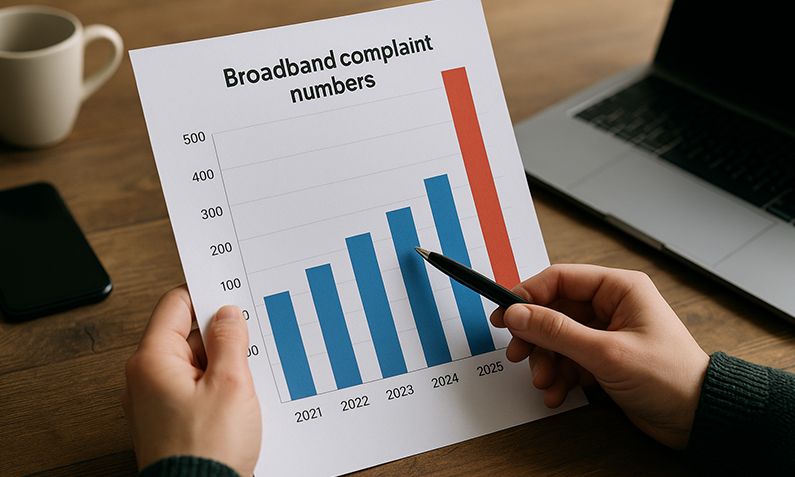
Ofcom has shared its Q2 2025 broadband complaints report. This report gives us a new look at UK internet providers and how reliable they are. It also shows which ones have the most problems and lead people to feel unhappy about the service in their homes.

Complaint levels are one of the best ways to see what people feel about their real-world experience. These numbers include problems like:

  • Faults and outages
  • Slow speeds or poor Wi-Fi performance
  • Installation delays
  • Billing disputes
  • Poor customer service
  • Problems switching provider

This year’s numbers show that the big ISPs are not all the same. There are more chances now for new full fibre networks. These new groups try to make things better for everyone in the industry.

If you are thinking about switching, it is a good idea to look at Ofcom’s complaint rankings. Check the price, speed, and reliability too. This will help you pick the right package. You can also compare broadband deals to see what is in your area.

James Ford Broadband Deals Reviewed by James Ford, TV and Broadband Expert

Superior

  • New customers only
900Mb average* speed
Unlimited Downloads
£0.00 Setup costs
24 Month contract
Pay as you goCalls
£34.99per month

500Mbps Fibre Broadband - 12 months

  • New customers only
550Mb average* speed
Unlimited Downloads
£0.00 Setup costs
12 Month contract
Pay as you goCalls
£29.00per month

Full Fibre 1000 - Total Home Wi-Fi

  • New customers only
982Mb average* speed
Unlimited Downloads
£0.00 Setup costs
18 Month contract
Pay as you goCalls
£32.99per month

Looking to upgrade with fewer issues? Check broadband options available at your postcode

What do the 2025 broadband complaint numbers show?

The latest numbers show how many complaints there are for every 100,000 customers. If the number is low, it means things work better for people in real life.

Provider

Complaints per 100,000 customers

Plusnet 4
Sky 6
Virgin Media 8
BT 9
TalkTalk 9
NOW Broadband 9
Vodafone 9
EE 10
Industry average 8

Key takeaways from the new report

1. Complaint levels have improved overall

The industry average is now 8 complaints for every 100,000 people. This has gone down from 10 complaints in the previous quarter.

2. Some providers consistently outperform the market

Providers like Plusnet and Sky stay under the average, which shows they have better reliability. This means you get more steady broadband connections.

3. EE recorded the most complaints — but the gap is small

EE had the most complaints for broadband, landline and pay-TV. But even with that, its results are much better than what has been seen before with Virgin Media, NOW Broadband and Shell Energy Broadband.

4. Faults and installation issues remain the biggest pain points

Across the board, the customers said most about these complaints:

  • Loss of service
  • Slow speeds
  • Delayed installations
  • Missed engineer appointments
  • Technical issues and dropped connections

These groups have been the main reason for many complaints for several years.

What do the 2025 broadband complaint numbers show

Which broadband providers are performing well in 2025?

Several companies have more complaints than others, though the number of reports can change.

Sky

  • There are not many complaints about broadband, landline, mobile, and pay-TV.
  • Customers feel good about the service all the time.
  • The service works well even when a lot of people use it.

Virgin Media

  • The internet gives faster speeds than most other companies.
  • There are fewer complaints than in past years.
  • There are many changes to service and infrastructure, making it better often.

BT

  • Most people have an average number of complaints.
  • The full fibre rollout is helping to make the internet more reliable across the country.

Challenger full fibre providers (including Orbus)

Full fibre altnets are becoming better than big internet companies when it comes to reliability. Ofcom does not show them in its tables yet because they are smaller. However, full fibre altnets do a good job.

  • They use newer fibre-to-the-premises (FTTP) networks.
  • They do not run into copper-based slowdowns.
  • They often give out premium routers as the standard.
  • They usually have UK-based customer support. This often means less wait time for people who call in.

Orbus gives each customer a top Amazon eero router, not only to people on the highest package. This helps lower the Wi-Fi problems that often make people send complaints to Ofcom.

Why broadband complaint levels matter when choosing a provider

Broadband is not only about how fast it is. The number of complaints people make is also a key way to know if it’s good or not.

Lower complaints often mean:

  • You will get fewer dropped connections.
  • Your speed will be more steady, even when many people are online.
  • You will not wait as long to get it installed.
  • The customer service team will be better.
  • Things will be fixed faster when there is a problem.

For people who work from home, play games online, stream videos or use smart-home devices, having a steady connection is just as important as having good broadband speed.

If you want to find a plan that gives you good, fast, and dependable service at a good price, you can compare broadband deals anytime.

Want a smoother, more reliable connection? Start comparing broadband deals today

Why full fibre networks may reduce complaints in future

The UK is quickly shifting from copper broadband (FTTC) to full fibre (FTTP). This change is important for a few reasons:

  • Full fibre networks have far fewer problems.
  • Fibre cables do not get as affected by weather or how far they go.
  • Upload speeds are much better.
  • Connections stay strong even when a lot of people use them at the same time.

This is why some providers who get more complaints still use a lot of copper lines in some places.

Providers such as Orbus and Community Fibre use only full fibre. When they get bigger and Ofcom starts to add them in its reports, these providers will likely move up in the rankings.

What the latest data means for customers in 2025

Here is a way UK households can use Ofcom’s complaint numbers to help them make better choices:

1. If you value reliability, choose providers with low complaint rates

Sky, Plusnet, and some full fibre altnets often give stronger results.

2. Check availability in your area

What you can get will depend on your local network. It could be FTTP, FTTC, or cable. You can use a broadband checker. Or, just compare broadband deals to see what is working in your area code.

3. Look beyond speed

Things like customer service, how fast your internet is during busy times, and how fast problems get fixed are more important than the big number you see in ads.

4. Consider switching if your connection is unstable

If your current provider is higher than the industry average, moving to a new one may give you fewer problems and better results.

Grab the cheapest Broadband & Phone Deals

Make savings up to 44% & keep the operational cost lower!!!

How broadband value, pricing and customer satisfaction influence complaints

Ofcom’s complaints data gives one way to look at how good UK broadband is. UK broadband customers often pick broadband companies by looking at speed, customer service, monthly costs, and what they feel is good value for money. Surveys done by analysts or consumer groups also help to show which broadband companies offer the best broadband service to people. These surveys give UK broadband customers more info to help them find the best broadband for their needs.

In UK broadband reviews done recently, people talked about a few main things:

  • The best broadband providers have strong customer service. They also give steady speeds and face less drop-out.
  • Home broadband plans that keep up good speeds at busy times often get the highest customer satisfaction.
  • Providers with best value broadband, especially smaller broadband providers, do well when they offer personal help and clearer communication.
  • A lot of the UK’s complaints are about internet connection not being stable, slow download speed during busy hours, or long support wait times.

These reviews look at thousands of UK broadband customers. A sample size like this helps show how major broadband providers match up. This way, you get a good idea of what UK broadband customers feel and how the big companies do.

Full fibre deals are now very popular with new customers. A lot of providers talk about fastest broadband. These offers help people who want better internet at home for things like streaming, playing games, or work. Many full fibre deals now come with lower setup costs or short introductory offers. This makes it easier for households to get started.

How price rises and customer support shape complaint levels

Another reason people are complaining more is because of price rises from the UK’s biggest broadband providers. A lot of customers feel frustrated. They notice that monthly costs go up while they are still in the middle of their contract. It can feel unfair, especially if the broadband service does not give the advertised average speeds.

Broadband companies that get a lot of complaints usually have the same problems.

  • It is hard to get in touch with customer service.
  • There be long wait times when you call the centre.
  • People do not feel there is clear talk during engineering appointments.
  • When there is a fault and you lose service, it takes a long time to get a reply.
  • There is a lot of confusion about the home phone or landline add-ons.
  • Customers feel like they do not get good value for what they pay each month.

These problems make people change to a new broadband provider. They often pick one that talks about cheap broadband deals or better promises with their service.

Why smaller broadband providers sometimes outperform major ISPs

Recent broadband surveys done between 6th June and 14th July show that smaller broadband providers like Zen Internet often get the highest customer satisfaction rating. These smaller companies give:

  • The broadband connection you get is more steady.
  • It is easier to reach support when you need help.
  • You spend less time waiting to talk to someone.
  • You see clear prices without any confusion.
  • The routers you get have better quality.
  • You can switch your broadband connection without any issues.

Some of the UK’s biggest broadband providers often have more customers to help. This leads to long wait times. A lot of people end up feeling unhappy as they have to wait longer for support.

Even though some smaller providers do not show up in Ofcom’s official complaint tables, as they do not have a big enough group of customers, they still come near the top end of the scale in many independent reviews.

This shows why you should not look at only complaints data. Broadband customers need to also think about the following things:

  • Ease of contact
  • How well it works at the time they use the most
  • If the provider gives automatic compensation
  • The range of broadband speeds in their postcode
  • How their experience is when using tools like a speed test or Wi-Fi analyser

Why smaller broadband providers sometimes outperform major ISPs

Why it’s important to compare broadband deals regularly

Most people in the UK now can get full fibre or very fast internet. The market is busy, and there is a lot of choice. So, people who want good customer service, the best broadband deals, or faster speeds are able to change to plans that cost less. A new person signing up will often pay less than someone who has been with their provider for a while.

Many people now change to a new provider when their minimum term is over. They like to use comparison tools for this.

  • Monthly cost
  • Download and upload speed
  • Contract length
  • Setup fees
  • Broadband connection type (FTTC, DOCSIS or FTTP)
  • Broadband provider’s customer service record

This helps people at home keep from paying more over time and getting slow or bad help. It makes sure they are always on a quick and steady internet service.

Thinking of switching provider? See which broadband packages offer the best value where you live

Where can I find recent UK broadband reliability reviews?

You can get the latest reviews about broadband reliability from places like Ofcom’s telecoms reports, customer surveys, and broadband comparison sites. These reviews talk about things like real customer experience, how often connections drop, how good the customer service is, average speeds, and how well it works during busy hours. Looking at a few different sources is a good way to know more, because reliability can change based on where you live and the type of broadband connection you have.

How do Ofcom complaint numbers compare with real customer reviews?

Ofcom tracks formal complaints that the regulator gets. Customer review websites show what people feel about their broadband every day. Ofcom’s data is checked and follows set rules. But it often misses small problems, because people do not always send an official complaint. To get the best idea of how good broadband is, it helps to look at both kinds of reports.

Why do smaller broadband providers sometimes have higher satisfaction?

Smaller providers, like many full fibre altnets, often give better customer service. You can wait less time to get help from them. They usually let you know what is going on in a clear way. Their networks are new, so they do not have many technical faults. Because of this, people feel more satisfied with the service. These providers are still growing. They are not big enough yet to show up in Ofcom’s official complaint tables.

Do Ofcom complaints include issues with Wi-Fi performance?

Ofcom complaints happen because of faults, problems with setting up, billing issues, and bad customer service. Wi-Fi problems inside the home do not count unless they are not fixed or someone gets poor help. This is why some internet providers with premium routers, like Orbus using Amazon eero systems, usually get less complaints that go further.

What role does broadband speed testing play in identifying problems?

Speed tests show if the broadband connection is working at the speed that was promised. If you keep getting low results, especially when many people are online, it may mean the internet is slow or there are problems with the service. Ofcom uses speed test information when making market reports. However, complaints are tracked on their own. You should run speed tests with a cable for the best results.

Can full fibre broadband help lower complaint levels nationally?

Yes. As the UK makes the change from copper networks to full fibre (FTTP), Ofcom should see less complaints about problems, downtime, and slow speeds. Full fibre is stronger, gives faster internet, and does not get affected much by weather or how far you live. This new change should help cut down the number of complaints as full fibre becomes more common.

Why do some broadband companies have higher call wait times despite fewer complaints?

Complaint levels show big problems that get sent to Ofcom. Call wait times tell us about daily customer service workload. A provider may not have many serious complaints, but it can still get a lot of questions from people. Times like season changes, billing periods, and network work can sometimes make call wait times higher.

Are broadband price rises linked to higher complaint figures?

Yes, in some cases, this can happen. Price rises, especially when they happen during a contract, can make customers unhappy. This is more likely if they feel they were not told enough or feel they cannot leave the contract. A provider who has a clear price plan and not many price rises will usually have about the same number of complaints each time.

Why do broadband complaints matter when comparing deals?

Complaint data is a good way to check how well customer service works and how reliable a broadband provider is. A low number of complaints often shows that there may be fewer problems like outages. It can also mean quicker installation and better help when things go wrong. When you look at broadband deals, do not focus on speed and price only. You should also think about contract length, complaint numbers, and how easy is it to get the service.

How can I tell if a new or challenger broadband provider is reliable if Ofcom hasn’t rated them yet?

Check factors such as:

  • Customer service ratings
  • Average speeds given at peak times
  • If they offer premium routers
  • Full fibre is available in your area
  • Local feedback from neighbours or community groups

Companies like Orbus, Hyperoptic, and Community Fibre are known for having good reliability. This is true even when they have not yet met Ofcom’s level for reporting results.

Grab the cheapest Broadband & Phone Deals

Make savings up to 44% & keep the operational cost lower!!!

Do complaint levels differ between home broadband and business broadband?

Yes. Business broadband often has faster help with problems, set times for fixing issues, and its own support hotline. This can cut down on big complaints. Home broadband uses usual help steps and can get more complaints when lots of people use the internet, like during busy times or when the network is crowded.

Where else can I check a broadband provider’s complaint history?

You can review:

  • Ofcom gives out complaint reports every three months.
  • There are customer satisfaction surveys once a year.
  • Broadband comparison sites show ratings that are added up from different reviews.
  • There are forums for people and social review sites where you can read more about others’ experiences.
  • Local Facebook or community groups often talk about how stable and reliable the internet is in the area.

These sources help us check if the problems are happening everywhere or just in some places.

Correct as of 03 December 2025

FAQs About Broadband Complaints and Reliability in 2025

Why does Ofcom publish broadband complaint statistics?

Ofcom shares its complaint data every few months. People can use this information to see how different internet providers do in things like fixing faults, slow speeds, billing problems, and customer service. It lets households find out which companies give the most reliable broadband connection.

Which broadband providers had the lowest complaints in 2025?

Ofcom’s Q2 2025 report shows that Plusnet and Sky got the least complaints for every 100,000 customers. Both of them stay below the industry average. They also do well when it comes to reliability and customer satisfaction.

Why do some broadband providers receive more complaints than others?

Complaint levels can be different because of things like network technology, customer service, how long it takes to set up, and how fast a company fixes problems. Providers that still use old copper networks often get more complaints. This is because these networks are more likely to have outages and the speed can change a lot. Full fibre networks usually have fewer issues and better customer service.

Do newer full fibre providers have fewer complaints?

Full fibre “altnets” like Orbus, Hyperoptic, and Community Fibre usually have fewer problems. They use new FTTP networks that are more reliable. But many of them are not on Ofcom’s tables yet because they do not have enough customers.

What is the main cause of broadband complaints in the UK?

Most people complain about problems with faults, service quality, and how things are set up. This can be dropped connections. It also means installs that take too long, missed appointments, and slow times to fix things. A lot say speeds can get slow when busy hours start.

Are broadband complaints improving nationwide?

Yes. The industry average dropped from ten to eight complaints for every 100,000 customers in the second quarter of 2025. This shows that service quality is better now, and it’s likely because full fibre is becoming more available all over the UK.

How can I reduce issues with my broadband service?

You can get better stability when you put your router in a place with more open space. Try to use a wired Ethernet connection for your most important devices. Make sure you update your router software often. You can also switch to a full fibre package, which may help. If you change to a provider that gets fewer complaints, it can make things run better too.

Are business broadband packages less likely to generate complaints?

In many cases, the answer is yes. Business broadband gives you faster help when problems come up. You get special support lines, and sometimes you can have a fixed IP address. If you work from home or run a small business, it can lower the time you spend waiting for things to be fixed. It also helps make things work better.

Does full fibre broadband reduce the likelihood of complaints?

Full fibre is the UK’s most reliable broadband. It does not use copper wiring, so it avoids many faults and drop-outs found in old networks. This broadband also has less congestion. People who use FTTP packages usually get fewer service interruptions.

Should complaint levels influence my choice of broadband provider?

Yes, that’s right. Complaint data shows what real people feel about a service. When you look at broadband deals, you should think about complaint numbers, contract length, speed, and price. All of these matter when you pick the best one for you.

Also Read Related Articles

Grab the cheapest Broadband & Phone Deals

Make savings up to 44% & keep the operational cost lower!!!

Compare Now
4000+ reviews