

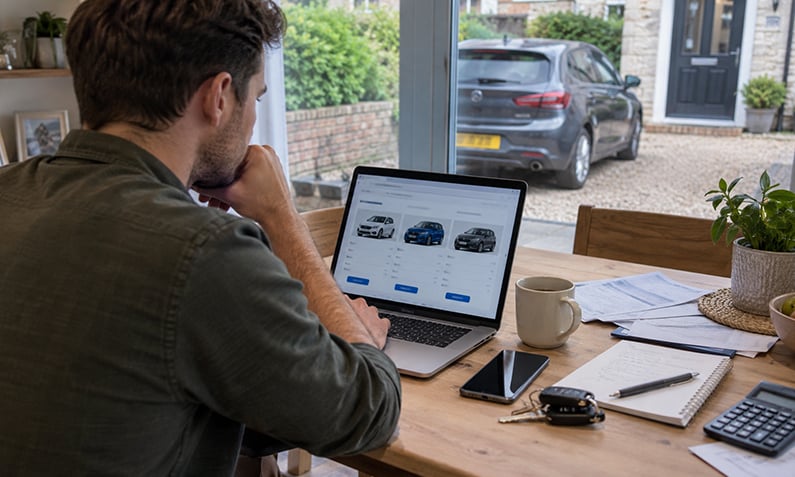




Car Insurance Quotes Online UK: What You Need to Know

Written by Pratik Aghera
Reviewed by Brijesh Patel
Updated: 10 Sep 2026
Car Insurance Quotes Online UK: What You Need to Know

Car insurance quotes online UK let you compare prices from many insurers in one place, usually within a few minutes, by entering your car registration, address and driving details. According to the Association of British Insurers, the average price paid for comprehensive motor cover was £560 in Q1 2026, but the figure you see on screen depends heavily on your age, car, postcode and claims history.

Most buyers now quote and buy on a phone: around 8 in 10 Free Price Compare car insurance journeys happen on a mobile device (Free Price Compare data, Jan-Jun 2026). Comparing across a panel of 130+ insurers gives you a realistic picture of the market before you commit, rather than accepting a single renewal price.

Quick Answer: Car Insurance Quotes Online UK

  • The ABI average price paid for comprehensive cover was £560 in Q1 2026, £20 lower than a year earlier (ABI, April 2026).
  • A quote is a legally binding price offer; comparison-site averages sit higher than prices paid because not every quote turns into a sale.
  • Getting car insurance quotes uses a ‘soft’ credit search that only you can see and does not lower your credit score.
  • Third party only cover is often not the cheapest option, so always compare comprehensive alongside it.
  • Renewing 20-26 days before your policy ends tends to produce lower quotes than buying on the day cover expires.

Last updated: August 2026

Written by the Free Price Compare editorial team | Reviewed August 2026

How online car insurance quotes actually work

An online car insurance quote is a binding price an insurer offers to cover your car for a set period, based on the details you enter. When you compare online, you fill in one form about your car, your address, your licence and your claims history, and the system returns prices from multiple insurers ranked by cost. Free Price Compare sources these from a panel of 130+ insurers, so you see a spread of the market rather than one provider’s number.

The details drive the price. Insurers assess risk using your age, where you park overnight, your annual mileage, your job, your no-claims bonus and the car itself. A quote is valid for a limited window, so you are not tied in by requesting one, and you can walk away without buying. If you want to understand the mechanics in more depth, our walkthrough on how to compare car insurance quotes online and save money sets out each step.

Accuracy matters more than speed. Guessing your mileage or leaving off a past claim can void a policy later, so enter real figures. Around 98-99% of cars quoted through Free Price Compare have no modifications (Free Price Compare data, Jan-Jun 2026), but if yours does, declare it, because an undeclared modification is a common reason claims get rejected.

Compare car insurance quotes online

How much is the average premium and why does mine differ?

The average price paid for comprehensive car insurance was £560 in Q1 2026, according to the ABI Motor Insurance Premium Tracker, which analyses over 28 million policies sold a year. That was up just £1 (0.2%) on the previous quarter and £20 lower than Q1 2025, so prices had steadied after their earlier peak.

Your own quote can sit well above or below that average because the £560 blends every driver, car and postcode together. A 19-year-old in a city with no no-claims bonus and a 55-year-old in a village with 15 years of clean driving are both in that average, yet they pay very different prices. Younger drivers carry higher premiums: drivers aged 17-25 make up around 21-28% of Free Price Compare quotes but only 10-17% of sales (Free Price Compare data, Jan-Jun 2026), partly because prices push some to keep shopping.

Claims costs also shape the market. The ABI reported the average accidental damage claim reached £3,699 in early 2026, up 8% on the prior quarter, and insurers paid £11.9 billion to motorists across 2.5 million claims in 2025. Higher repair bills feed through into everyone’s premiums over time.

Figure Amount Source and period
Average comprehensive price paid £560 ABI Motor Insurance Premium Tracker, Q1 2026
Change vs previous quarter Up £1 (0.2%) ABI, Q1 2026 vs Q4 2025
Change vs a year earlier Down £20 ABI, Q1 2026 vs Q1 2025
Average accidental damage claim £3,699 ABI, early 2026

Figures are indicative and may change.

Why quoted prices look higher than the ABI average

Quoted prices on comparison sites tend to sit above the ABI’s average because they measure different points in the buying journey. The ABI figure of £560 (Q1 2026) is a price actually paid, while comparison-market quote indices measure prices offered before anyone buys. A quoted-market benchmark put the average comprehensive quote at £619 in Q2 2026, higher than the ABI paid figure, but the two are not directly comparable.

Buyers naturally gravitate to the cheaper quotes on the list, so the price people pay ends up lower than the average price offered. That gap is exactly why comparing pays off: you are choosing from the full spread rather than accepting the middle. Our guide to getting cheap car insurance quotes online explains how to filter for value rather than the lowest headline number.

Why quoted prices look higher than the ABI average

See your own car insurance prices

Compare quotes from 130+ UK insurers in minutes

Does getting a quote affect my credit score?

Getting car insurance quotes does not affect your credit score. Insurers and comparison sites run a ‘soft’ credit search (also called a quotation search) to verify your details and check for anything relevant to pricing. A soft search is visible only to you on your credit file and leaves no mark that other lenders can see.

A ‘hard’ search, which can affect your score, only happens when you apply for credit, such as paying for your policy monthly by finance. Even then, the impact is usually small and temporary. Requesting several online car insurance quotes to compare prices is safe and is exactly how the market is meant to work.

One thing to be aware of is repeated quoting on a single insurer’s own site in a short space of time, which some systems flag. Comparing through a comparison journey avoids hammering any one insurer, and you can save a quote and come back to it rather than re-running it repeatedly.

Is comprehensive cover really more expensive than third-party?

Comprehensive cover is often the same price or cheaper than third party only, despite covering more. Third party only is the legal minimum and pays for damage or injury you cause to others but nothing for your own car. Third party, fire and theft (TPFT) adds cover for your car being stolen or catching fire. Comprehensive covers all of that plus damage to your own car, even when an accident is your fault.

The reason third party only is not automatically cheapest is risk profile. Insurers found that drivers choosing minimum cover statistically made more claims, so basic policies are priced accordingly. On Free Price Compare, around 88-89% of car insurance quotes are for comprehensive cover, rising to roughly 88-91% of actual purchases (Free Price Compare data, Jan-Jun 2026). The practical advice is to quote all three cover levels and compare the real prices side by side.

  • Third party only: the legal minimum under the Road Traffic Act 1988; covers others, not your car.
  • Third party, fire and theft: adds fire and theft cover for your own vehicle.
  • Comprehensive: covers your car too, including at-fault accidents, and is frequently priced competitively.

Compare comprehensive and third-party prices

Car insurance is a legal requirement in the UK for any vehicle driven or kept on a public road, under the Road Traffic Act 1988. The minimum is third party cover. Driving uninsured risks a fixed penalty, points, an unlimited fine on conviction and potentially having your vehicle seized.

You cannot tax a car without insurance in England, Scotland and Wales. When you tax through the DVLA, the system checks the Motor Insurance Database to confirm valid cover is in place. The only lawful way to keep a car off the road untaxed and uninsured is to declare a Statutory Off Road Notification (SORN), in which case it must be kept off public roads. Continuous Insurance Enforcement means a registered vehicle without a SORN must stay insured at all times, even when parked.

Which car insurance comparison approach is best?

The best comparison approach is one that shows a wide panel of insurers, uses accurate details and lets you weigh cover and excess against price, not just the cheapest headline figure. Comparing across many insurers matters because prices for the same driver vary enormously between providers. Free Price Compare compares car insurance across a panel of 130+ insurers and 60+ insurance products in total, which gives a realistic spread rather than a handful of results.

To get the most from any comparison, keep your details consistent, review the excess and any add-ons, and check the cover meets your needs before sorting purely on price. It helps to run an estimate first so you know roughly what to expect. Our car insurance calculator gives a ballpark, and our five strategies for cheaper car insurance cover the levers that move your price most.

What car insurance is not on comparison sites?

Some insurers choose not to appear on comparison sites and sell only direct, so a comparison list rarely shows the entire market. A few well-known direct-only brands price their policies themselves and are worth a separate quote alongside your comparison. Specialist cover, such as classic cars, high-value vehicles, imports, taxi and courier use, or drivers with unusual histories, is also often better arranged directly or through a broker.

The practical route is to use a comparison first to establish the going rate across a broad panel, then check one or two direct-only insurers to see if they beat it. That covers most of the market without spending hours re-keying your details. If your circumstances are unusual, a broker can hand-place cover that comparison forms struggle with.

Start comparing car insurance now

How can I get cheaper car insurance quotes?

The most reliable way to get cheaper car insurance quotes is to compare early, keep your details accurate and adjust the controllable factors. Timing has a measurable effect: quoting around 20-26 days before your renewal date typically returns lower prices than buying on the day your cover lapses, because insurers price last-minute buyers as higher risk.

Beyond timing, a few adjustments move the price. Paying annually rather than monthly avoids interest on instalments. Increasing your voluntary excess lowers the premium but raises what you pay after a claim, so pick a figure you could actually afford. Adding a named experienced driver, improving security, and building your no-claims bonus all help.

  • Compare across a wide panel of insurers rather than auto-renewing.
  • Quote roughly three to four weeks before renewal, not on the day.
  • Pay annually if you can to avoid instalment interest.
  • Set a voluntary excess you could realistically pay after a claim.
  • Keep mileage and job description accurate; small changes can shift the price.

Around a third of Free Price Compare quotes come from drivers with no no-claims bonus (Free Price Compare data, Jan-Jun 2026), so if you are new or have recently claimed, comparing widely matters even more, as pricing between insurers varies most at that end.

How can I get cheaper car insurance quotes

FAQs about car insurance quotes online uk

What is a car insurance quote?

A car insurance quote is a price an insurer offers to cover your car for a set period, based on the details you provide about yourself, your vehicle and your driving history. It is a binding offer, so if you accept it and the details are accurate, that is the price you pay. Quotes are usually valid for a limited window and requesting one does not commit you to buying.

How long does an online car insurance quote last?

Most online car insurance quotes are held for around 30 days, though the exact window varies by insurer. Saving a quote and returning to it later, rather than re-running it from scratch, means you keep the same price if it has not expired. Prices can change once the quote lapses, because insurer pricing updates continuously.

Does comparing quotes online guarantee I get the cheapest price?

Comparing online shows you a wide spread of prices but no single comparison shows every insurer, because some sell direct only. To get close to the cheapest suitable cover, compare across a broad panel first, then check one or two direct-only insurers separately. Sort on value, not just the lowest headline figure, so cover and excess still meet your needs.

Why are my car insurance quotes so high?

Quotes rise when insurers see higher risk in your profile, such as a young age, a powerful or high-value car, a poor claims record, a city postcode or high annual mileage. Recent claims and points on your licence also push prices up. Comparing across many insurers usually reveals a wide range, so a high quote from one provider does not mean the whole market is that expensive for you.

Can I renew my car insurance online instead of over the phone?

Yes, most insurers let you renew online, and many allow you to review and adjust cover before confirming. Renewing online also makes it easy to compare your renewal price against fresh quotes elsewhere before you commit. Never assume your renewal is the best price; insurers often quote new customers less than existing ones.

Can I tax my car without insurance?

No, you cannot tax a car without valid insurance in England, Scotland and Wales. When you tax through the DVLA, the system checks the Motor Insurance Database to confirm cover is in place. The only exception is declaring a Statutory Off Road Notification (SORN), which means the car must stay off public roads and untaxed.

Do multiple insurance quotes hurt my credit score?

No, requesting car insurance quotes uses a soft credit search that only you can see and does not affect your credit score. A hard search, which can leave a mark, only happens if you apply to pay monthly by finance. Comparing several quotes to find the best price is safe and expected.

What information do I need to get a quote online?

You will need your car registration, your address, your driving licence details, your date of birth, your occupation, your estimated annual mileage and your no-claims bonus history. Having recent claims or convictions to hand speeds things up. Entering accurate details is essential, because guessed figures can invalidate a policy at claim time.

Is third party cover always cheaper than comprehensive?

No, third party only cover is frequently the same price or more expensive than comprehensive, even though it covers less. Insurers found drivers choosing minimum cover statistically claimed more, so basic policies are priced higher. Always quote comprehensive alongside third party and third party, fire and theft to compare the real prices.

Why is the average premium different from my quote?

The ABI average of £560 for Q1 2026 blends every driver, car and postcode into one figure, so it rarely matches an individual quote. Your price reflects your specific age, location, car, mileage and claims record. Younger drivers and those without a no-claims bonus typically pay well above the average, while older drivers with clean records often pay less.

Can I get insured on a car I have not bought yet?

Yes, you can get a quote on a car you are considering buying by entering its registration and details, which many buyers do to check running costs before purchase. The quote is just a price estimate until you accept it and cover starts. This is a sensible way to avoid an unpleasant surprise after committing to a car.

Is it worth using a broker instead of comparing online?

For most standard drivers, comparing online across a wide panel finds competitive cover quickly. A broker is worth considering if your circumstances are unusual, such as a modified or high-value car, non-standard use, an import, or a complicated claims or driving history. Brokers can hand-place cover that automated comparison forms struggle with.

Also Read Related Articles


Information correct as of 27 August 2026. Prices, tariffs, policy details and providers change frequently, so please check the latest details before making a decision. This article is for general information only and does not constitute financial advice. Free Price Compare is authorised and regulated by the Financial Conduct Authority (FCA).

4000+ reviews