

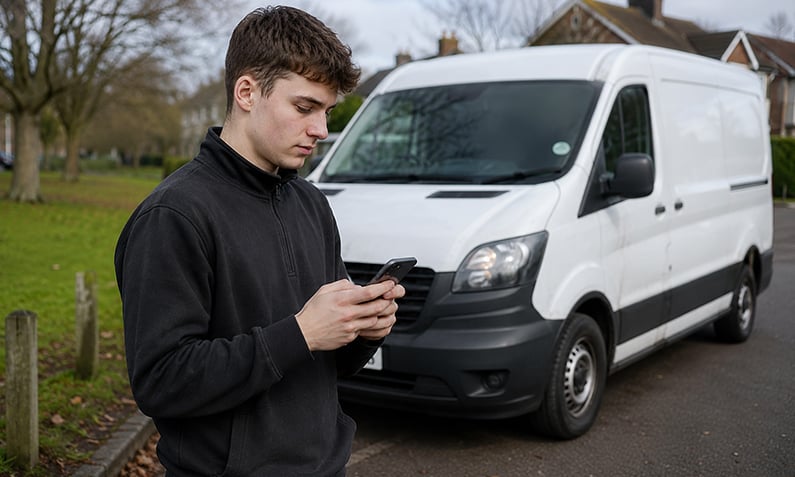




Cheap Van Insurance for Young Drivers Explained

Written by Shay Ramani
Reviewed by Tim Bailey
5 min read
Updated: 2 Sep 2026
Cheap Van Insurance for Young Drivers Explained

Cheap van insurance for young drivers is harder to find than standard cover because insurers treat 17-25 year olds as higher-risk, but there are legal ways to bring the price down. You can insure a van from age 17 with a full UK licence, and the biggest savings come from choosing a low insurance-group van, agreeing to telematics, limiting your mileage and building no-claims history correctly.

The under-25 age band is the most expensive part of the van market, and quotes of well over £1,500 a year are common for a first policy. Free Price Compare compares van insurance from a panel of 63 UK providers, so you can see how different vans, cover levels and driver setups change the price before you commit.

This explainer answers the questions younger and newer van drivers actually ask: whether you can even get cover, why it costs so much, and the specific tactics that reduce the premium without invalidating the policy.

Quick Answer: Cheap Van Insurance for Young Drivers Explained

  • You can legally insure a van from age 17 with a full UK driving licence, though fewer insurers accept under-21s and some (like certain large motor insurers) decline drivers under 21 entirely.
  • Choosing a low insurance-group van matters most: Howden’s 2026 data lists the Vauxhall Astravan, Nissan Primastar and Renault Kangoo among the cheapest vans to insure.
  • Telematics (black box) policies price you on how you actually drive, which can reduce premiums for careful young drivers over the policy year.
  • Adding an older, experienced named driver can lower the quote, but the youngest or main user of the van must be the main policyholder – listing an experienced driver as ‘main’ when they are not is ‘fronting’, which is insurance fraud.
  • You build a van no-claims bonus (NCB) by insuring in your own name and going a full policy year without a claim; a car NCB is not always accepted on a van policy.

Last updated: August 2026

Written by the Free Price Compare editorial team | Reviewed August 2026

Can you even get van insurance as a young driver?

Yes, a young driver can get van insurance from age 17, provided you hold a full UK driving licence rather than a provisional one. The catch is that fewer insurers offer cover to under-21s, and a small number of large motor insurers will not cover anyone under 21 on any van product, so your choice of provider narrows at the youngest ages.

The Road Traffic Act 1988 makes at least third-party van insurance a legal requirement for driving on UK roads, and driving uninsured risks a fixed penalty, points and vehicle seizure. That legal floor applies whatever your age, so the question is never whether you need cover but how to get it at a workable price.

Availability improves sharply once you pass 21, and again at 25. If you are struggling to find a quote at 17 or 18, comparing across a broad panel matters more than at any other age, because acceptance varies significantly between insurers.

Building experience early also helps. Many of the same principles that apply to cheap car insurance for new drivers carry over to vans, particularly around telematics and low-value vehicles.

Compare young driver van insurance quotes

Why is young driver van insurance so expensive?

Young driver van insurance is expensive because insurers price on claims risk, and drivers aged 17-25 statistically make more claims and more costly claims than experienced drivers. Vans add extra cost on top of this because they are larger, often carry tools or goods, and are more expensive to repair or replace than a small car.

Newly qualified drivers are treated as higher risk than provisional learners, because a learner is always supervised while a newly passed driver is not. That is why a quote can jump the moment a licence goes from provisional to full. A first-year comprehensive van policy for someone in their late teens can run well beyond £1,500, and quotes near or above £2,000 are common at 17-18.

Business use, mileage and where you park the van all push the figure up further. A van used for a courier round covers more miles in higher-risk conditions than one used to move personal belongings, so the intended use has a large effect on the price.

Understanding your cover level helps you judge value rather than just chasing the lowest number. Our guide to comprehensive versus third party cover explains why the cheapest headline option is not always the cheapest overall.

Which is the cheapest van to insure for young drivers?

The cheapest van to insure for young drivers tends to be a small, low-powered panel van in a low insurance group, because insurance groups reflect repair costs, performance and the value of the vehicle. According to Howden’s 2026 van insurance data, the Vauxhall Astravan, Nissan Primastar and Renault Kangoo rank among the cheapest vans to insure by lowest average quoted premium.

Small car-derived vans and compact panel vans generally cost less to cover than large high-roof vans or performance-badged models. Thatcham Research assesses vehicles for security and repairability, and vans with better security ratings and cheaper parts sit in lower groups.

The list below reflects the type of van that keeps premiums down for a younger driver.

  • Compact panel vans and car-derived vans in low insurance groups, such as the Renault Kangoo or Vauxhall Astravan.
  • Vans with lower engine power rather than high-performance or heavily modified models.
  • Vans with factory security (immobiliser, deadlocks) intact and no aftermarket modifications.
  • Older, lower-value vans, where the cost to replace or repair is smaller.

Before you buy, check the insurance group and get an indicative quote on the exact van, because two similar-looking models can sit in different groups. The Society of Motor Manufacturers and Traders, according to SMMT, reported UK new van registrations of 187,226 in the first seven months of 2026, up 4.3% year on year, so there is a wide and growing pool of models to compare.

Which is the cheapest van to insure for young drivers

Find a low-group van to insure

Compare cover across 63 UK van insurers and see how the model changes your price

How can young drivers get cheaper van insurance?

Young drivers get cheaper van insurance mainly by lowering the risk the insurer prices on: a smaller van, fewer miles, a telematics policy, a sensible voluntary excess and paying annually rather than monthly. No single tactic transforms the price, but combined they can meaningfully reduce a first-year premium.

Consider a telematics or black box policy

Telematics van insurance is a policy that uses a black box or app to record how you actually drive, then prices your cover on that behaviour rather than on age alone. For careful young drivers, this can reduce the premium over the policy year, because you are judged on your own speed, braking and mileage instead of the average for your age group.

Telematics suits low-mileage, considerate drivers best. If you drive late at night frequently or cover very high mileage, the savings are smaller. The same telematics principle underpins many young driver car insurance policies, and the logic transfers directly to vans.

Reduce your mileage and increase your voluntary excess

Lowering your estimated annual mileage reduces the premium because less time on the road means less exposure to claims, so give an honest but not inflated mileage figure. Increasing your voluntary excess, the amount you agree to pay towards a claim on top of the compulsory excess, also lowers the price, but only raise it to a level you could afford after an accident.

Pay annually and keep the policy clean

Paying annually rather than in monthly instalments avoids the interest that monthly payment adds, since spreading the cost is effectively a short-term credit agreement regulated by the FCA. If you cannot pay in one go, compare the total annual cost of monthly plans rather than just the monthly figure.

See how telematics changes your van quote

How to add a named driver without committing fronting

Adding an experienced named driver can lower a young driver’s van premium, but the youngest or main user of the van must always be listed as the main policyholder or main driver. Listing an older, experienced driver as the main driver when a young person is actually the main user is called fronting, and fronting is insurance fraud that can void the policy and leave you uninsured after a claim.

Done correctly, a named driver with a clean record and years of no-claims experience reduces the assessed risk on the policy, so the insurer may lower the quote. The rule is simple: describe who really drives the van most. If you use the van daily and a parent drives it occasionally, you are the main driver and they are the named driver, not the other way round.

Getting this right protects you. A voided policy for fronting means the insurer can refuse a claim and the Motor Insurers’ Bureau may pursue costs, so the short-term saving is never worth the risk. For more detail on structuring cover honestly, see our young driver insurance strategies guide.

Does a no-claims bonus lower the cost, and how do you build one?

A no-claims bonus (NCB) lowers the cost by giving you a discount for each consecutive year you hold a policy without making a claim, and it is one of the most reliable long-term ways to reduce young driver van insurance. You build a van NCB by insuring the van in your own name and completing a full policy year without a fault claim.

A car no-claims bonus is not always transferable to a van policy, because some insurers treat van and car NCB separately. If you already hold car NCB, ask each insurer whether they will accept it on a van; some will, some will not, and it can be worth comparing on both bases. If you cannot transfer it, insuring the van in your own name from the start begins your van NCB straight away.

The most cost-effective route for many young drivers is to insure a low-value van in their own name, drive carefully, and let the discount build year on year. After one clean year, renewal quotes usually drop noticeably, and the effect compounds. Protecting your NCB once you have built a few years is often worthwhile, as one claim can otherwise reset it.

Start building your van no-claims bonus

Insure in your own name and compare renewal-friendly cover across our panel

Do you need business cover if you use the van for work?

You need business use van insurance if you use the van for work, because a standard personal or social-use policy does not cover commercial activity and a claim could be refused. The cover you need depends on what the van does: carriage of own goods covers transporting your own tools and equipment, while hire and reward or courier cover is required if you deliver goods for payment.

Getting the use class right is essential. If you use the van to carry your own trade tools between jobs, carriage of own goods is usually correct. If you deliver parcels or goods for a fee, you need courier van insurance or hire and reward cover, which costs more because of the higher mileage and risk. Declaring the wrong use to save money can invalidate a claim.

For younger drivers, business and courier cover is harder to find and more expensive, so comparing widely matters. Whether you need commercial van insurance for a trade van or simpler carriage of own goods cover, describe your real use accurately when you quote.

Where to get cheap van insurance as a young driver

The most effective way to find cheap van insurance as a young driver is to compare quotes across as many insurers as possible, because acceptance and price for under-25s vary more between providers than for any other age group. Free Price Compare compares van insurance from a panel of 63 UK providers, which widens the pool of insurers willing to cover younger drivers.

Comparing also lets you test the tactics side by side: the same driver on a lower-group van, with telematics, or with a correctly listed named driver, will see different prices in a single search. That makes it easier to see which changes actually move the premium for your circumstances rather than guessing.

Check details carefully before buying: the cover level, the compulsory and voluntary excess, the mileage limit and the use class all affect whether a cheap headline price is good value. If a quote looks unusually low, confirm the use class and excess are right for how you actually drive. You can also read our van insurance FAQs for more on cover levels and extras.

Where to get cheap van insurance as a young driver

Compare van insurance from 63 UK providers

FAQs about van insurance

How much does van insurance cost for a young driver in the UK?

Young driver van insurance is the most expensive age band, and a first comprehensive policy for someone aged 17-20 commonly costs well over £1,500 a year, with quotes near or above £2,000 not unusual at 17-18. Prices fall as you gain experience and no-claims years. Because quotes vary widely between insurers for under-25s, comparing across a broad panel is the single biggest factor in finding a workable price.

Can I get van insurance at 17?

Yes, you can insure a van from age 17 as long as you hold a full UK driving licence rather than a provisional one. Fewer insurers cover 17 and 18 year olds, and some large motor insurers decline drivers under 21 entirely, so your choice of provider is narrower at the youngest ages. Comparing across many insurers matters most at 17 because acceptance differs significantly between them.

Is van insurance cheaper than car insurance for young drivers?

Van insurance is usually more expensive than car insurance for young drivers, because vans are larger, cost more to repair and often carry tools or goods that increase the potential claim. Occasionally a low-group small van can quote competitively against a poorly-rated car, but as a rule a young driver should not assume a van will be cheaper than a small, low-group car.

Does telematics really reduce van insurance for young drivers?

Telematics can reduce van insurance for careful young drivers because the policy prices you on your actual driving, using a black box or app, rather than only on your age. Drivers who avoid harsh braking, keep to speed limits and cover fewer miles tend to see the most benefit over the policy year. Very high-mileage or frequent late-night driving reduces the potential saving.

How do I build a no-claims bonus on a van?

You build a van no-claims bonus by insuring the van in your own name and completing a full policy year without making a fault claim. Each clean year adds to your discount and lowers future renewals. A car no-claims bonus is not always accepted on a van policy, so ask each insurer whether they will transfer it before assuming it applies.

What is fronting and why should young van drivers avoid it?

Fronting is when an older, experienced driver is listed as the main driver on a policy while a young person is actually the main user of the van, done to lower the premium. It is insurance fraud and can void the policy, meaning a claim is refused and you are left uninsured. Always list the person who drives the van most as the main driver, with others as named drivers.

Do I need business cover to use my van for work?

Yes, you need business use van insurance if you use the van for any work purpose, because social or personal-use cover excludes commercial activity. Carriage of own goods covers transporting your own tools and equipment, while hire and reward or courier cover is required if you deliver goods for payment. Declaring the wrong use class can invalidate a claim, so describe your real use accurately.

Which vans are cheapest for a young driver to insure?

Small, low-powered panel vans and car-derived vans in low insurance groups are generally cheapest for young drivers, because they cost less to repair and replace. Howden’s 2026 data lists the Vauxhall Astravan, Nissan Primastar and Renault Kangoo among the cheapest vans to insure. Always check the insurance group and get an indicative quote on the exact model before buying, as similar vans can sit in different groups.

Can I use my parent's van insurance as a young driver?

You can be added as a named driver on a parent's van policy if you only drive the van occasionally, which can be a cheaper way to gain experience. However, if you are the main user of the van, you must be the main policyholder or main driver, otherwise it becomes fronting. Being a legitimate named driver does not build your own no-claims bonus in most cases.

Will increasing my voluntary excess make van insurance cheaper?

Increasing your voluntary excess usually lowers the premium, because you agree to pay more towards any claim before the insurer contributes. Only raise it to a level you could realistically afford after an accident, since you pay both the compulsory and voluntary excess when you claim. Setting it too high to chase a low price can leave you unable to afford a claim later.

How can a young driver reduce a van insurance quote quickly?

The fastest ways to reduce a young driver van quote are choosing a low insurance-group van, agreeing to a telematics policy, giving an honest lower mileage, paying annually rather than monthly, and adding an experienced named driver correctly. Comparing quotes across many insurers on the same details also reveals which changes move the price most for your circumstances.

Does paying monthly cost more than paying annually for van insurance?

Paying monthly usually costs more than paying annually because monthly instalments include interest, effectively a short-term credit agreement. If you can pay the full annual premium at once, you avoid that added cost. If you need to spread payments, compare the total annual cost of each monthly plan rather than only the monthly figure, as interest rates differ between insurers.

Also Read Related Articles


Information correct as of 28 August 2026. Prices, tariffs, policy details and providers change frequently, so please check the latest details before making a decision. This article is for general information only and does not constitute financial advice. Free Price Compare is authorised and regulated by the Financial Conduct Authority (FCA).

4000+ reviews