





Learners Car Insurance: The Cheapest Way to Practise

Written by Andrea Troy
Reviewed by Prajesh Manvar
5 min read
Updated: 6 Aug 2026
Learners Car Insurance: The Cheapest Way to Practise

Learners car insurance is short-term or annual cover that lets a provisional licence holder practise legally in their own, a friend’s or a family member’s car. Anyone driving on a UK public road must have valid insurance, including learners, so this cover is a legal requirement under the Road Traffic Act 1988 while you build up practice hours between lessons.

If you are a learner (or the parent arranging cover), the cheapest legal route usually depends on whose car you practise in and how often you drive. Median provisional cover works out far lower than a first-year full-licence policy, so it pays to understand the options before you buy. Free Price Compare compares car insurance from a panel of 130+ insurers, and this explainer sets out the choices, the rules and the traps that catch learners out.

Quick Answer

  • Learner cover comes in two forms: short-term (pay by the day, week or month) or an annual learner policy – short-term suits occasional practice, annual suits regular driving.
  • A learner policy ends the moment you pass your test, so you cannot legally drive home on it – you must arrange full cover before leaving the test centre.
  • You must be supervised by someone aged 21 or over who has held a full UK licence for the correct category for at least 3 years while you drive on your provisional.
  • Learner-specific cover often protects the car owner’s own no-claims bonus, because a claim sits on the learner’s separate policy rather than the parent’s.
  • Driving without insurance carries a £300 fixed penalty and 6 points, or an unlimited fine and a driving ban if the case goes to court.

Last updated: July 2026

Written by the Free Price Compare editorial team | Reviewed July 2026

What learners car insurance actually covers

Learners car insurance is a policy that covers a provisional licence holder to drive under supervision while learning, and it is separate from the standard annual policy on the car. It exists because insurers price a supervised learner as a lower risk than a newly qualified driver who drives alone, so learners generally pay less than they would in their first year on a full licence.

According to gov.uk and the Road Traffic Act 1988, every driver on a public road must be insured, and a provisional licence does not exempt you. Learner cover is usually fully comprehensive, so it protects the car you practise in as well as third parties. The two main formats are short-term (top-up) cover and a dedicated annual learner policy.

Short-term learner cover works as a top-up: it only insures the learner while they are driving, and only for the days or hours you buy. Annual learner cover runs for up to 12 months and tends to be better value if you practise several times a week. Around 88-89% of car insurance quotes through Free Price Compare are for comprehensive cover (Free Price Compare data, Jan-Jun 2026), and learner policies follow the same pattern.

How much does learner driver insurance cost?

Learner driver insurance is usually modestly priced for a few months of supervised practice, with short-term daily cover available and monthly policies tending to work out cheaper for regular drivers. The exact price depends on your age, postcode, the car and how long you need cover for.

As a general guide, the typical price paid for comprehensive cover by provisional licence holders tends to be far lower than a newly qualified driver pays in their first year. Drivers who have held a full UK licence for under a year typically pay several times as much, which is why learner cover is usually the cheaper option during the learning period. That gap exists because insurers treat a supervised learner as lower risk than a new driver on the road alone.

Adding a learner to an existing family policy is the more expensive alternative. Adding a 17-year-old learner driver to an established annual policy typically costs a substantial amount each year, so a dedicated learner policy is usually cheaper for the learning period itself. Free Price Compare data shows young drivers aged 17-25 make up 21-28% of quotes but only 10-17% of sales (Free Price Compare data, Jan-Jun 2026), reflecting how heavily first-time drivers shop around on price.

It is also worth understanding excess when you compare. The compulsory excess is a fixed amount set by the insurer that you always pay towards any claim, while the voluntary excess is an extra amount you choose to add on top; raising your voluntary excess usually lowers the premium, but it means paying more out of pocket if you claim. For a learner on a tight budget, a modest voluntary excess can trim the price, provided you could genuinely cover the total excess after an accident.

Cover type Typical cost Best for
Short-term (daily) Around £10 to £20 a day Occasional practice between lessons
Short-term (monthly) Around £100 to £300 for the learning period Regular practice over a few months
Annual learner policy Median around £326 (provisional holders) Frequent practice over many months
Added to a parent’s policy Average around £1,705 a year (17-year-old) Rarely the cheapest for learners

Figures are indicative and may change.

Compare learner driver insurance

Short-term vs annual learner cover: which is cheaper?

Short-term learner cover is cheaper if you only practise occasionally, while an annual learner policy is cheaper if you drive several times a week over several months. The right choice comes down to how often you get behind the wheel and how long you expect to need before your test.

Short-term policies are pay-as-you-go top-ups. You buy cover for the days you need, which suits a learner who mostly relies on paid lessons and only borrows a family car now and then. Some providers offer cover from as little as a single day, though 1-day policies often require the car to already hold its own annual insurance.

An annual learner policy runs for up to 12 months and stops the moment you pass. With DVSA waiting times for a practical test averaging around 22 weeks in Great Britain in 2025, many learners now need cover for far longer than they once did, which tips the balance towards an annual policy. A first-attempt pass is not guaranteed either: the category B car test pass rate was 48.7% in 2024-25, so budgeting for repeat practice after a failed test is sensible.

Short-term vs annual learner cover: which is cheaper

Whose car can a learner practise in?

A learner can practise in their own car, a friend’s car or a family member’s car, provided the vehicle is valid, taxed, has a current MOT and is insured for the learner to drive. Learner policies commonly require the car to be valued up to around £20,000 and to sit within a lower insurance group, so a high-value or high-performance car may not qualify.

Practising in a family member’s car with a separate learner top-up policy has a real advantage: because the learner is insured under their own policy, a claim does not usually fall on the car owner’s own policy or their no-claims bonus. That protects the parent’s premium and their bonus if the worst happens during a practice session.

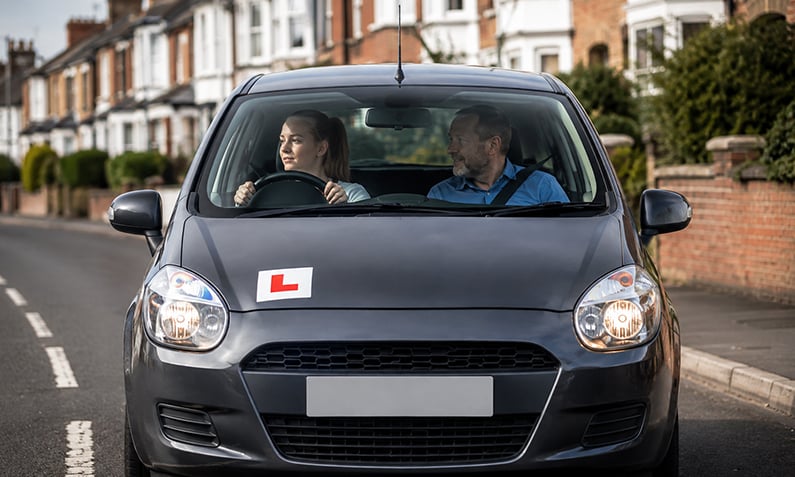
Whatever car you use, it must display L plates (or D plates in Wales), be roadworthy and the learner must be supervised correctly. Free Price Compare data shows Ford and Vauxhall are the most-quoted makes at around 12% and 10% of quotes (Free Price Compare data, Jan-Jun 2026), and these smaller, lower-group cars are typically the cheapest for a learner to insure.

Practising in the family car?

Learner top-up cover can protect the owner’s no-claims bonus.

Who can supervise a learner driver?

A supervising driver for a learner must be aged 21 or over and have held a full driving licence for the same category of vehicle (usually a manual or automatic car) for at least three years. This is a legal requirement, not just an insurer condition, and driving unsupervised on a provisional licence is an offence.

The supervising driver does not have to be a paid instructor. A parent, older sibling or family friend who meets the age and licence conditions can supervise, which is what makes learner top-up cover so cost-effective. The supervisor is responsible for the vehicle and can be prosecuted if the learner drives dangerously, so they must stay alert and sober throughout.

There is no legal requirement for the supervising driver to be named on the learner’s insurance, though some policies note the supervisor. [STAT NEEDED: Ofcom, Ofgem, ABI, FCA or ONS] If you are unsure, check the policy wording carefully before your first practice session so there is no gap in cover.

Can you drive home after passing your test?

No, you cannot drive home on a learner policy after passing your test, because learner-specific cover ends the instant the examiner confirms you have passed. At that moment your provisional restrictions lift, but so does your learner insurance, leaving you uninsured to drive away alone.

To drive home legally, arrange full new-driver cover before you sit the test, so it is ready to activate the moment you pass. Many drivers set up an annual policy that starts on the test date or buy short-term cover to bridge the day, then switch to a full annual policy. Driving away uninsured risks a £300 fixed penalty and 6 penalty points, plus the cost of an untraced or uninsured claim.

This is one of the most common and costly mistakes learners make. Free Price Compare data shows around a third of car insurance quotes come from drivers with zero years of no-claims bonus (Free Price Compare data, Jan-Jun 2026), many of them recently passed, so comparing a new-driver policy in advance is worth doing before test day.

See new driver insurance options

How learner insurance affects your no-claims bonus

A no-claims bonus is a discount insurers apply for each consecutive year you drive without making a claim, and time on a learner policy does not usually build one because learners are not yet fully licensed drivers. Once you pass and take out your own annual policy, you start earning your bonus from year one.

The main no-claims advantage of learner cover is defensive: because the learner carries their own separate policy, an accident during practice sits on that policy rather than the car owner’s, protecting the owner’s accumulated bonus. For a parent who has spent years building a no-claims discount, keeping the learner on a standalone policy rather than adding them as a named driver can be the safer choice.

When you move to your first full-licence policy, the price will reflect your inexperience, but a clean record from the start builds your bonus quickly. Free Price Compare compares quotes from a panel of 130+ insurers, so a new driver can see how different insurers price that first year side by side. [STAT NEEDED: Ofcom, Ofgem, ABI, FCA or ONS]

What is changing for learner and young drivers?

Graduated Driver Licensing (GDL) is being introduced in Northern Ireland from 1 October 2026, the most significant reform to driver licensing there in almost 70 years. It brings a mandatory minimum learning period of six months before the practical test, a logbook of recorded training, an extended restriction period, and nighttime driving and passenger restrictions for the youngest new drivers.

GDL currently applies only to Northern Ireland. If you live in England, Scotland or Wales, these rules do not apply, though the Department for Transport has sought views on a minimum learning period for Great Britain. Evidence suggests GDL can reduce collision risk among new drivers, which could support lower premiums over time, but any effect on insurance prices would be gradual rather than immediate.

On the wider market, the average motor premium held steady at £560 in Q1 2026, up just £1 on the previous quarter but £20 lower than Q1 2025, according to the ABI Motor Insurance Premium Tracker published on 30 April 2026. Young and new drivers still pay well above that average, but the recent stabilising trend is helpful context for anyone budgeting for their first policy.

Compare car insurance quotes

How to keep learner cover as cheap as possible

The cheapest legal way to insure a learner is usually a dedicated learner policy on a low-value, low-group family car, bought for the specific period you need rather than added to a parent’s annual policy. Matching the cover length to how often you actually practise avoids paying for days you will not drive.

  • Choose a smaller car in a low insurance group – Ford, Vauxhall and Volkswagen models are among the cheapest to insure for learners.
  • Buy short-term cover for occasional practice and an annual learner policy only if you drive several times a week.
  • Keep the learner on their own policy so a practice accident does not affect the car owner’s no-claims bonus.
  • Arrange your first full-licence policy before test day so you are covered the moment you pass.
  • Compare across multiple insurers rather than renewing with the first quote, since new-driver prices vary widely.

A telematics or black box policy is worth comparing once you pass, because it can reduce the price for careful drivers by pricing on how you actually drive. [STAT NEEDED: Ofcom, Ofgem, ABI, FCA or ONS] For learners on a budget, the biggest saving still comes from choosing a modest car and only buying the cover you need. You can also read our guide on car insurance for young drivers for the transition after passing, or compare cheap learner driver insurance options directly.

How to keep learner cover as cheap as possible

FAQs about learners car insurance

How much does learner driver insurance cost per day?

Daily learner cover is usually available at a low per-day rate, though the exact price depends on your age, postcode and the car you practise in. Buying cover only for the days you drive keeps costs down for occasional practice. If you drive several times a week, a monthly or annual learner policy usually works out cheaper per day.

Do I need insurance on my own car or a family member’s car?

You need valid insurance whichever car you drive, but the car itself must also be legally insured, taxed and have a current MOT. If you practise in a family member’s car, a separate learner top-up policy insures you without affecting the owner’s own policy or their no-claims bonus. If you own the car yourself, a learner policy can cover both you and the vehicle.

Is learner insurance cheaper than being added to a parent’s policy?

A dedicated learner policy is usually cheaper for the learning period than being added to a parent’s annual policy. Adding a 17-year-old learner to an existing policy typically costs significantly more, while dedicated provisional cover usually works out far lower. A learner policy also protects the parent’s no-claims bonus if there is an accident during practice.

Am I covered to drive home immediately after passing my test?

No. Learner-specific insurance ends the moment you pass, so you are not covered to drive away alone on a learner policy. You must have full new-driver insurance in place before you leave the test centre. Many drivers arrange an annual policy that starts on their test date, or buy short-term cover to bridge the day they pass.

Can a learner be insured on a normal annual car insurance policy?

Yes, a learner can be added as a named driver on a standard annual policy, but this is often more expensive and can put the main policyholder’s no-claims bonus at risk if the learner has an accident. A standalone learner policy is usually cheaper for the learning period and keeps any claim separate. Check whether the standard policy covers the practical test, as some do not.

What are the eligibility and vehicle rules for learner insurance?

Most learner policies require the driver to hold a valid provisional licence and the car to be valued up to around £20,000 and fall within a lower insurance group. The car can usually be owned by the learner, a friend or a family member. Age minimums often apply, and high-value or heavily modified cars may not qualify for cover.

Who is legally allowed to supervise a learner driver?

A supervising driver must be aged 21 or over and have held a full driving licence for the same category of vehicle for at least three years. They do not need to be a paid instructor, so a parent or family friend who meets these conditions can supervise. The supervisor is legally responsible for the vehicle and must stay alert and within the drink-drive limit.

Does my learner insurance cover the practical driving test itself?

Dedicated learner policies usually cover you right up to the point you pass, including the test drive. Standard annual policies with a learner added as a named driver may not automatically cover the practical test, so check the wording before test day. If you are unsure, contact the insurer to confirm the test is included so there is no gap in cover.

How long do I need to keep learner insurance for?

You need learner cover for the whole time you are practising on a provisional licence, which can be several months given practical test waits averaged around 22 weeks in Great Britain in 2025. A short learning period suits daily or monthly cover, while a longer one may make an annual learner policy better value. Cover ends automatically once you pass.

What happens if a learner drives without valid insurance?

Driving without valid insurance, even on a provisional licence, is an offence that can lead to a £300 fixed penalty and 6 penalty points. If the case goes to court, the penalty can rise to an unlimited fine and a driving ban. The learner’s supervisor can also face consequences if they allow uninsured or unsupervised driving.

Do the graduated driving licence rules apply where I live?

Graduated Driver Licensing starts in Northern Ireland from 1 October 2026 and applies only there. If you live in England, Scotland or Wales, the rules do not currently apply, though the government has consulted on a minimum learning period for Great Britain. Learners across the UK still need valid insurance whichever nation they are in.

Does time as a learner build up a no-claims bonus?

Time spent on a learner policy does not usually build a no-claims bonus, because you are not yet a fully licensed driver. You start earning your bonus once you pass and take out your own annual policy. Keeping a clean record from your first full-licence year builds your discount and helps bring down future renewal prices.

Also Read Related Articles


Information correct as of 6 July 2026. Prices, tariffs, policy details and providers change frequently, so please check the latest details before making a decision. This article is for general information only and does not constitute financial advice. Free Price Compare is authorised and regulated by the Financial Conduct Authority (FCA).

4000+ reviews