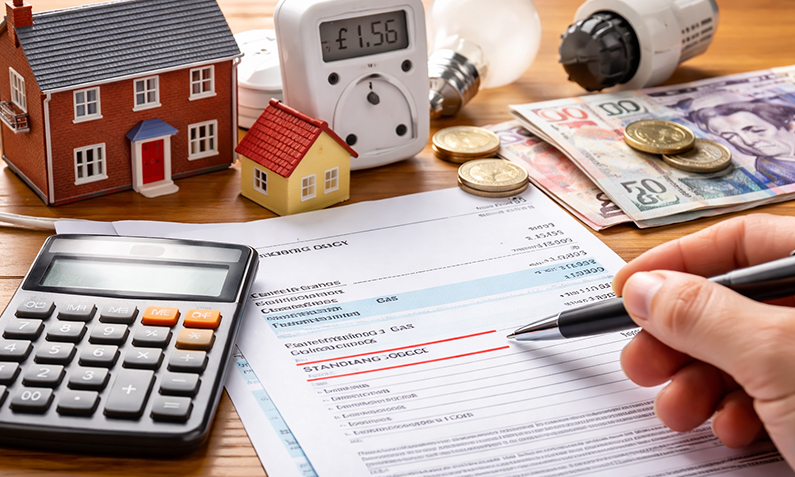






Understanding the Standing Charge on Energy Bills

March 17th, 2026
Understanding the Standing Charge on Energy Bills

Content in this article

Energy bills in the UK usually contain two main costs. The first is the unit rate, which is the price you pay for the energy you use. The second is the standing charge, which is a fixed daily cost applied to most energy tariffs.

The standing charge is a fixed daily amount added to your electricity or gas bill to cover the cost of maintaining the UK’s energy supply network. It applies every day your property has an active energy connection, even if you do not use any gas or electricity.

Many households focus on the price per unit of energy when choosing a tariff. However, the standing charge can have a significant impact on the total cost of a bill.

Understanding how standing charges work can help households compare tariffs more effectively and identify the most suitable deal when they compare energy prices across suppliers.

You can compare energy prices to see how standing charges vary between suppliers.

What Is a Standing Charge in Energy Bills?

A standing charge is a fixed daily charge that energy suppliers apply to electricity and gas tariffs. The charge is designed to cover the cost of maintaining the infrastructure required to deliver energy to homes across the UK.

This includes maintaining the energy infrastructure that allows electricity and gas to be transported safely through cables and pipelines.

Even if a household uses no energy during a billing period, the standing charge still applies as long as the property remains connected to the network.

Key features of a standing charge

Feature Explanation
Fixed daily cost A set amount charged each day
Applies regardless of usage Charged even if no energy is used
Covers infrastructure costs Helps maintain the energy supply network
Regulated by Ofgem Limited by the existing price cap
Charged on most tariffs Applies to electricity and gas tariffs

Because the standing charge is applied every day, it can make up a noticeable portion of an annual energy bill.

How Much Is the Standing Charge in the UK?

Standing charges vary depending on the energy supplier, region and tariff type.

The energy regulator Ofgem sets limits through the existing price cap, which ensures suppliers cannot charge above a certain level for default tariffs.

As of 2025–2026, typical UK standing charges fall within the ranges shown below.

Typical UK standing charges

Energy Type Average Daily Standing Charge Approximate Annual Cost
Electricity 50p – 65p per day £182 – £237 per year
Gas 25p – 35p per day £91 – £128 per year

Electricity standing charges are generally higher than those for gas because electricity networks are more complex and expensive to maintain.

These charges can also vary by region because network costs differ across the UK.

Save More with Dual Fuel Energy Tariffs

Switch both gas and electricity in just 6 minutes and cut your bills.

Standing Charge vs Unit Rate: What Is the Difference?

Energy tariffs typically contain two main pricing elements.

Standing charge

The standing charge is a fixed daily amount that covers infrastructure, network maintenance and operational costs.

Unit rate

The unit rate is the cost charged for each unit of energy consumed. Energy usage is measured in units of energy, usually kilowatt hours (kWh).

Example of how an energy bill is calculated

Charge Type Example Cost
Electricity standing charge 60p per day
Annual standing charge £219
Electricity daily unit rate 24p per kWh
Average household usage 2,700 kWh per year
Estimated electricity cost £648

In this example, the standing charge represents a large part of the bill even before energy consumption is considered.

This is why households should review the total estimated annual cost when comparing tariffs rather than focusing only on the daily unit rate.

It may help to compare energy deals before choosing a tariff.

Do All Energy Suppliers in the UK Charge the Same Standing Charge?

No. Energy suppliers do not all charge exactly the same standing charge.

Although the energy regulator Ofgem sets the existing price cap for default tariffs, suppliers still have flexibility in how they structure their tariffs within this limit.

This means different suppliers may combine:

  • lower standing charges with higher unit rates
  • higher standing charges with lower unit rates

Example of how standing charges may vary

Supplier Type Electricity Standing Charge Gas Standing Charge
Supplier A 55p per day 30p per day
Supplier B 60p per day 28p per day
Supplier C 63p per day 32p per day

For households that use very little energy, high standing charges may represent a larger portion of the overall bill.

For households that use much electricity or gas, a tariff with lower unit rates may be more cost effective.

Because of these variations, reviewing the full tariff structure is important when households compare energy prices.

Do All Energy Suppliers in the UK Charge the Same Standing Charge

Why Do Energy Bills Include a Standing Charge?

Standing charges exist because the UK energy system requires constant maintenance and investment.

The charge helps fund several important components of the energy system.

Energy network maintenance

The UK energy network includes thousands of miles of cables, pipelines and substations. These require ongoing maintenance to keep homes connected safely.

Metering systems

Energy meters must be installed, maintained and sometimes replaced. Smart meters also rely on communication systems that transmit data to suppliers.

Government support schemes

Standing charges can contribute to several government support schemes designed to help households and improve energy efficiency.

Examples include:

Scheme Purpose
Warm Home Discount Scheme Provides financial support to eligible households
Energy Company Obligation Supports home insulation improvements
Environmental policy schemes Helps fund renewable energy initiatives

The Warm Home Discount Scheme is widely recognised as a primary government initiative designed to help lower income households manage energy costs.

Some commentators have suggested these costs could instead be funded through general taxation, but currently they remain part of the energy pricing system.

Standing charges differ by supplier, so it can be useful to compare energy tariffs.

Do Standing Charges Apply to Prepayment Meters?

Yes. Households using a prepayment meter also pay standing charges.

Instead of appearing on a monthly bill, the standing charge is usually deducted automatically from the credit balance on the meter.

Prepayment tariffs still include:

  • a fixed daily charge
  • a daily unit rate for energy usage

Under current regulations, the energy regulator Ofgem ensures that the price cap for prepayment tariffs is broadly aligned with tariffs for direct debit customers.

If the meter runs out of credit, the standing charge may still accumulate and be recovered when the meter is next topped up.

Prepayment Meter Tariffs – Find Cheaper Options Today

Compare top-up tariffs in your area and cut your prepayment energy costs.

Are Zero Standing Charge Tariffs Available?

Some suppliers offer tariffs marketed as a zero standing charge tariff.

These tariffs remove the daily standing charge but usually increase the daily unit rate for electricity or gas.

Comparison of tariff structures

Tariff Type Standing Charge Unit Rate
Standard tariff Yes Lower
Zero standing charge tariff No Higher

These tariffs may suit certain households.

For example, a low energy user who uses electricity only occasionally may benefit from avoiding the daily charge.

They may also suit properties used only for part of the year, such as holiday homes.

However, households that use larger amounts of electricity or gas may find that higher unit rates increase their overall bill.

Why Standing Charges Have Increased in Recent Years

Standing charges have risen in recent years as energy suppliers recover the cost of maintaining networks and stabilising the UK energy market.

When energy suppliers fail, some of the costs associated with transferring customers are redistributed across the market.

This means remaining suppliers may have to absorb some of the financial impact.

In some cases this has resulted in additional increases to standing charges as suppliers adjust tariffs to recover these costs.

The regulator has described some of these changes as the first of many decisions required to stabilise the energy market following major disruption.

The energy regulator continues to review the structure of tariffs to explore longer term solutions for energy pricing.

How Customers Manage Their Energy Accounts

Many households now manage their energy account through an online account provided by their energy supplier.

This allows customers to:

  • track their energy usage
  • review bills
  • monitor tariff rates
  • submit meter readings

Customers paying by direct debit may receive slightly different pricing structures compared with prepayment customers, but both types of tariffs include standing charges.

Monitoring energy usage through an online account can help households understand their energy consumption and identify ways to reduce their gas bill or electricity costs.

Checking tariffs can help, so some households choose to compare energy suppliers before switching.

How to Reduce the Impact of Standing Charges

Although standing charges cannot usually be removed entirely, households can take steps to reduce the overall impact on their energy bills.

Review tariffs regularly

Energy tariffs change frequently, so reviewing available deals may help identify tariffs with lower costs.

Compare tariff structures

Some tariffs balance lower standing charges with higher unit rates.

Monitor energy usage

Understanding household energy consumption helps determine which tariff type provides the best value.

Compare energy deals

Looking at multiple suppliers can make it easier to identify tariffs with competitive pricing structures.

For households reviewing their options, it can be useful to compare energy prices across suppliers and evaluate how the standing charge and unit rate combine to create the total annual cost.

How to Reduce the Impact of Standing Charges

Correct as of 16 March 2026

FAQs about Standing Charges on Energy Bills

What is a standing charge on energy bills?

A standing charge is a fixed daily fee added to most electricity and gas tariffs. It helps cover the cost of maintaining the UK energy network, meter services and supplier operations. This charge applies even if you use very little energy.

Do all energy suppliers charge the same standing charge?

No. Standing charges vary between suppliers, tariffs and regions. However, the Ofgem energy price cap limits how high suppliers can set standing charges on default tariffs.

Do you pay a standing charge if you use no energy?

Yes. As long as your property remains connected to the energy supply, the standing charge usually still applies. This means you may still see a cost on your bill even if you do not use any electricity or gas.

What is a zero standing charge tariff?

A zero standing charge tariff removes the daily charge but increases the price per unit of energy used. This type of tariff may benefit households that use very little energy but can cost more for homes with higher energy usage.

Why are electricity standing charges higher than gas?

Electricity networks require more complex infrastructure than gas pipelines. Maintaining cables, substations and distribution networks is more expensive, which contributes to higher standing charges.

Do prepayment meters have standing charges?

Yes. Standing charges also apply to prepayment meters. The charge is usually deducted automatically from the credit balance on the meter each day.

Can you avoid paying a standing charge?

In most cases standing charges cannot be avoided if a property is connected to the energy network. Some suppliers offer tariffs without standing charges, but these usually have higher unit rates.

Are standing charges the same across the UK?

No. Standing charges vary by region because energy network costs differ across the country. This means households in different areas may see slightly different standing charges.

What is the average standing charge for electricity in the UK?

Electricity standing charges typically range between 50p and 65p per day depending on the supplier, region and tariff. These costs are influenced by the Ofgem price cap.

What is the average standing charge for gas in the UK?

Gas standing charges are usually lower than electricity charges and often fall between 25p and 35p per day. The exact amount depends on the supplier and location.

Why have standing charges increased in recent years?

Standing charges have increased in recent years due to higher energy infrastructure costs and changes in the energy market. Supplier failures and policy costs have also influenced pricing.

Do fixed energy tariffs include standing charges?

Yes. Most fixed energy tariffs include both a standing charge and a unit rate. The standing charge covers fixed costs, while the unit rate reflects the price of energy used.

Do standing charges apply to both electricity and gas?

Yes. Electricity and gas tariffs each have their own standing charge. Households with dual fuel tariffs typically pay one standing charge for each fuel.

Can standing charges change during the year?

Yes. Standing charges may change when the Ofgem energy price cap is updated. The price cap is reviewed four times per year and can affect both standing charges and unit rates.

Also Read Related Articles

Compare Energy Prices in Just 6 Minutes

Switch today and start saving — quick, easy, and with zero obligation.

4000+ reviews