


100Mbps Broadband: Speed, Price and Whether You Need It

Written by Shay Ramani
Reviewed by Prajesh Manvar
6 min read
Updated: 10 Aug 2026
100Mbps Broadband: Speed, Price and Whether You Need It

100Mbps broadband is an ultrafast home internet service with average download speeds of around 100 megabits per second, and for most UK households it is more than enough. It comfortably handles 4K streaming on several screens at once, video calls for working from home, online gaming and a house full of smart devices. Ofcom classes anything at or above 30Mbps as “superfast”, so a 100Mbps line sits well above the everyday threshold.

One point that trips people up: a genuine 100Mbps product usually needs full fibre (FTTP), and many deals badged around “100” actually advertise higher average speeds. Several mainstream “Full Fibre 100” or “150” packages deliver 145Mbps to 150Mbps in practice, while the closest cable option quotes 132Mbps. Free Price Compare checks live availability at your postcode across Openreach and altnet networks, and we source speed and coverage data from Ofcom and pricing from providers directly.

Quick Answer

  • A 100Mbps connection can support a household of three to five people streaming, gaming and working from home at once, provided upload speed is around 10-20Mbps.
  • Advertised speeds are averages: since 23 May 2018 the ASA requires broadband ads to quote a speed achievable by at least 50% of customers at peak (8-10pm).
  • In-contract new-customer prices for 100Mbps-class broadband ran roughly £17.99-£28.99 a month in June 2026, with out-of-contract prices around £60-£68.
  • Full fibre (FTTP) is now available to 78% of UK homes (23.7 million premises) as of Ofcom’s Connected Nations 2025 (data to July 2025).
  • Streaming quality is capped by the platform, not your line: Netflix 4K needs about 15-25Mbps per stream, so going far above 100Mbps rarely improves picture quality.

Last updated: July 2026

Written by the Free Price Compare editorial team | Reviewed July 2026

Is 100Mbps broadband good enough for most homes?

100Mbps broadband is good enough for the large majority of UK households, including homes with several heavy internet users. At 100Mbps you can run multiple 4K streams, video meetings, cloud backups and online gaming at the same time without one activity slowing the others noticeably. Ofcom defines “superfast” as any service delivering at least 30Mbit/s, so 100Mbps gives you well over three times that everyday benchmark.

The practical limit is usually how much you upload and how many devices are active at once, not the download headline. A single 4K stream needs roughly 15-25Mbps, so even three simultaneous 4K screens leave plenty of a 100Mbps line spare. For context, average data usage reached 583GB per connection in July 2025, up 10% year on year, according to Ofcom‘s Connected Nations 2025 report.

Where 100Mbps starts to feel tight is a large household regularly uploading big files, running frequent cloud backups, or several people making 4K video calls while others download game updates. If that describes your home, a 200Mbps-plus tier is worth considering, mainly for the higher upload speed.

James Ford Broadband Deals Reviewed by James Ford, TV and Broadband Expert

Superior

  • New customers only
900Mb average* speed
Unlimited Downloads
£0.00 Setup costs
24 Month contract
Pay as you goCalls
£29.99per month

5G Home Broadband

  • New customers only
  • Switch to Three and claim up to £200 switching credit
  • Next working day delivery
150Mb average* speed
Unlimited Downloads
£0.00 Setup costs
24 Month contract
Pay as you goCalls
£15.00per month

Extra

  • New customers only
500Mb average* speed
Unlimited Downloads
£0.00 Setup costs
24 Month contract
Pay as you goCalls
£27.99per month

Is 100Mbps enough for working from home?

100Mbps broadband is comfortably enough for working from home, including full-time video calls, cloud file access and large downloads. Standard HD video meetings on the main platforms need only around 1.5-4Mbps each, so a 100Mbps line can run several calls plus other household use at once. Upload speed matters more for home working than the download figure, because sending video, files and screen shares relies on it.

Most 100Mbps-class products offer around 20Mbps upload, which handles simultaneous video calls and file uploads without strain. If two or more people in your home regularly upload very large files, share high-resolution video, or run cloud backups during the working day, check the upload speed of any deal before you commit rather than assuming a bigger download number solves it.

If your current line struggles with calls despite a decent speed, the cause is often Wi-Fi rather than the broadband itself, especially in larger homes or where the router sits far from where you work.

Compare 100Mbps broadband deals

Why “100Mbps” deals often advertise 130-150Mbps

Many broadband deals badged around “100” actually advertise average speeds of 130Mbps to 150Mbps, because of how UK providers name and market their tiers. A true 100Mbps product usually needs full fibre (FTTP) to the home, but the closest cable option quotes 132Mbps average, and several “Full Fibre 100” and “Full Fibre 150” packages deliver 145Mbps to 150Mbps in practice.

Advertised speeds are averages, not guarantees. Since 23 May 2018, the Advertising Standards Authority has required any numerical speed claim in broadband ads to be a figure achievable by at least half of customers at peak time (defined by Ofcom as 8-10pm) and described as “average”. So a headline “145Mbps average” means half of that provider’s customers get that or more at the busiest time of day, not that everyone gets exactly 145Mbps.

This is why comparing on price alone can mislead. A “Full Fibre 100” deal and a “Full Fibre 150” deal from the same provider may cost a similar amount, so it is worth checking the actual average download and upload figures quoted at your postcode before choosing.

Product (June 2026) Average download Upload Network type
Virgin Media M125 Around 132Mbps Around 20Mbps Cable
EE 100Mbps Core Around 100Mbps Around 20Mbps Full fibre (FTTP)
Sky Full Fibre 150 Around 145Mbps Varies Full fibre (FTTP)
BT Full Fibre 100 Around 150Mbps Around 30Mbps Full fibre (FTTP)
Community Fibre 100Mbps Around 100Mbps Varies Full fibre (altnet)

Figures are indicative and may change; check availability and current speeds at your postcode before choosing.

How much does 100Mbps broadband cost in 2026?

In-contract new-customer prices for 100Mbps-class broadband ran roughly £17.99 to £28.99 a month in June 2026, with altnet promotions from around £19 and out-of-contract prices around £60 to £68 a month. Prices depend on your postcode, the provider’s network and any promotional discount, and most deals sit on a 24-month contract with staged price rises during the term.

As a rough guide on value, the cable option at around £23.99 for 132Mbps works out near 18p per Mbps, while a full fibre “150” tier at around £28.99 for roughly 150Mbps sits near 19p per Mbps. Altnet providers on full fibre often undercut the mainstream names in areas they cover. Ofcom pricing research indicates ultrafast (100Mbps-plus) bundle prices fell in real terms through 2024 and 2025, though the exact figure should be checked against Ofcom’s latest pricing report.

Watch the mid-contract price rises. Most 24-month deals now step the monthly price up on set dates, so the equivalent monthly cost over the whole term matters more than the opening promotional figure. Also note the out-of-contract price you will roll onto, which is often more than double the in-contract rate.

Full fibre in your area?

Check which 100Mbps deals reach your postcode across Openreach and altnet networks.

How many devices and people can 100Mbps handle?

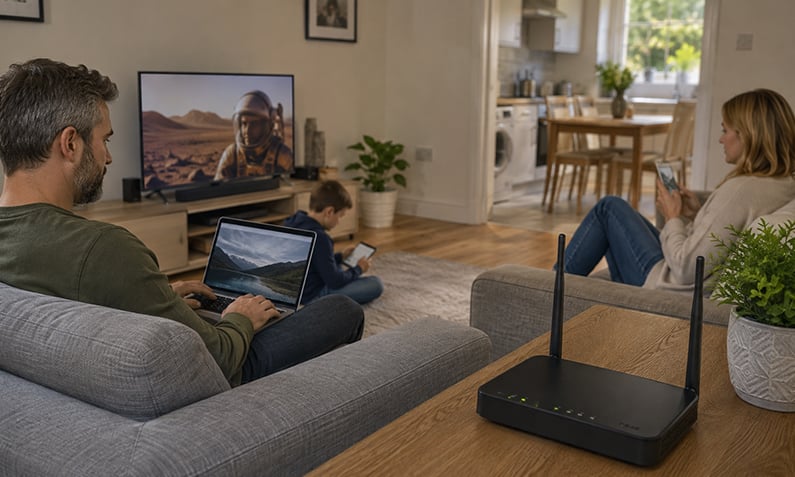
100Mbps broadband can comfortably serve a household of three to five people using multiple devices at once, including phones, laptops, smart TVs and games consoles. Modern full fibre and cable connections are built to run dozens of connected devices simultaneously, because most devices only draw bandwidth in short bursts rather than continuously.

What matters is how many demanding activities run at the same time, not the raw device count. A typical evening might involve two 4K streams (around 40-50Mbps combined), a video call (a few Mbps) and background phone use, which still leaves a 100Mbps line with capacity to spare. Smart-home gadgets, doorbells and speakers use very little bandwidth individually.

Performance problems in busy homes are more often caused by Wi-Fi coverage than the broadband speed itself. If devices in far rooms lag while the router area is fine, a mesh Wi-Fi system or better router placement usually helps more than paying for a faster tier.

How many devices and people can 100Mbps handle

Do you need a phone line for 100Mbps broadband?

You do not need a traditional phone line for most 100Mbps broadband, because full fibre (FTTP) and cable connect directly without the old copper phone network. Providers running on Openreach’s full fibre, on cable, or on altnet networks deliver broadband over a dedicated fibre line, so there is no separate line rental for a phone service you may not use.

Full fibre is now available to 78% of UK homes, or 23.7 million premises, up nine percentage points on 2024, according to Ofcom‘s Connected Nations 2025 (data to July 2025). Gigabit-capable networks now cover 87% of the UK. Where full fibre has not reached yet, some “up to” fibre products still run partly over copper and can behave differently, so it is worth confirming the connection type on offer at your address.

If you still want a home phone, most providers offer a digital voice service that plugs into the router instead of a wall socket, as the UK moves off the old analogue network.

See if full fibre reaches your home

Will a faster tier improve streaming or picture quality?

Moving above 100Mbps will not improve streaming picture quality once your line already comfortably carries each stream. Streaming quality is set by the platform and your subscription, not by extra spare bandwidth: Netflix 4K needs roughly 15-25Mbps per stream, so a 100Mbps line already has ample capacity for several 4K screens at once.

Upgrading only helps streaming if your current speed cannot keep up, for example if too many high-quality streams and downloads run at once on a slower connection and cause buffering. Going from a slower line to 100Mbps removes that bottleneck; going from 100Mbps to 500Mbps or 1Gbps does not make an individual 4K stream look better, because the picture is already at maximum quality.

If streaming stutters on a 100Mbps line, check whether the device is on Wi-Fi rather than a wired connection, whether other large downloads are running, and whether the streaming app or subscription tier itself limits resolution. Switching provider can still be worth it for a better price or upload speed, and our tips for switching broadband cover how to compare deals without gaps in service.

How long does it take to download at 100Mbps?

At 100Mbps, a 1GB file takes roughly 80 seconds to download, and a 50GB game download takes around 65-70 minutes at full speed. Download time depends on the file size and the speed you actually achieve, which varies with peak-time demand, your Wi-Fi and the server you are downloading from.

As a quick reference, 100Mbps equals about 12.5 megabytes per second in real terms, so a 10GB file takes roughly 13-14 minutes and a 100GB modern game can take a couple of hours. Doubling your speed roughly halves download times, which is the main practical benefit of moving above 100Mbps if you regularly download very large games or work files.

Real download speeds are often lower than the headline because of Wi-Fi limits and the download source. A wired connection to the router gives the most consistent result, and for the closest-to-100Mbps full fibre options you can also read our guide to NOW Broadband Full Fibre 100.

Compare full fibre deals near you

FAQs about 100mbps broadband

Is 100Mbps broadband still above the UK average?

100Mbps is above the everyday superfast threshold but below the UK average maximum available speed, which reached 285Mbps in 2025 as networks upgrade to full fibre. Average maximum speed reflects the fastest tier available at a premises, not what most people buy. In real terms, 100Mbps remains a fast, capable speed that suits the large majority of homes.

Is 100Mbps enough for a household of three?

Yes, 100Mbps is comfortably enough for a household of three, even with several 4K streams, video calls and gaming happening at once. Most activities use bandwidth in bursts rather than continuously, so the line rarely runs out of capacity. The main thing to check is that the upload speed is at least around 10-20Mbps if people work from home.

Does a 100Mbps connection guarantee 100Mbps speeds?

No, a 100Mbps connection does not guarantee exactly 100Mbps at all times, because advertised figures are peak-time averages rather than fixed rates. Some providers offer a minimum speed guarantee with compensation if speeds fall below it, so it is worth checking whether a deal includes one. Wi-Fi, distance from the router and busy periods all affect the speed you actually see.

What is the difference between 80Mbps fibre and 100Mbps broadband?

An 80Mbps part-fibre product runs partly over copper, while many 100Mbps products are full fibre all the way to the home, which is more consistent and offers higher upload speeds. The 20Mbps download difference is small in everyday use, but full fibre tends to hold its speed better at peak times. If both are available, the connection type often matters more than the headline number.

Can I get 100Mbps broadband without full fibre in my area?

Yes, cable networks can deliver 100Mbps-plus speeds without full fibre, and are available to a large share of UK homes. Some older part-fibre lines cannot reach 100Mbps reliably, so availability depends on the networks that serve your postcode. Checking your address shows exactly which networks and speed tiers reach your home.

Why is my 100Mbps broadband running slowly?

Slow speeds on a 100Mbps line are usually caused by Wi-Fi rather than the broadband itself, especially in larger homes or where the router sits far from your devices. Running a speed test on a wired connection close to the router shows whether the line or the Wi-Fi is the problem. Old routers, many active devices and interference from neighbouring networks can all reduce real-world speed.

How long does a 24-month 100Mbps broadband contract last, and what happens after?

Most 100Mbps deals run on a 24-month contract, after which the price usually rises to a higher out-of-contract rate that can be more than double the in-contract price. You are free to switch or renegotiate once the contract ends without paying an exit fee. Setting a reminder near the end of your term helps you avoid rolling onto the standard price.

Is satellite broadband a good way to get 100Mbps in a rural area?

Satellite broadband can reach around 100Mbps in areas with no fixed full fibre or cable, which makes it an option for remote homes with poor wired coverage. It usually costs more per month than fixed-line 100Mbps and can have higher latency, which affects gaming and some video calls. Where full fibre or cable is available, a fixed line is generally cheaper and more consistent.

Do I need to pay an upfront fee for 100Mbps broadband?

Many 100Mbps deals have no upfront or setup fee, though some charge a small one-off amount or postage for the router. Full fibre may involve an engineer installation if your home is not already connected, which is usually arranged and often included by the provider. Always check the total first-year cost, including any upfront fee, rather than the monthly price alone.

Will switching to a faster tier than 100Mbps make my Wi-Fi reach further?

No, buying a faster broadband tier does not extend how far your Wi-Fi signal travels, because coverage depends on the router and your home’s layout, not the line speed. If rooms far from the router are slow, a mesh Wi-Fi system or better router placement helps more than a faster package. Upgrade the tier only if devices near the router run out of speed.

Can I keep my current provider and just switch to a 100Mbps deal?

Yes, most providers let existing customers move to a 100Mbps package, though new-customer deals are often cheaper than upgrade offers. Comparing across providers before your contract ends usually finds a better price than automatically renewing. If you switch to a provider on the same network, the changeover is typically arranged for you with little or no downtime.

Also Read Related Articles


Information correct as of 1 July 2026. Prices, tariffs, policy details and providers change frequently, so please check the latest details before making a decision. This article is for general information only and does not constitute financial advice. Free Price Compare is authorised and regulated by the Financial Conduct Authority (FCA).

4000+ reviews


