

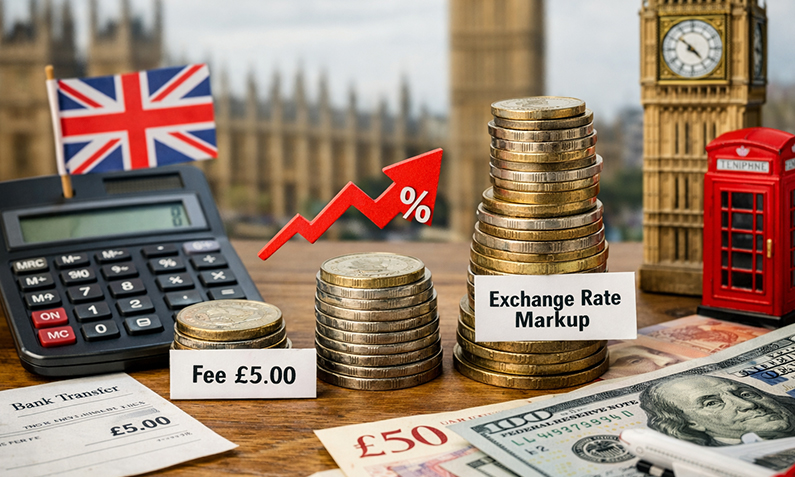




How Exchange Rate Markups Cost You More Than Transfer Fees

February 5th, 2026
How Exchange Rate Markups Cost You More Than Transfer Fees

When sending money abroad, many people focus on the transfer fee shown upfront. However, in many international transactions, exchange rate markups cost more than the fee itself. Understanding how foreign exchange pricing works — and how markup fees are applied — is essential to knowing the true cost of sending money internationally.

What is an exchange rate markup?

An exchange rate markup, sometimes called a foreign exchange markup or forex markup, is the difference between the real exchange rate and the rate used by a payment provider or financial institution.

Instead of charging all costs as a visible fee, some providers build a profit margin into the conversion rate. This reduces the amount of local currency the recipient receives.

How do exchange rate markups cost more than transfer fees?

Exchange rate markups can cost more than transfer fees because they increase as the amount sent increases. Even a small margin added to the exchange rate can reduce the final amount received by more than a fixed transfer fee, especially for large international money transfers.

Money Guides

Helping You Borrow Money at the Right Price

Why exchange rate markups are often hidden

Unlike transfer fees, exchange rate markups are rarely labelled clearly. Many payment providers simply show a conversion rate without explaining how it compares to the interbank rate or actual exchange rate.

This creates:

  • A lack of transparency
  • The appearance of low fees
  • Hidden costs within currency conversion

Because foreign exchange rates change constantly, these markups can be difficult to spot.

Transfer fees vs exchange rate markups

Transfer fees are usually fixed or clearly stated. Exchange rate markups increase as the transaction amount increases.

Cost type How it’s applied Impact
Transfer fee Flat or percentage Predictable
Exchange rate markup Built into FX rate Scales with amount

This difference explains why a small markup fee can outweigh a visible service charge.

How exchange rate markups affect different transfer sizes

The larger the transaction amount, the greater the impact of a foreign exchange markup.

Amount sent Small markup Larger markup
£100 Minor impact Moderate
£1,000 Noticeable High
£10,000 Significant impact Very high

For large transfers, exchange rate differences often cost far more than a fixed transfer fee.

The role of the real exchange rate

The real exchange rate, sometimes called the interbank rate, is the rate banks use when trading currencies with each other.

Many payment providers and traditional banks apply a markup to this rate. Comparing the offered rate with live exchange rates helps reveal whether a currency conversion fee is being applied.

Why traditional banks rely on exchange rate margins

Traditional banks often rely on foreign exchange margins rather than transparent pricing.

Reasons include:

  • Legacy systems
  • International routing through wire transfers
  • FX risk management
  • Simpler fee presentation

Rather than itemising every additional charge, costs are bundled into the exchange rate.

Why traditional banks rely on exchange rate margins

Zero-fee transfers and exchange rate markups

Zero-fee transfers commonly rely on exchange rate markups to generate revenue.

While there may be no visible service fee, the weaker exchange value can result in:

  • A lower final amount received
  • Higher overall costs than low-fee alternatives

This is why zero-fee pricing does not always mean better rates.

How to spot an exchange rate markup

To identify a markup, compare:

  • The conversion rate offered
  • The real exchange rate at the same time
  • The final amount received in the destination bank account

This is why it helps to compare money transfer rates rather than relying on advertised fees.

Are there tools that help reveal the true exchange rate markup?

Yes. Tools that compare live market exchange rates with the rate offered by a bank or payment provider can help reveal an exchange rate markup. By checking the real exchange rate at the same time as a transfer quote, users can see whether a margin has been added to the conversion rate.

Bank transfers vs card-funded transfers

The payment method affects how exchange rate markups impact cost.

Bank transfer funding

Bank-funded international transfers often involve:

  • Lower visible fees
  • Exchange rate markups within the conversion

They are usually cheaper than card payments but still affected by FX margins.

Credit card payments

Credit card transactions and debit card payments may include:

  • Card issuer fees
  • Currency conversion fees
  • Foreign exchange markups
  • Additional charges from the payment processor

These costs can significantly increase the total cost.

Money Guides

Helping You Borrow Money at the Right Price

Wire transfers and intermediary costs

Some international wire transfers pass through intermediary banks. While intermediaries do not usually change the exchange rate, they may deduct a wire transfer fee during processing.

These deductions combine with exchange rate markups to reduce the final amount received.

Are exchange rate markups worse for certain currencies?

Yes. Markups are often higher for:

  • Less frequently traded currency pairs
  • Transfers involving complex banking systems
  • Routes requiring multiple intermediaries

Major currencies tend to have more competitive rates, but markups still apply.

Why exchange rate differences matter more for regular payments

For regular international payments, small FX differences add up.

A slightly weaker conversion rate applied repeatedly can cost more over time than a visible transfer fee. This is particularly important for recurring payments and small businesses making frequent foreign exchange transactions.

Comparing payment providers effectively

When comparing financial services, look beyond the headline fee.

Key factors include:

  • Exchange rate used
  • Final amount received
  • Transparency of pricing
  • Payment method costs

This approach provides a clearer picture of total cost.

Country-specific exchange rate effects

Exchange rate impacts vary by destination due to:

  • Currency liquidity
  • Local banking systems
  • Market demand

Country-specific guides such as Cheapest Way to Send Money to [COUNTRY] from the UK often provide more accurate comparisons.

Country-specific exchange rate effects

Regulation and transparency

UK-regulated financial institutions must provide clear pricing information. However, regulation does not prevent exchange rate markups.

Understanding how currency conversion works is still essential to avoid overpaying.

Correct as of 19 December 2025

FAQs about exchange rate markups and transfer fees

Are exchange rate markups always more expensive than transfer fees?

Not always, but they often are for larger transfers. As the amount sent increases, foreign exchange markups usually have a greater impact on the total cost than a fixed transfer fee.

Why don’t providers clearly show exchange rate markups?

Exchange rates fluctuate constantly, and many providers present pricing as a single rate. This makes it harder to see the markup without comparing against the real exchange rate.

Can a higher transfer fee ever be cheaper overall?

Yes. A higher transfer fee combined with better exchange rates can result in a lower total cost than a low-fee or zero-fee transfer with a poor conversion rate.

Do banks use worse exchange rates than specialist providers?

Traditional banks often apply wider foreign exchange margins than providers focused on international transfers, which can increase overall costs.

Is comparing exchange rates more important than comparing fees?

In many cases, yes. Exchange rate differences often have a greater impact on the final amount received than transfer fees alone.

Also Read Related Articles

Explore Money Guides

Helping You Borrow Money at the Right Price

4000+ reviews