

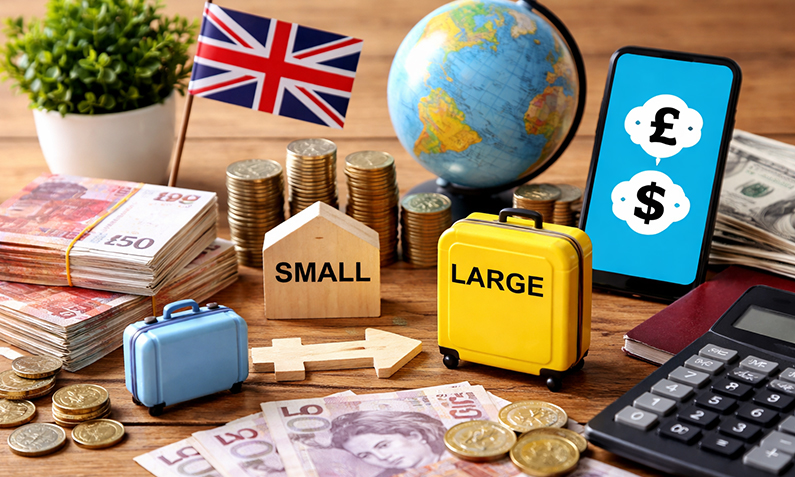




Cheapest Way to Send Small vs Large Amounts of Money Abroad

January 1st, 2026
Cheapest Way to Send Small vs Large Amounts of Money Abroad

The cheapest way to send money abroad depends on how much money you are sending. A method that offers lower costs for small international payments may become expensive for larger transfers. This is because transfer costs, currency conversion, and pricing structures affect small and large transfers in different ways.

Why transfer size matters when sending money internationally

International money transfers are priced using a combination of:

  • Transfer fees
  • Exchange rates
  • Payment method costs

For small transfers, fees upfront usually have the biggest impact. For large transfers, exchange rate differences often matter more than the visible fee.

Understanding this difference helps identify the best way to send money abroad.

What counts as a small or large international transfer?

There is no fixed definition, but most users think in these ranges:

Transfer size Typical example
Small amount £50–£500
Medium amount £500–£5,000
Large amount £5,000+

As the amount increases, the pricing model that offers competitive rates often changes.

Money Guides

Helping You Borrow Money at the Right Price

Cheapest way to send small amounts of money abroad

For small transfers, the cheapest option is usually the one with:

  • Low or zero fees upfront
  • Simple pricing
  • Minimal fixed charges

Even a modest flat fee can make a small transfer expensive relative to the amount sent.

Why fees matter more for small transfers

If you send £100 and pay a £10 fee, you lose 10% of the value. For small amounts, this has a much bigger impact than minor exchange rate differences.

Payment methods for small transfers

Bank transfers

Bank transfers funded from a bank account can be cost-effective for small amounts if fees are low. However, many traditional banks apply fixed charges that make very small international transfers poor value.

Debit card transfers

Debit card transfers can be convenient and fast, but they may include:

  • Card processing fees
  • Foreign currency charges

These extra costs can quickly increase the cost of your transfer.

When small transfers make sense

Small transfers are often:

  • One-off payments
  • Emergency payments
  • Personal support transfers

In these cases, speed and ease of use may matter as much as price.

Cheapest way to send large amounts of money abroad

For large transfers, the cheapest option is usually the one offering:

  • Competitive exchange rates
  • Lower currency conversion margins
  • Fewer intermediary charges

At higher amounts, even a small difference in exchange rate can have a significant impact on the currency equivalent received.

Cheapest way to send large amounts of money abroad

Which online service offers the lowest transfer fees for international payments?

There is no single online service that always offers the lowest transfer fees for international payments. Fees vary by transfer amount, destination country, payment method, and currency pair. Some services focus on low upfront fees, while others reduce costs through exchange rate pricing.

What paperwork is needed to send large amounts of money overseas?

Sending large amounts of money overseas may require additional paperwork, including proof of identity, source of funds, and transfer purpose. Banks and payment providers may request documents to meet regulatory and anti-money laundering requirements, especially for high-value international transfers.

Why exchange rates matter more for large transfers

If you send £10,000, a 1% exchange rate difference equals £100. This can outweigh a £10 or £20 transfer fee.

This is why focusing only on fees is rarely the best way to compare large international transfers.

Fees vs exchange rates by transfer size

Transfer size Main cost driver
£50–£500 Fees
£500–£5,000 Fees and exchange rates
£5,000+ Exchange rates

Bank transfers for large amounts

Large transfers are usually funded from a bank account rather than a card.

Bank transfers are often preferred because:

  • Card limits may apply
  • Card fees scale poorly for large amounts
  • Bank-funded transfers are more stable

However, wire transfer routes used by traditional banks can still involve exchange rate margins and intermediary fees.

Money Guides

Helping You Borrow Money at the Right Price

Card payments and large transfers

Debit and credit card payments are rarely the cheapest option for sending much money abroad.

They may include:

  • Higher processing fees
  • Foreign transaction charges
  • Lower transfer limits

For large amounts, these costs can quickly add up.

Intermediary banks and large transfers

Large international wire transfers may pass through intermediary banks, especially when sending money outside Europe.

Intermediary banks may:

  • Deduct fees during processing
  • Increase international transfer duration
  • Reduce the final amount received

These costs should be considered when comparing transfer speeds and pricing.

Zero-fee transfers: small vs large amounts

Zero-fee transfers can sometimes offer lower costs for small amounts. However, for large transfers, they often rely on exchange rate markups.

This means a zero-fee option may look cheap for £100 but expensive for £10,000.

Speed vs cost for different transfer sizes

Priority Small transfer Large transfer
Speed Often important Less critical
Cost certainty Moderate Very important
Best pricing focus Fees Exchange rates

Regular payments vs one-off transfers

For regular international payments, small pricing differences can add up over time.

A method that is cheap for a one-off transfer may become expensive when used repeatedly, especially if exchange rate margins apply each time.

Regular payments vs one-off transfers

Country-specific differences

The cheapest way to send money abroad also depends on:

  • Destination country
  • Currency pair
  • Local banking systems

This is why guides such as Cheapest Way to Send Money to [COUNTRY] from the UK are often more accurate than general advice.

Comparing providers properly

To compare a money transfer service effectively:

  • Check the final amount received
  • Review fees upfront
  • Compare exchange rates
  • Consider payment method costs

This approach gives a clearer picture of total cost.

Regulation and safety considerations

International money transfer services operating in the UK must meet regulatory standards.

These rules focus on:

  • Protecting customer funds
  • Transparency of pricing

They do not guarantee that a provider offers the lowest cost for every transfer.

Money Guides

Helping You Borrow Money at the Right Price

What paperwork is needed to send large amounts of money overseas?

When sending large amounts of money overseas, providers may request proof of identity, proof of address, and evidence of the source of funds. Additional payment details, such as account number, bank code, and account type, may also be required to complete regulatory checks.

Correct as if 19 December 2025

FAQs about sending small vs large amounts of money abroad

Is the cheapest option the same for all transfer sizes?

No. The cheapest option often changes as the transfer amount increases because fees and exchange rates affect small and large transfers differently.

Are bank transfers cheaper for large international payments?

They can be, but not always. Bank transfers avoid card fees but may still include exchange rate margins and intermediary charges.

Are debit card transfers cheaper for small amounts?

Sometimes. Debit card transfers can be convenient for small amounts, but additional fees can make them more expensive than bank transfers.

Do zero-fee transfers work better for small payments?

Often yes. Zero-fee pricing can suit small transfers, but exchange rate markups usually make them poor value for large transfers.

Why should I compare providers for each transfer?

Prices vary by amount, destination, currency, and payment method. Comparing options helps identify the cheapest method for each transfer.

Also Read Related Articles

Explore Money Guides

Helping You Borrow Money at the Right Price

4000+ reviews