



5 Ways to Improve Broadband Speed at Home

Written by Shay Ramani
Reviewed by Prajesh Manvar
10 min read
Updated: 1 Sep 2026
5 Ways to Improve Broadband Speed at Home

To improve broadband speed the fastest way is to run a speed test on your line, check whether it is below the speed your provider promised, and either force a fix under Ofcom’s rules or move to a faster full fibre package. For a heavy user gaming, streaming and working from home, real-world speed depends on three things at once: the line coming into your home, the wiring and Wi-Fi inside it, and how many devices are competing for that connection at peak times.

Free Price Compare checks live broadband availability by postcode across full fibre and standard networks, so you can see what speeds you can actually get before deciding whether the fix is at the router, on the wiring, or on the tariff. This walks through five practical steps in the order that gives you the biggest gain for the least cost.

Quick Answer: 5 Ways to Improve Broadband Speed at Home

  • If your line runs below the speed your provider promised, Ofcom rules give the provider one month to fix it before you can leave penalty-free (Ofcom, updated June 2025).
  • Test at peak times: Ofcom’s broadband speeds code of practice judges home speeds in the 8-10pm busy window, not off-peak.
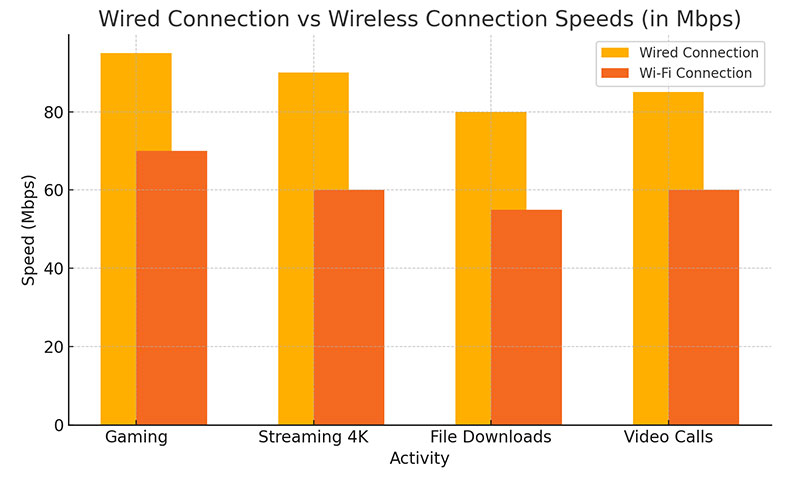
  • A wired Ethernet connection removes Wi-Fi interference and is the most reliable way to hit your full line speed for gaming and video calls.
  • Full fibre (FTTP) is available to 82% of UK homes, around 24.9 million premises (Ofcom Connected Nations, data as of January 2026).
  • Upgrading tier is often cheap: 150 Mbps full fibre starts around £25 to £30/month and 900 Mbps around £32 to £38/month at many UK postcodes in 2026.

Last updated: August 2026

Written by the Free Price Compare editorial team | Reviewed August 2026

Start with a speed test on your line

A broadband speed test is the single most useful first step because it tells you whether the problem is your line, your Wi-Fi, or your device before you spend anything. Run a wired test plugged directly into the router with an Ethernet cable, then a Wi-Fi test in the room where you actually use the connection. If the wired result is close to your promised speed but Wi-Fi is much slower, the fix is inside your home. If the wired result itself is well below the promised figure, the problem is the line or the provider. Test more than once, because a single reading can be misleading.

Timing matters. Ofcom’s broadband speeds code of practice judges home broadband against performance in the 8-10pm busy window, so a slow evening result is what counts when you challenge a provider. Our broadband speed test guide explains how to record results properly so they stand up if you need to complain.

James Ford Broadband Deals Reviewed by James Ford, TV and Broadband Expert
Extra

  • New customers only
500Mb average* speed
Unlimited Downloads
£0.00 Setup costs
24 Month contract
Pay as you goCalls
£27.99per month

Superior

  • New customers only
900Mb average* speed
Unlimited Downloads
£0.00 Setup costs
24 Month contract
Pay as you goCalls
£29.99per month

Full Fibre 150

  • New customers only
  • Switch to Fibrus and they'll cover up to £400 of your switching fees
  • No mid-contract price rises
159Mb average* speed
Unlimited Downloads
£0.00 Setup costs
18 Month contract
Pay as you goCalls
£34.99per month

How do I get my provider to fix a slow line?

Your provider has one month to improve a line that runs below its promised minimum speed before you can leave without penalty, according to Ofcom’s practical tips for improving broadband speed (updated June 2025). Contact your provider with dated, wired speed test results taken at peak times and quote the minimum guaranteed speed on your contract. If the provider cannot bring the line up to that level within a month, you have the right to exit the contract early, penalty-free, including on any bundled landline.

This rule applies to providers signed up to Ofcom’s speeds code of practice, which covers most major UK broadband providers. Keep a written record of every call and reference number. If the line problem is on the network rather than in your home, the provider will usually arrange an Openreach engineer visit at no cost to you.

Check what speed you can get at your postcode

Wire up: why Ethernet beats Wi-Fi for heavy use

A wired Ethernet connection is the most reliable way to reach your full line speed, which matters most for gaming, large downloads and stable video calls. Wi-Fi signal weakens through walls, floors and interference from other networks, so a device three rooms from the router will rarely hit the speed shown when it is plugged in directly. Running an Ethernet cable from the router to a games console, desktop PC or work laptop removes that loss entirely and gives lower, steadier latency (ping), which is what competitive gaming and calls depend on.

Where running a cable is not practical, powerline adapters send data through your home’s electrical wiring and often outperform a weak Wi-Fi signal. Making sensible use of the two Wi-Fi bands also helps: put slower or distant devices on the 2.4GHz band, which reaches further, and keep fast devices on 5GHz, which is quicker but shorter range. Our router troubleshooting guide covers band settings, channel changes and firmware updates in detail.

Wire up: why Ethernet beats Wi-Fi for heavy use

Where should I put my router to boost Wi-Fi speed?

Position your router centrally, high up and out in the open to boost Wi-Fi speed across the whole home. Routers broadcast in all directions, so tucking one behind a TV, inside a cupboard or in a corner on the floor wastes a large share of the signal. Keep it away from thick walls, metal objects, cordless phones and microwaves, all of which cause interference. In a multi-storey house, a first-floor central spot usually gives the most even coverage.

If one router cannot cover the whole home, a Wi-Fi extender or, better, a mesh Wi-Fi system spreads a single network across several access points so you keep speed as you move between rooms. A Wi-Fi extender is not a cure for a slow line, though: it can only rebroadcast the speed reaching it, so it helps with coverage, not with a slow connection. Our guide on when a Wi-Fi extender is the right fix explains the difference, and our tips to boost Wi-Fi signal strength cover placement in practice.

Getting weak signal upstairs?

Coverage fixes are cheaper than a new tariff, but check both before you commit.

Should you upgrade to a faster full fibre broadband package?

Upgrading to a faster full fibre broadband package is the most effective way to improve real-world speed when your line, not your Wi-Fi, is the limit. Full fibre, also called Fibre to the Premises (FTTP), runs an optical cable all the way to your home rather than the older copper connection used in Fibre to the Cabinet (FTTC), so speeds are far higher and, importantly for heavy users, upload speed is usually much better. Full fibre is available to 82% of UK homes, around 24.9 million premises, according to Ofcom’s Connected Nations update (data as of January 2026).

Upgrading is often cheaper than people expect. At many UK postcodes, 150 Mbps full fibre packages can be found at lower monthly prices than 900 Mbps packages, while budget essentials tariffs are typically the cheapest options available. Ofcom’s guidance describes speed tiers as 30 Mbps and above for superfast, 100 Mbps and above for ultrafast, and 1,000 Mbps and above for gigabit broadband. For a household gaming, streaming in 4K and working from home at the same time, a symmetrical or near-symmetrical full fibre connection removes the upload bottleneck that copper lines struggle with. Compare the gigabit full fibre options against a mid-tier 150 Mbps package before deciding how much speed you actually need.

Compare full fibre deals in your area

Is full fibre worth it for gaming and working from home?

Full fibre is worth it for heavy users because it delivers consistent download and upload speeds and lower latency than copper-based broadband, which matters for online gaming, cloud backups and video calls. Independent full fibre providers offered 900 Mbps to 1 Gbps deals from around £26 a month, against about £39 a month for the cheapest comparable deal from a larger provider, according to Ofcom’s Pricing Trends for Communications Services in the UK report (pricing data October 2024). Even a mid-tier full fibre plan usually beats top-end copper for upload, which is the number that fails first when several people are online at once.

Do you need line rental for fibre broadband?

You do not need separate line rental for full fibre broadband, because FTTP does not use the old copper phone line at all. On full fibre, the broadband arrives over a dedicated fibre connection, so there is no line rental to pay and often no traditional landline unless you choose a digital voice add-on. Older FTTC and copper-based packages may still bundle line rental into the monthly price, but on modern full fibre the advertised price is the price.

How can I get faster internet in a rural area with poor signal?

In a rural area with poor broadband, your realistic routes to faster internet are a 4G or 5G home router, checking for an altnet full fibre build, or the government-backed Universal Service Obligation. A 4G or 5G router uses a mobile SIM instead of a fixed line and can deliver far higher speeds than a slow copper connection where mobile coverage is good, though performance depends heavily on the signal at your address. Test mobile coverage on your phone at the exact spot the router would sit before buying one.

Two other options matter. Independent network builders (altnets) are laying full fibre in areas the larger providers have skipped, so a postcode check is worth doing even if you were told nothing was available a year ago. And under the broadband Universal Service Obligation, homes without access to a decent connection of at least 10 Mbps download and 1 Mbps upload can request an upgrade. Our guide to improving broadband speeds in rural areas sets out each route step by step.

Can I switch provider without losing service?

You can switch broadband provider without losing service because most UK providers now use the One Touch Switch process, which handles the move for you and reduces the risk of a gap in connection. Over 2 million customers used One Touch Switch to change broadband or landline provider between its September 2024 launch and the end of 2025, according to Ofcom. You arrange the new deal, and the new provider organises the switch and any cancellation with your old one.

Watch the timing around price rises and contract end dates. Mid-contract price rises still apply to many packages, so check whether switching triggers an early exit fee, or whether a recent price increase gives you a right to leave. Providers must give notice of price changes, and some rises come with a 31-day window to leave penalty-free. If cost rather than speed is the real problem, broadband social tariffs may offer a lower-cost option for eligible households, and entry-level tariffs are usually the cheapest packages available for lower speeds.

Figures are indicative and may change.

Can I switch provider without losing service

See broadband deals and switch in minutes

FAQs about improve broadband speed

How can I improve my broadband speed for free?

The cheapest ways to improve broadband speed cost nothing: restart your router, move it to a central, elevated and open spot, and disconnect devices you are not using. Put slow devices on the 2.4GHz Wi-Fi band and fast ones on 5GHz, and keep the router's firmware up to date. These fixes address Wi-Fi and interference problems rather than a slow line.

How do I check if my broadband is running slower than promised?

Run a wired speed test plugged directly into your router at peak times, then compare the result against the minimum guaranteed speed on your contract. Ofcom's speeds code of practice judges home broadband in the 8-10pm busy window, so an evening reading is what counts. Record several dated results before you raise it with your provider.

What is full fibre 900 and how fast is it?

Full fibre 900 is a Fibre to the Premises package offering download speeds of around 900 Mbps, close to gigabit and among the fastest widely available UK tiers. It suits households gaming, streaming in 4K and working from home at once, largely because full fibre also delivers much higher upload speeds than copper connections. At many UK postcodes in 2026 it costs around £32 to £38 a month.

What is full fibre 500?

Full fibre 500 is a Fibre to the Premises package offering around 500 Mbps download speed, sitting between mid-tier and gigabit plans. It is more than enough for most heavy households, comfortably handling several simultaneous 4K streams, large game downloads and video calls. It usually offers strong upload speeds too, which is where copper-based packages fall short.

Is fibre 65 full fibre?

No, fibre 65 is not full fibre. A 65 Mbps package is almost always Fibre to the Cabinet (FTTC), where fibre runs to a street cabinet and copper carries the last stretch to your home. Full fibre (FTTP) runs fibre all the way to the property and reaches far higher speeds, so fibre 65 is a part-fibre, part-copper connection rather than true full fibre.

Does using an Ethernet cable actually make internet faster?

An Ethernet cable does not raise your line speed, but it lets a device reach the full speed your line delivers without Wi-Fi loss and gives lower, steadier latency. For gaming, large downloads and stable video calls, a wired connection is the most reliable choice. Wi-Fi speed drops with distance and interference, so a wired device often measures noticeably faster than the same device on Wi-Fi.

Will a Wi-Fi extender speed up my slow broadband?

A Wi-Fi extender improves coverage, not the speed of a slow line. It rebroadcasts the signal it receives, so it helps rooms with weak Wi-Fi but cannot deliver more speed than your line already provides. If wired speed tests near the router are already low, the problem is the line or tariff, and an extender will not fix it.

Is a 5G router a good way to get faster internet?

A 5G router can deliver much faster internet than a slow fixed line where mobile coverage is strong, because it uses a mobile SIM instead of a copper connection. Speed depends heavily on the signal at your address, so test mobile coverage on a phone at the exact spot the router would sit before buying. It is often worth considering in rural areas with poor fixed broadband.

How many devices can broadband handle before it slows down?

There is no fixed limit, but every active device shares your total bandwidth, so speed drops when many stream, download or back up at once. On a gigabit or full fibre line, dozens of devices can run comfortably; on a slow copper line, even a few can cause buffering. Prioritising bandwidth-heavy devices with a wired connection helps keep them fast.

Can I leave my broadband contract early if the speed is too slow?

Yes, if your line runs below the minimum speed your provider promised, Ofcom rules give the provider one month to fix it before you can leave penalty-free. This applies to providers signed up to Ofcom's speeds code of practice. Gather dated, wired speed test results taken at peak times and quote your contract's minimum guaranteed speed when you contact them.

How long does it take to switch broadband provider?

A broadband switch usually completes within a couple of weeks, and the One Touch Switch process is designed to move you with little or no gap in service. You arrange the new deal and the new provider handles cancellation with the old one. Always check for early exit fees before switching, unless a recent price rise gives you a right to leave without penalty.

Is full fibre worth paying more for?

Full fibre is worth it for heavy users because it delivers consistent download and much higher upload speeds than copper broadband, with lower latency for gaming and video calls. The price gap is often small: 150 Mbps full fibre is often available at competitive monthly prices at many UK postcodes. If you frequently upload files, back up to the cloud or game competitively, the upgrade usually pays off in reliability.

Also Read Related Articles


Information correct as of 24 August 2026. Prices, tariffs, policy details and providers change frequently, so please check the latest details before making a decision. This article is for general information only and does not constitute financial advice. Free Price Compare is authorised and regulated by the Financial Conduct Authority (FCA).

4000+ reviews



