





E Scooter Laws Young Drivers

Written by Shay Ramani
Reviewed by Pratik Aghera
8 min read
Updated: 28 Sep 2026
E Scooter Laws Young Drivers

E-scooter laws impact young drivers most through a single mistake: riding a privately owned e-scooter in public is illegal in the UK, and being caught uninsured can trigger an IN10 conviction that can significantly increase a first car insurance premium before the rider has even passed their test. For a 17-25 year-old already facing the highest premiums on the road, that is a costly own goal that stays on record for years.

Younger drivers often shop hard on price, so even a small conviction can make a big difference to what they pay. Understanding how an e-scooter offence works, and knowing the legal ways to cut a real car premium, matters far more than any short-term convenience.

Quick Answer: E Scooter Laws Young Drivers

  • Private e-scooters are illegal on UK roads, pavements and cycle paths, and cannot be insured, so riding one in public risks a conviction (Road Traffic Act 1988).
  • Riding uninsured can bring an IN10 conviction: a £300 fixed fine and 6 penalty points, and the offence must be declared to insurers for around 5 years.
  • Under-17s and provisional holders can have penalty points held on a ‘ghost’ licence by the DVLA that apply the moment they get a full licence.
  • Parents can be prosecuted for allowing a child to ride uninsured, which can add hundreds of pounds to the household’s car insurance premium.
  • Rental scheme e-scooters are legal for over-18s with at least a provisional licence, capped at 15.5 mph, with insurance provided by the operator (DfT trials).

Last updated: August 2026

Written by the Free Price Compare editorial team | Reviewed August 2026

Private e-scooters are illegal to use on any public road, pavement or cycle path in the UK in 2026, and this has not changed. You can legally buy, sell and own an e-scooter, but riding a privately owned model in a public place is a criminal offence under the Road Traffic Act 1988. The only legal way to ride in public is through a government-approved rental trial, which the Department for Transport has run since 2020 and extended to 31 May 2028. A privately owned e-scooter may only be used on private land with the landowner’s permission.

Privately owned e-scooters are legally classified as “powered transporters”. Because they are motorised, the law treats them like other motor vehicles: they require insurance, tax and technical standards. No insurer offers cover for a private e-scooter, which is precisely why riding one in public is always unlawful. GOV.UK guidance on powered transporters states that private e-scooters are classed as motor vehicles requiring insurance, technical standards and vehicle tax, and that in practice riders cannot meet these requirements, making their use on public roads a criminal offence. For the full picture, see our guide on whether e-scooters are legal in the UK and where you can ride.

How does an e-scooter offence affect young driver insurance?

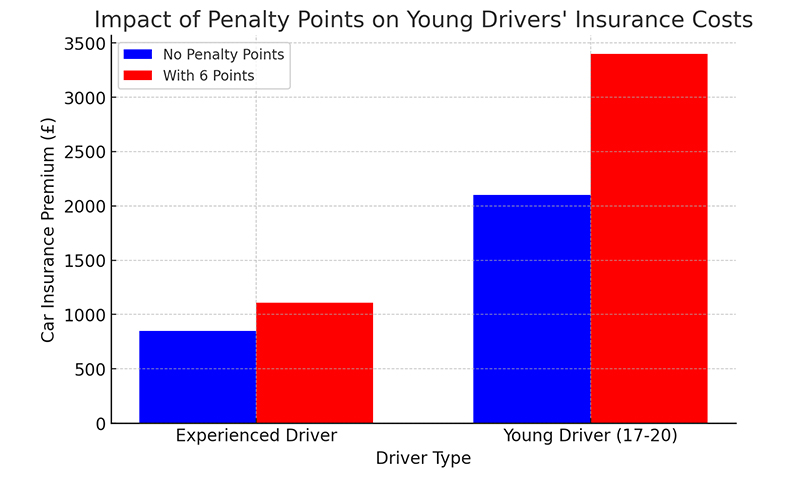
An e-scooter offence can raise a young driver’s car insurance for years because a conviction stays on record long after the incident. The most damaging is an IN10 (using a vehicle uninsured against third-party risks), which carries a £300 fixed penalty and 6 penalty points, must be declared to insurers for around 5 years from the conviction date, and can add several hundred pounds, in some cases up to around £1,000, to a first premium. For someone in the 17-25 age group already paying the highest rates, an IN10 turns a costly premium into an extreme one.

Insurers price convicted drivers as higher risk, and a fresh IN10 sitting on a new driver’s record with zero no-claims history is a difficult combination to shop around. Many car insurance quotes come from drivers with no no-claims bonus at all, so young riders start from a weak position before any conviction is added. The ABI says no claims discounts vary by insurer but can be as much as 30% after one claim-free year and 60% after five claim-free years. If you want to see how this plays out in numbers, read our explainer on how e-scooters can increase your car insurance costs.

Compare young driver car insurance quotes

What is the ‘ghost licence’ and why does it matter for under-17s?

A ‘ghost licence’ is a record the DVLA holds for someone who commits a driving offence before they hold a full licence, storing the penalty points until they apply for one. Penalty points can still be issued to under-17s or provisional holders caught riding an e-scooter uninsured, and those points take effect the moment the young person applies for their driving licence. Because an IN10 carries 6 points, a new licence holder can start their driving life already close to the totting-up threshold.

The consequence is severe for a would-be new driver. If a young rider accumulates 12 or more points within three years of passing, they face a totting-up disqualification and a minimum six-month ban. Newly qualified drivers are also subject to a lower threshold: under the New Drivers Act, six points within two years of passing revokes the licence entirely, forcing a re-test. An e-scooter conviction picked up at 15 or 16 can therefore wreck a driving licence before it has properly started.

Can parents be prosecuted and does it affect their premium?

Parents can be prosecuted if their child rides an e-scooter uninsured, and it can push up the household’s car insurance premium. Police can report a parent for permitting a child to ride otherwise than in accordance with a licence, or with no insurance, which is a separate offence from the rider’s. Where the rider is under 17, the consequences can also affect the parent or household, including insurance costs.

Enforcement in practice often starts with a warning. Several forces first educate a young rider and their parents that private e-scooter use is illegal, then may prosecute if the rider is caught again. Police also hold seizure powers, and forces across the South East have confiscated many e-scooters in enforcement action. A seized e-scooter can be disposed of, so the financial hit is not limited to fines. The Metropolitan Police (met.police.uk) states that breaching e-scooter rules can lead to a fixed penalty notice plus Households comparing renewals can see the effect of any conviction when they check why car insurance quotes differ between sites.

Can parents be prosecuted and does it affect their premium

Protect your first premium

Understand the real, legal ways to cut young driver car insurance before you buy.

What happens if the police stop you on an e-scooter?

If police stop you riding a private e-scooter in public, they can issue a penalty notice, add penalty points, and seize the e-scooter for having no insurance. Standard penalties published by police can include fines and penalty points for no insurance, riding without the correct licence, using a phone while riding and riding on the pavement. Drink or drug driving on an e-scooter is treated the same as in a car: court fines, a driving ban and possible imprisonment.

Penalties vary by force because each sets its own approach, and some, such as Devon and Cornwall, may not issue fines at all. Real prosecutions show the scale of the risk: in one case a rider stopped on an e-scooter and convicted of drink-related and uninsured offences was banned from driving for 23 months and fined, plus costs and a victim surcharge. According to BBC reporting on a Stevenage Magistrates’ Court case, the rider was banned from driving for **23 months** and fined **£120**, plus **£85 costs** and a **£48 victim surcharge**; the report says he admitted drink-driving, no insurance, and driving otherwise than in accordance with a licence.[1] A ban and conviction of that kind follows a young person straight onto their car insurance record.

How much does a young driver’s car insurance actually cost?

The average UK motor insurance premium paid was around £566 for April to June 2026, up just £6 on the previous quarter, according to the ABI Motor Insurance Premium Tracker. That is a whole-market average, not a young driver figure: drivers aged 17-25 typically pay several times the average because insurers price them as statistically higher risk. The ABI tracker is based on prices customers actually pay across more than 28 million policies a year, which makes it more reliable than quoted figures.

Claims costs keep pressure on young driver premiums. Insurers paid out a large amount to support motor insurance customers in Q2 2026, and average claim payouts also rose. Comprehensive cover dominates the market and, on Free Price Compare, accounts for around 88-89% of car insurance quotes, so most new drivers are comparing like-for-like on the most complete cover level. For deeper context on where prices are heading, see our analysis of rising car insurance costs in the UK.

E-scooter offence Typical penalty Insurance impact
No insurance (IN10) £300 fine, 6 points Declare for around 5 years; can add up to around £1,000
No correct licence £100 fine, 3-6 points Points can transfer to a ‘ghost’ licence
Phone while riding £200 fine, 6 points Contributes to totting-up risk
Riding on the pavement Fixed penalty, £50 fine Recorded offence, may be disclosed

Figures are indicative and may change; penalties vary by police force.

What is the most affordable way to insure a first car?

Black box (telematics) insurance combined with a low-value, low-insurance-group car and an accurate low-mileage estimate is usually the most affordable way to insure a first car. Black box insurance is a policy where a small device or app tracks how, when and how far you drive, and rewards safe, low-mileage driving with lower premiums. For careful new drivers it is often the single biggest legal saving, because it lets insurers price on actual behaviour rather than assuming worst-case risk for the whole 17-25 group.

  • Choose a car in a low insurance group; on Free Price Compare, around 43-48% of quotes are for cars valued between £1,000 and £5,000, which suits first-time buyers.
  • Consider telematics or a low-mileage policy if you drive well under the average annual mileage.
  • Build a no-claims bonus, since roughly a third of quotes come from drivers with zero years of no-claims history.
  • Keep your record clean: an IN10 or other conviction removes most of these savings.

Our roundup of smart strategies for cheaper car insurance and our guide to insuring low-value cars go through these options in detail.

See black box and low-mileage options

Should learners add a named driver instead of an e-scooter shortcut?

Learners should build cheap, legal cover through learner driver insurance and correctly declared named drivers rather than relying on an e-scooter to get around before passing. Learner driver insurance is short-term or provisional cover that lets you practise legally in your own or a family car, either as a standalone policy or added to an existing one. Adding an experienced named driver, such as a parent, can reduce a young driver’s premium legitimately, provided the young person is the genuine main driver.

Declaring a parent as the main driver when the young person actually drives most is called “fronting”, and it is insurance fraud that can void a policy and lead to a refused claim. The safe route is a properly structured policy where the young driver is named as the main user and an older driver is added as a genuine second driver. The FCA says that giving false information to get insurance, or arranging the policy so someone else is shown as the main driver when they are not, can amount to insurance fraud, so the safer route is to insure the young driver as the main driver and add the older driver only if that accurately reflects who uses the car most.[FCA] You can compare provisional cover through our cheap learner driver insurance options, which is a far better foundation than a conviction that follows you for years.

Compare learner driver insurance

Privately owned e-scooters are not road legal in 2026 and there is no confirmed date for when, or if, they will be. The government has been reviewing proposals to create a new vehicle category for Low-speed Zero-emission Vehicles, which could eventually allow private e-scooters to be sold and used on roads if they meet safety standards such as indicator lights. A second national evaluation of the rental trials is due to conclude in 2026, which will inform any future legislation.

Until any law changes, the position is unchanged: riding a private e-scooter in public remains illegal, uninsurable and a route to penalty points. Reports have also flagged the possibility of a minimum age of 16 for private use if scooters are ever legalised, which would still leave younger riders exposed. For young drivers, the safest assumption for now is that no private e-scooter can be legally ridden on a public road, so any offence carries the full insurance consequences.

Will privately owned e-scooters become road legal soon

FAQs about e scooter laws young drivers

Do you need a driving licence to ride an e-scooter?

For a rental scheme e-scooter you must be 18 or over and hold at least a provisional UK driving licence, and the operator provides insurance. There is no legal way to ride a privately owned e-scooter in public, so no licence can make private use lawful on a public road.

Can you insure a privately owned e-scooter in the UK?

No. Privately owned e-scooters cannot be insured in the UK because no insurer offers cover for them, and they are not licensed by the DVLA. This lack of available insurance is one reason riding a private e-scooter in a public place is always illegal.

How long does an IN10 conviction stay on your insurance record?

An IN10 conviction generally must be declared to insurers for around five years from the date of conviction, and the six penalty points remain on your licence for four years. During that time your car insurance premium is likely to be higher because insurers treat you as a convicted driver.

Can under-17s get penalty points for riding an e-scooter?

Yes. Police can issue penalty points to under-17s and provisional holders caught riding an e-scooter uninsured, and the DVLA holds them on a 'ghost' licence. The points then take effect as soon as the young person applies for a driving licence, which can push them close to a ban immediately.

Where can I legally ride a private e-scooter?

You can only legally ride a privately owned e-scooter on private land with the landowner's permission. Riding it on any public road, pavement or cycle path is a criminal offence, regardless of your age or how careful you are.

What happens if my child's e-scooter is seized by police?

Police can seize an e-scooter ridden uninsured on a public road and, in some cases, dispose of it. Forces across the country have confiscated hundreds of e-scooters, so the loss of the machine is on top of any fine or penalty points issued to the rider.

Does black box insurance really cut costs for new drivers?

Black box (telematics) insurance can meaningfully reduce premiums for safe, low-mileage new drivers because it prices on your actual driving rather than assuming worst-case risk. It is often the biggest legal saving available to a 17-25 year-old, though results depend on how and when you drive.

Is it fronting if my parent is a named driver on my policy?

No, provided you are correctly listed as the main driver and your parent is a genuine additional driver. Fronting is when a parent is falsely declared as the main driver of a car mainly used by a young person, which is insurance fraud and can void the policy and lead to a refused claim.

Can an e-scooter conviction stop me passing my driving test?

An e-scooter conviction does not stop you sitting your test, but points held on a 'ghost' licence apply the moment you get your full licence. If those points, or points gained soon after passing, reach six within two years of passing, your licence is revoked under the New Drivers Act.

Rental scheme e-scooters are legal for riders aged 18 or over who hold at least a provisional licence and stay within designated trial areas at up to 15.5 mph. Insurance is provided by the rental operator, not the rider, so approved rental use does not create an insurance liability for you.

What is the cheapest way to insure a first car after passing?

The cheapest route is usually a low insurance group car, an honest low-mileage estimate and a telematics policy, plus a genuine named driver where appropriate. Building a no-claims bonus and keeping a clean record matters most, because a conviction removes nearly all of these savings.

Will e-scooter laws change to allow private use?

There is no confirmed date for legalising private e-scooters. The government is evaluating rental trials, which run to May 2028, and reviewing a possible new low-speed vehicle category, but until any law passes, private e-scooter use on public roads remains illegal and uninsurable.

Also Read Related Articles


Information correct as of 18 August 2026. Prices, tariffs, policy details and providers change frequently, so please check the latest details before making a decision. This article is for general information only and does not constitute financial advice. Free Price Compare is authorised and regulated by the Financial Conduct Authority (FCA).

4000+ reviews